Rooftop Deck Access Stairs in Vancouver: A Working Spec Guide
Rooftop deck access stairs in Vancouver: City permit notes, snow and rain drainage, and the structural and finish details for outdoor roof exposure.
A rooftop deck stair sees more weather than any other stair on the home. The spec has to assume the worst Vancouver winter, not the best.
The rooftop deck is one of the most popular post-construction additions on Vancouver homes built in the last twenty years, and the stair that gets to it is one of the most-asked-about elements after the deck itself is built. A roof environment is the harshest exposure on the property, the most wind, the most rain, the most UV, the most temperature swing, and the stair has to perform under all of it for the life of the deck.
This post walks through how rooftop deck access stairs are designed and fabricated for Vancouver projects, where the City of Vancouver permit process applies, and the spec decisions that separate a stair that ages well from one that needs replacement after a decade.
The roof environment is the worst exposure on the property
A rooftop stair sees rain horizontally because the wind drives it sideways at roof level. It sees direct UV because there are no surrounding trees or buildings to shade it. It sees the full snow load that falls on the deck and any drift snow that accumulates against the stair structure. It sees freeze-thaw cycles more intensely than ground-level stairs because the roof radiates heat back at night.
The exposure category in ISO 12944 terms is typically C3 or C4 for a Vancouver rooftop deck, depending on the proximity to the coast. The finish system specification has to match. A painted carbon steel stair, the spec that is fine for an interior residential stair, fails on a roof within years. The substrate has to survive without the topcoat.
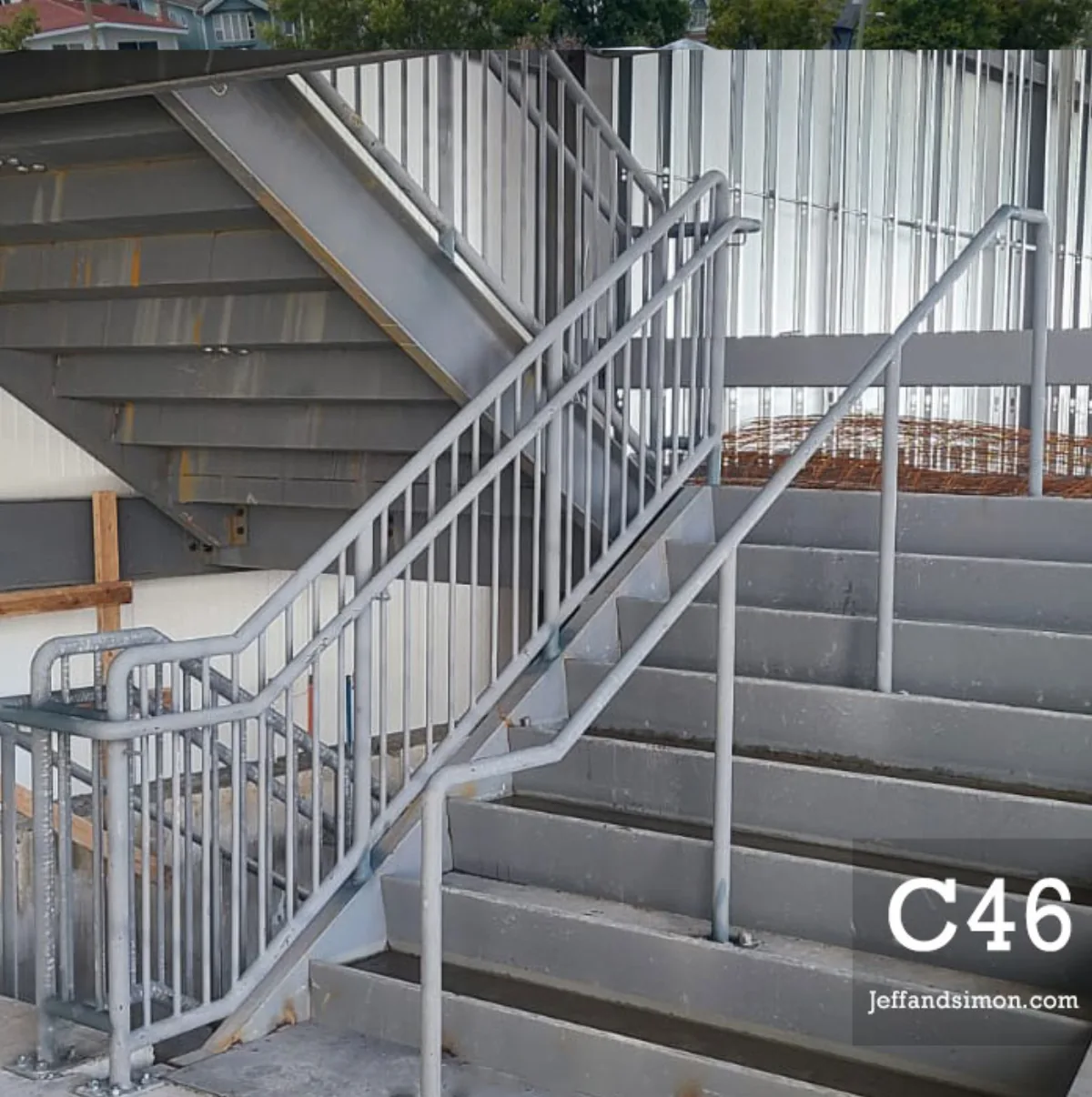
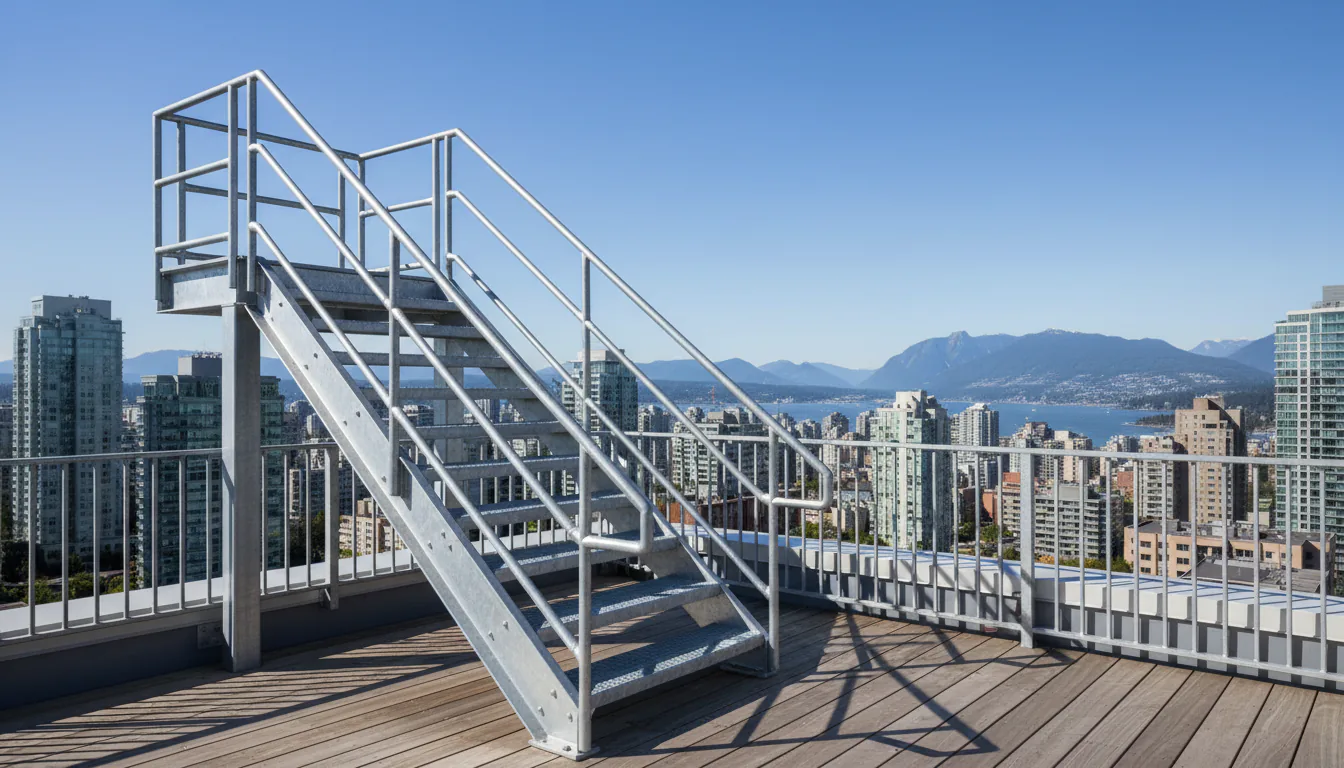
We default to hot-dip galvanized carbon steel stringers and posts on every rooftop stair. The galvanizing provides the corrosion protection. A topcoat (usually a powder coat in the architectural colour) provides the visible finish. When the topcoat eventually fails, and it will, given enough years of UV and weather, the galvanizing is still doing its job underneath.
This article is not a substitute for code review by the authority having jurisdiction, an architect, or an engineer.
Drainage decides the tread material
The single most important decision on a rooftop stair is the tread material. The tread is the horizontal surface that catches every leaf, every snowfall, and every raindrop, and the wrong tread accumulates debris and water in ways that produce both safety and structural problems.
The right tread is a drainage tread. Serrated bar grating, expanded mesh, or perforated metal, all three allow water, leaves, snow, and pine needles to fall through the tread to the deck or the gutter below. The tread surface stays clear, the slip resistance is structural rather than coating-based, and the maintenance overhead is low.
The wrong tread is a solid plate. A solid plate on a rooftop accumulates standing water, develops freeze-thaw damage at the edges, and traps debris that holds moisture against the steel. The corrosion shows up first at the leaves-trap zone, then progressively across the tread.
We have seen rooftop stairs with solid plate treads fail in less than a decade. We have not seen well-specified grating treads fail in a comparable timeframe.
Anchoring without breaching the waterproofing
The most expensive failure on a rooftop stair is not the stair itself, it is a roof leak that develops because the stair anchored through the waterproofing membrane. A penetration through a roof membrane is a permanent maintenance liability, and the cost of finding and repairing a roof leak is large.
The right detail supports the stair structure on a steel curb, a sleeper, or a freestanding base that sits on the structural deck without penetrating the membrane. The waterproofing is detailed around the support with a flashing system that maintains the seal. The roofing trade and the stair fabricator coordinate the detail at the design stage, not at the install.
The structural engineer for the building sets the load path. The stair load reaches the structural deck through the support, the structural deck carries the load to the framing, and the framing carries it to the building structure. The waterproofing is in front of all of this but does not carry any of the load. Done right, the membrane is continuous and unbroken.
For broader context on related exterior stair work, see our pieces on the North Shore exterior stair and deck considerations and the hot-dip galvanizing for exterior stairs on the North Shore.
The railing, wind load and salt exposure
The railing on a rooftop stair sees wind loads that are meaningfully higher than at grade. The wind speed at roof level on a typical Vancouver three-storey home is significantly above the grade wind speed at the same property. The railing has to be designed for the wind pressure, not just the human loading.
The structural engineer sets the wind load from the building’s exposure category and applies it to the railing design. The post spacing, the top rail size, and the bracket pattern all have to take the wind load with the appropriate code factors.
For coastal Vancouver rooftops within range of the strait, salt exposure is also a consideration. The hardware spec follows the same logic as for ground-level coastal stairs, grade 316 stainless on cable end fittings, base shoes, and exposed fasteners. The railing top rail and posts can be galvanized carbon steel with a high-quality topcoat, or stainless if the architectural intent and the budget allow.
The City of Vancouver permit pathway
A new rooftop deck on an existing Vancouver home almost always requires a City of Vancouver building permit. The permit reviews the structural impact on the existing roof framing, the egress changes from the addition, the guard and stair code compliance, and the impact on the building’s setbacks and overall building envelope.
Engineered structural drawings are typically required for the deck framing and the stair. The structural engineer evaluates whether the existing roof structure can carry the additional load, specifies any reinforcement, and stamps the drawings for the permit submission. The lead time on the engineered package frequently runs longer than the stair fabrication itself.
The egress review considers whether the rooftop deck creates a need for a second means of egress, what the path from the deck to the home interior looks like, and whether the access stair has to meet specific code provisions related to it being an egress path. The architect or the permit consultant typically resolves these questions at the design stage.
The permit timeline at the City of Vancouver varies by project complexity and the current submission volume. We confirm the timeline with the permit consultant at first design conversation.
The lower landing, where the stair meets the deck
The lower landing of the rooftop stair, where the stair meets the deck surface, is a detail that recurs on every project. The landing has to be at the right elevation relative to the deck, has to drain off the roof, and has to integrate with the deck finish.
The deck surface is typically a pedestal-mounted paver, a wood deck on sleepers, or a sealed concrete or membrane finish. The stair landing has to land on this surface without trapping water or creating a trip edge. The most common detail is a landing with a stainless or galvanized nosing at the deck surface elevation, drainage gaps at the perimeter, and a transition flashing where the landing meets the deck.
Pedestal-paver decks are the easiest to coordinate because the paver elevation can be set to match the landing. Wood decks require the landing nosing to be set against the deck board height. Sealed-membrane decks require the most careful detailing because the deck surface is the waterproofing and the landing cannot pool water against the membrane.
The upper landing, where the stair meets the home
The upper landing, where the stair meets the home, is the access point into the building interior. This is usually a door at an upper floor or a transition to a roof terrace adjacent to a habitable space.
The door threshold has to drain away from the home interior. The landing platform has to provide adequate clear floor area in front of the door for the swing and the user. The flashing under the threshold has to coordinate with the roof waterproofing and the door manufacturer’s recommendations.
We coordinate with the door supplier and the roofing trade at the shop drawing stage to make sure the landing dimension, the threshold elevation, and the flashing detail all match. A door that the manufacturer specifies at a 100 mm threshold above the deck surface cannot work with a landing at the deck elevation, and the conflict has to be resolved before fabrication.
Schedule and budget for a typical rooftop project
The total schedule from first design conversation to install on a typical Vancouver rooftop deck access stair runs four to seven months, with the permit pathway usually being the longest single element. The stair fabrication itself runs four to six weeks once the shop drawings are approved.
The budget is meaningfully higher than a ground-level exterior stair of the same height because of the engineering, the permit work, the higher-grade finish system, the drainage tread, and the coordination overhead with the deck and roofing trades. A typical rooftop access stair on a Vancouver residence lands well above a comparable ground-level stair of the same height.
The cost is concentrated in the engineering and the coordination, not in the steel. Clients who frame the budget only in terms of “steel and treads” are usually surprised by the quote. Clients who understand the engineering and coordination cost upfront end up with a stair that works for the life of the deck.
Sources
- City of Vancouver, Building Permits
- BC Building Code Section 9.8, Stairs, Ramps, Landings, Handrails and Guards
- ISO 12944, Corrosion protection of steel structures by protective paint systems
Related reading: the North Shore exterior stair and deck considerations, the hot-dip galvanizing for exterior stairs on the North Shore, and the outdoor steel stair snow and rain drainage piece.
Related questions
Does a rooftop deck stair need a permit in Vancouver?
Almost always yes. The City of Vancouver typically requires a building permit for a new rooftop deck, the deck structure, and the access stair, because the deck adds load to the existing roof framing and the access changes the egress configuration of the home. Engineered drawings are typically required.
What's the right tread material for a rooftop stair?
Serrated bar grating or perforated metal tread. Both allow water, leaves, and snow to fall through the tread rather than pool on it. Solid plate treads on a rooftop accumulate debris and freeze in winter, which is both a slip hazard and a structural concern.
How is the stair anchored at the roof level without damaging the waterproofing?
The stair structure is supported on a structural element below the waterproofing membrane, typically a steel curb or a sleeper bearing on the structural deck. The waterproofing membrane is detailed around the support with a flashing system that maintains the seal. The stair never penetrates the membrane directly.