Baluster Spacing Under BC Code: The Test That Decides a Railing
BC Building Code 9.8 baluster spacing on Vancouver stairs: the 100 mm sphere test, climbable guard rules, landing openings, and where failures cluster.
The 100 mm sphere test is the most common reason a railing fails an inspection in BC. The spacing is decided on the shop drawing, not on the railing photo.
Of the half-dozen most common reasons a residential stair railing fails an inspection in BC, the baluster opening is usually the first. The 100 mm sphere, the standard tool the inspector carries, does not negotiate. If it passes through the railing anywhere, the guard fails. The fix is rarely cheap because the spacing is built into the railing fabrication, and a railing that is a few millimetres out has to be modified at the post, the picket, or the panel level.
This post walks through how the baluster spacing rule actually works in BC, where the rule intersects with the climbable-guard provisions, and how the spacing is set in the shop drawings so the inspection is a confirmation rather than a surprise.
What the rule actually says
BC Building Code Section 9.8 governs guards on stairs and landings in the Part 9 small-buildings stream that covers most houses and small multifamily. The opening provision limits the dimension of any opening in a guard so a 100 mm sphere cannot pass through it. The 100 mm dimension is the opening, the clear distance, not the centre-to-centre dimension between balusters.
The intent is to prevent a small child from passing the head through the guard. The 100 mm sphere is the proxy for a head, and the test is conducted at any opening that exists within the height of the guard.
The rule applies to:
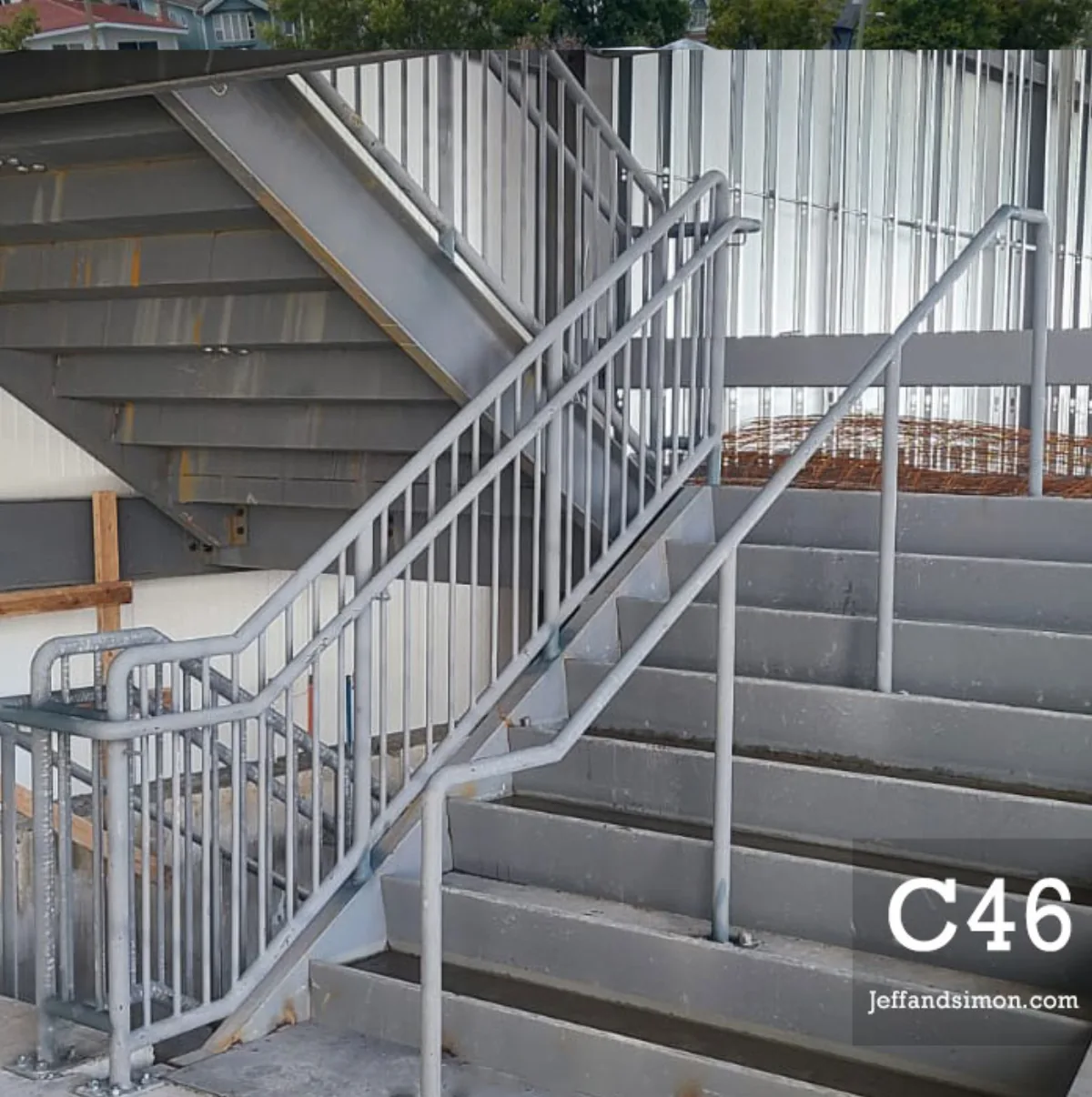
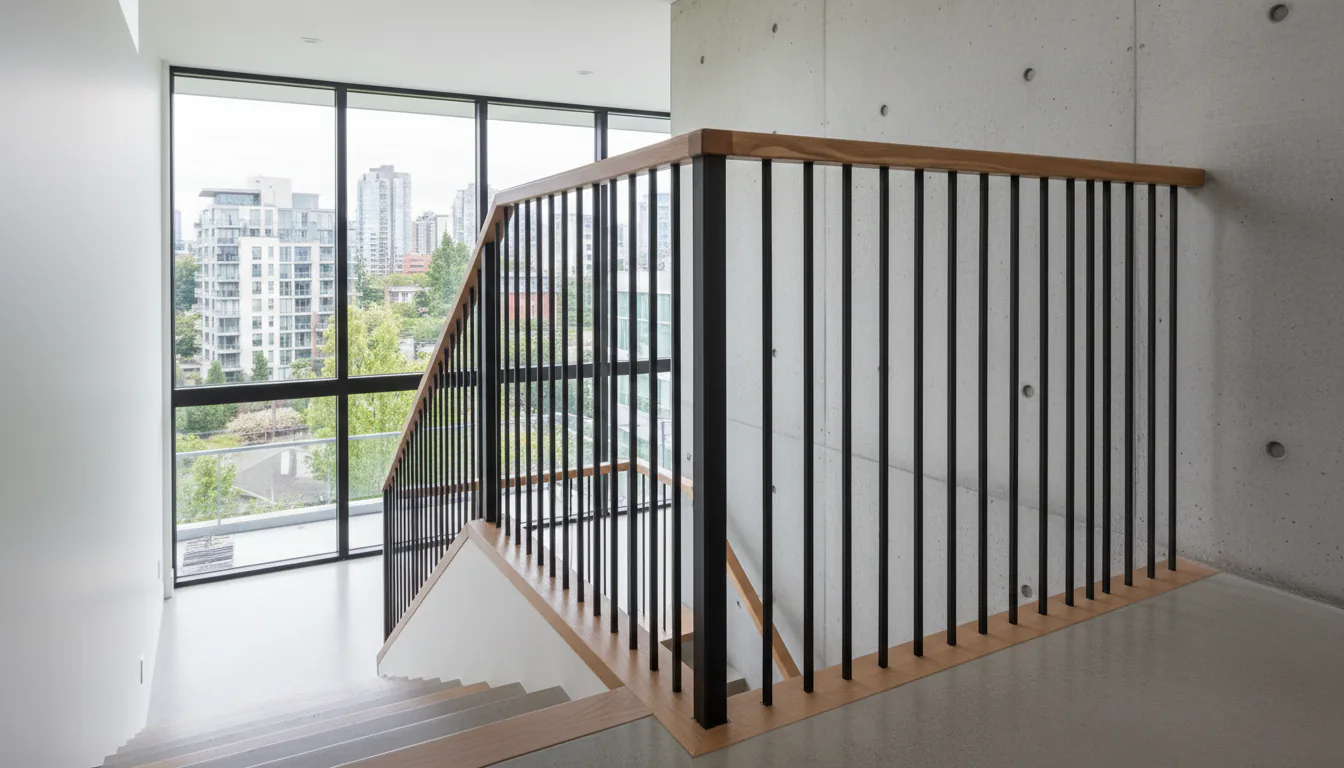
- Vertical picket guards (the most common case)
- Horizontal picket or cable guards (with additional climbable-guard provisions)
- Panel infill guards (the rule applies to any gaps in or around the panels)
- The bottom edge of any guard above a stair tread or a landing surface
- The top edge of any guard below the top rail
The same provision applies on stairs and on landings, with the measurement geometry adjusted for the slope (more on this below).
This article is not a substitute for code review by the authority having jurisdiction, an architect, or an engineer.
Centre-to-centre vs opening, the practical conversion
On a square or rectangular picket guard, the centre-to-centre dimension and the opening differ by the picket width. A 12 mm square picket spaced 100 mm centre-to-centre produces an opening of 88 mm, below the 100 mm maximum and code-compliant.
A 12 mm picket spaced 110 mm centre-to-centre produces an opening of 98 mm, still compliant but close to the limit. A 12 mm picket spaced 115 mm centre-to-centre produces an opening of 103 mm and fails the inspection.
The math is simple. The execution is where the failures happen, because the spacing on a stair has to be set at every individual picket location, not as a single dimension on a drawing. A picket pattern that is correct at the bottom of the flight can drift over the run if the spacing is not re-set at each tread. We mark the spacing on the rail at fabrication, not in the field.
The climbable-guard provisions
In addition to the opening rule, BC code includes a climbable-guard provision: horizontal members between certain heights on a guard cannot exist in a way that allows climbing, on guards that protect against a fall above a defined height threshold (typically 1800 mm). The intent is to prevent a child from climbing the guard like a ladder.
This is where horizontal cable railings come into the conversation. A horizontal cable system has, by definition, a series of horizontal members. The cables are individual, regularly-spaced horizontal elements between the floor and the top rail. The climbable-guard provision applies, and the AHJ has to interpret whether the specific cable spacing and tension presents a climbable hazard.
In practice, most BC AHJs accept horizontal cable systems on residential stairs and landings where the fall height is below the climbable threshold (often the case on a typical two-storey house) or where the home does not have children. AHJs are more restrictive on guards above the climbable threshold, on multifamily projects, and on projects where the guard protects a public space.
The right move is to confirm the AHJ’s position on horizontal cable before the railing is specified, not after the railing is fabricated. We document the AHJ’s position in the project file and reference it in the shop drawings.
For a closer look at cable railing specifications, see our pieces on cable railing specification for Vancouver decks and stairs and the cable railing cost in Vancouver.
The opening measurement on a stair slope
On a stair, the picket runs vertically (perpendicular to the floor) while the top rail and the bottom of the guard follow the slope of the stair. This creates a slightly different opening measurement than on a level landing.
The opening on a stair slope is measured perpendicular to the slope of the guard, not strictly horizontally. The 100 mm sphere has to be unable to pass through the opening in any orientation. A picket pattern that produces a 95 mm opening measured horizontally may produce a 100+ mm opening measured along the slope between two pickets, particularly at the tread nosings where the opening can widen.
We set the picket spacing on a stair slightly tighter than the level-landing spacing to account for the slope geometry. On a typical residential stair with a 14-degree slope, the picket spacing on the slope is reduced by a few millimetres compared to the same picket on a level guard. The shop drawings show the slope geometry explicitly and the picket spacing is derived from the slope, not assumed from the level-guard spacing.
The bottom of the guard at the tread nosing
The bottom of the guard at the tread nosing is the location where most inspector measurements happen. The opening between the bottom of the picket and the tread is the most accessible test point and the most common location for an opening to creep above 100 mm. A picket that is shop-fabricated with a slightly short bottom dimension, or a tread that is installed slightly low, can produce an opening that fails.
We fabricate the picket bottoms to land within a tight tolerance of the tread surface and we confirm the dimension at install. A picket with a 100 mm gap at the bottom is not compliant; the inspector reads it as part of the opening test.
The top of the guard below the top rail
The top of the guard below the top rail is the second-most-common location for an opening failure. A railing system that uses a wide flat top rail with a structural channel underneath can create an opening at the top of the picket where the picket terminates below the rail’s solid surface.
The fix is to extend the picket to the underside of the rail’s solid surface, not to the bottom of the structural channel. The shop drawings show the picket termination at the rail, and the railing is fabricated so the picket fully closes the opening.
Panel infill, the rule applies to the panel
Panel-infill guards (perforated metal, decorative laser-cut panels, or solid panels with a designed opening pattern) are reviewed under the same 100 mm opening rule. The perforation or opening pattern in the panel cannot allow a 100 mm sphere to pass.
This sounds obvious but it catches projects regularly. A decorative laser-cut panel with a beautiful pattern that includes some openings larger than 100 mm fails the test even if most of the panel is compliant. The opening rule applies at every opening in the guard, not as an average.
We review proposed panel patterns against the opening rule before fabrication. A pattern that requires modification is easier to modify in the CAD file than after the panel is cut.
The post and the corner, the small openings that fail
Where the picket meets a post or a corner, the opening between the last picket and the post is sometimes wider than the picket-to-picket opening because the post is wider than a picket. A picket pattern that is set on a regular spacing from one post to the next can produce an end gap that exceeds 100 mm if the end picket is not adjusted.
We adjust the end picket spacing at every post and corner so the picket-to-post opening matches the picket-to-picket opening below the limit. This is detail work in the shop drawings and the railing fabrication, and it is what separates a railing that passes the first inspection from one that needs modification.
For broader context on related code work, see our pieces on the handrail continuity under BC code and the BC stair code requirements for metal stairs.
How the opening rule shapes the design
The opening rule is one of the few rules that visibly shapes the look of a railing. A tight picket spacing reads as busy. A wider picket spacing reads as calm but flirts with the limit. A picket profile that is wider (square 16 mm rather than 12 mm) allows wider centre-to-centre spacing while keeping the same opening, and reads heavier as a result.
The architectural decision and the code decision interact. We work with the architect to land on a picket profile and spacing that reads the way they want and meets the opening test with margin. A railing that meets the limit by a single millimetre is technically compliant but vulnerable to the fabrication tolerance and the field measurement variability.
What to do if the AHJ flags the opening at inspection
If an opening is measured above 100 mm at inspection, the fix is to add picket material or modify the panel. Adding picket material is straightforward on a vertical picket railing, a slim additional picket can be welded into each affected location. Modifying a panel is more involved and may require fabricating a replacement.
The better path is to not arrive at this point. The shop drawings show every dimension, the fabrication respects the dimensions, and the install confirms the dimensions before the inspector arrives. The cost of doing this correctly is small. The cost of remediation after inspection is large.
Sources
- BC Building Code Section 9.8, Stairs, Ramps, Landings, Handrails and Guards
- City of Vancouver, Building permits and inspections
Related reading: the handrail continuity under BC code piece, the BC stair code requirements for metal stairs, and the cable railing specification piece.
Related questions
What's the maximum opening between balusters under BC code?
BC Building Code Section 9.8 limits the opening in a guard so a 100 mm sphere cannot pass through, in any location where the guard protects against a fall over a defined height. The 100 mm dimension is the opening, not the centre-to-centre spacing. On square pickets, the centre-to-centre is reduced by the picket dimension to keep the opening below 100 mm.
Does the same opening rule apply to horizontal cable railings?
BC code includes climbable-guard provisions that limit horizontal members between specific heights on guards above a defined threshold. Horizontal cable railings are reviewed under both the opening rule and the climbable rule, and the climbable rule is what most often shapes the cable spacing on residential guards. The AHJ interprets the provisions and we confirm before fabrication.
Are the rules different on a stair vs a landing?
Yes, in detail. The opening rule applies on both, but the geometry of a stair (sloped guard) and a landing (level guard) creates different measurement situations. On the stair, the opening is measured perpendicular to the slope; on the landing, it is measured horizontally. We adjust the picket spacing on the slope to keep the opening below the maximum in either measurement direction.