Craning a Steel Stair vs Carrying It In: Vancouver Access
How a prefabricated steel stair gets to the floor opening: when a crane lift makes sense, when the shop carries it in pieces, and what access and weight decide.
A welded steel stair is heavy and rigid. It either flies in on a crane or comes in as pieces the crew can carry. Access and weight make the call, not preference.
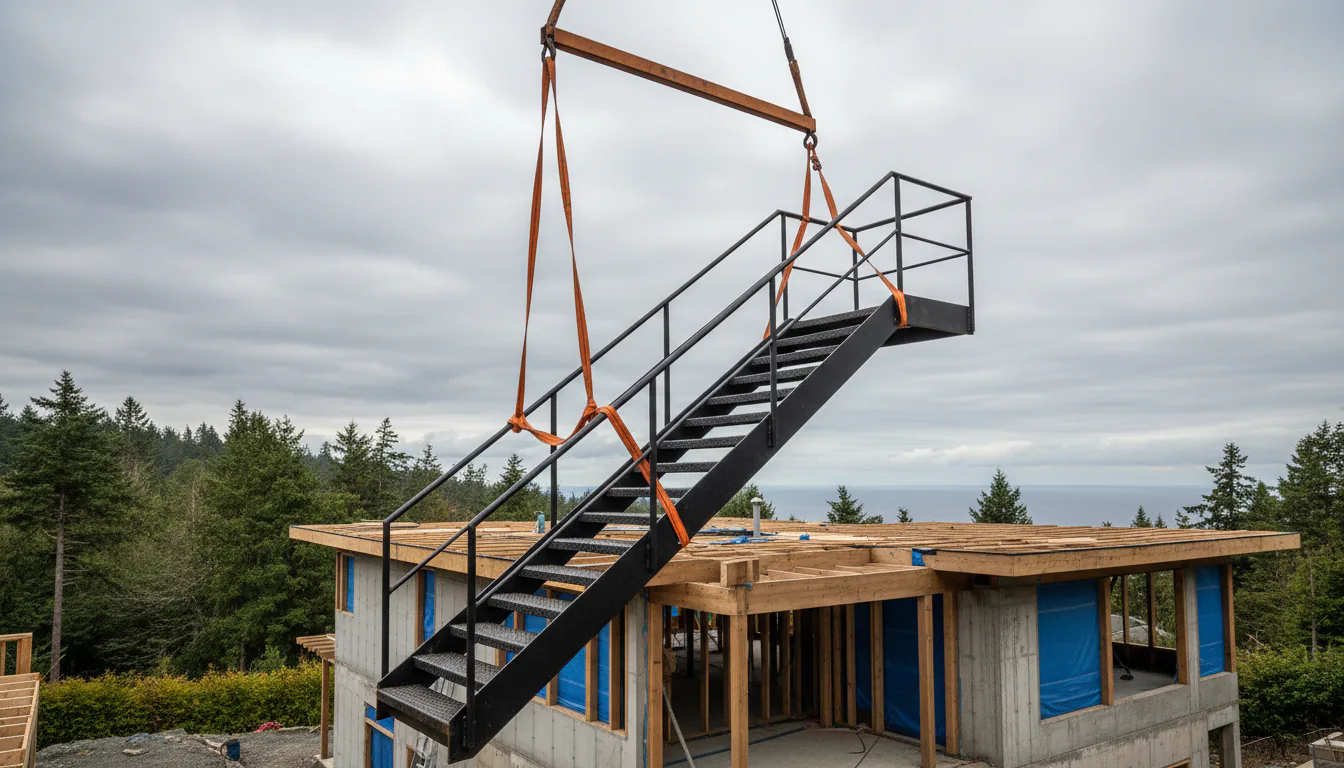
A prefabricated steel stair reaches the floor opening one of two ways. It flies in on a crane as one piece, or the shop builds it to break into sections a crew can carry through the house. Weight and site access decide which, and the choice is made long before install day.
This post explains what makes a stair too heavy or too large to carry, when a crane lift is the right call, what a lift needs for permits and a certified operator in Vancouver, how the shop plans the delivery, and why settling access early keeps the schedule from stopping at the curb.
A welded steel stair does not come apart on site
A steel stair is rigid by design. Once the stringers, treads, and connections are welded into an assembly, the stair holds its shape and its weight in one piece. That is what makes it strong underfoot. It is also what makes moving it a real problem.
The stair will not bend around a tight landing or flex through a narrow door. A wooden stair can sometimes be built in place, tread by tread. A welded steel stair usually arrives finished, or close to it, and has to travel from the truck to the opening as a solid object. If the object is too big or too heavy for the path, carrying it is not an option.
So the question is not whether steel is heavy. It is whether the largest single piece can travel the available path safely. That answer sets the whole install method. The access plan for getting a welded steel stair into the house is the groundwork this post builds on.
Weight and access decide crane versus carry
Two things drive the crane-versus-carry decision, and they work together. The first is the weight of the heaviest single piece. The second is the access path from the street to the floor opening.
Access is the path itself: the driveway slope, the door and hallway widths, the turns, any steps, and whether the opening is on the ground floor or up a level. A straight, wide, level path from a truck to a ground-floor opening is the easy case. A path that turns twice, climbs a short flight, and ends at a standard interior door is not. The stair has to fit through every point on that path, not just the widest one.
Weight is the other half. Even a stair that would fit the path geometrically can be too heavy for a crew to carry up a slope and around a corner without risk. A short straight residential flight in light steel can sometimes be handled by a few people. A long run in a heavy section, a stair with thick plate treads, or a stair with a landing welded in place quickly moves past what a crew can lift safely. When either the weight or the turns rule out a safe carry, the stair flies. When the path is clear and the pieces are light enough, the crew carries it and bolts the sections together inside. In our shop, this call is made on the first site visit, not left to the day of install.
The crane lift needs a permit and a certified operator
A crane lift on a Vancouver lot is rarely just backing a truck up to the house. The crane needs a stable, level place to set its outriggers and clear space to swing the load without hitting the building, the trees, or overhead wires. On tight lots where the house sits close to the property line, the crane often has to set up in the street or the lane.
Using the road space is not free of process. The City of Vancouver requires a construction street use or temporary street occupancy permit to occupy the roadway, a lane, or the sidewalk for activities like a crane lift. The permit covers the road space and any traffic control the lift needs. Confirm the current requirement and lead time with the City before the lift is booked, because a lift with no permit is a lift that does not happen.
The operator side is regulated too. In BC, WorkSafeBC OHS Regulation 14.34.1 requires that a mobile crane, tower crane, or boom truck be operated only by a person with a valid operator’s certificate issued by a party acceptable to the Board. The crane operator certification in BC is administered through the BC Association for Crane Safety. A homeowner does not arrange any of this directly, but it is part of why a reputable crane service is a real line on the install. This article is not a substitute for code review by the authority having jurisdiction, an architect, or an engineer.
Splitting the stair can avoid the crane
A crane lift is not the only answer to a heavy stair. The shop can often design the stair to break into pieces small enough to carry, which sidesteps the crane entirely when access is tight but a truck can still reach the door.
The common break points are at landings, along the stringers, or between the frame and the treads. A stair that separates at a landing travels as two shorter flights. A stair with bolt-on treads lets the stringer go in first and the treads follow, so no single piece carries the full weight. Each split lowers the piece weight and the length that has to make the turns.
There is a tradeoff. Every field connection is a joint the crew assembles and finishes on site, so more pieces mean more on-site work and more places where the finish has to be touched up. Some designs also resist splitting. A single welded mono stringer, where one central beam carries the treads, is meant to read as one clean line, and cutting it into pieces can defeat the look. The fabricator weighs piece size against field assembly for the specific stair. The installation day walkthrough for a Vancouver metal stair shows how the crew lands and joins those sections once they reach the opening.
The shop plans the delivery before steel is welded
The delivery method is a design input, not an afterthought. The shop measures the access path and picks the crane-versus-carry method before the stair is welded, because the method changes how the stair is built and where it splits.
If the path is clear and short, the stair can be built as fewer, larger sections, since they will be carried in without trouble. If the path is tight, the shop designs more break points so the pieces fit. If the piece has to fly, the shop places the rigging points and confirms the crane can reach the opening, and the crane and permit are booked to line up with the day the stair is ready. This is the same forward planning the custom staircase timeline from consult to install lays out across the whole project.
The information the shop needs is basic but has to be accurate: the door and hallway widths, the turns and their angles, any steps on the path, the driveway slope, the room outside the house, and where the opening sits in the floor plan. A door that measures a few centimetres narrower than assumed can change a carry-in stair into a crane lift, so the widths are measured, not estimated. Photos and rough measurements from the first visit are usually enough to choose the method. Getting them early is what lets the stair be built to match the site.
Finding out on install day is the expensive path
The worst case is discovering the access problem when the truck arrives. By then the stair is welded to a fixed size. It cannot be trimmed, folded, or split on the spot to fit a door it was never sized for.
If no crane was booked and the piece will not travel the path, the crew has to stand down, arrange a crane, pull the street permit, and come back another day. That is lost time on a schedule where other trades are often waiting on the stair before they can finish floors, guards, and drywall around the opening. The cost is not just the return trip. It is the ripple through everything scheduled behind the stair.
None of this is hard to avoid. It comes down to settling the access path and the delivery method at the start, while the design is still on paper. A stair built to match its site travels to the opening cleanly, whether it flies or gets carried. Send the fabricator door widths, hallway turns, driveway photos, and where the opening sits, at the first visit. That is the information that keeps the install off the list of surprises.
Sources
- City of Vancouver, Construction street use permits
- WorkSafeBC, OHS Regulation Part 14 (section 14.34.1, crane operator certification)
- WorkSafeBC, Crane operator certification in BC
Related reading: the access plan for craning a steel stair into a home, the metal stair installation day walkthrough, and the custom staircase timeline for Vancouver.
Related questions
Why does a steel stair need a crane at all?
A welded steel stair is one rigid piece and it is heavy. If the stringer, treads, and connections are welded into a single assembly, it will not bend around a tight landing or fit through a standard door. When the piece is too heavy or too large for a crew to carry along the available path, a crane lifts it to the opening in one move. The choice depends on weight and access, not preference.
When does the shop carry a stair in by hand instead?
The crew carries a stair in pieces when there is a clear, wide enough path from the truck to the opening and the sections are light enough to handle safely. Straight stairs, stairs that bolt together from stringers and treads, and stairs going into a home with a level driveway and a wide door are good candidates. The shop plans the break points during fabrication so the pieces fit the path.
What decides crane versus manual carry?
Two things: the weight of the largest single piece and the access path from the street to the floor opening. If the path is tight, has sharp turns, stairs, or a narrow door, or if the piece is too heavy to carry safely, the stair flies in on a crane. If the path is clear and the pieces are light enough, the crew carries it. The shop settles this before steel is welded so the stair is built to match the plan.
Do I need a permit for a crane lift in Vancouver?
Usually yes, if the crane occupies the street, a lane, or the sidewalk. The City of Vancouver requires a construction street use or temporary street occupancy permit to use the roadway or lane for activities like a crane lift. The permit covers the road space and any traffic control. Your fabricator or the crane company arranges this, but confirm the current requirement with the City before booking the lift.
Does the crane operator need to be certified?
Yes. In BC, WorkSafeBC OHS Regulation 14.34.1 requires that a mobile crane, tower crane, or boom truck be operated only by a person with a valid operator's certificate. This applies to the crane companies a fabrication shop hires. You do not arrange this yourself, but it is why a reputable crane service costs what it does. The certification and the lift plan are part of a safe lift.
How much room does a crane need on a Vancouver lot?
It depends on the crane size, the reach to the opening, and the weight being lifted. A mobile crane needs a stable, level place to set up its outriggers and clear space to swing the load without hitting the house, trees, or overhead wires. On tight lots with the house close to the property line, the crane often sets up in the street or lane, which is why the road permit matters. The crane company assesses the site during planning.
Can a floating or mono stringer stair be carried in by hand?
Sometimes. A mono stringer stair is a single central steel beam with treads, and depending on the length and steel section, the beam alone can be very heavy. If it is one welded piece, it usually flies in. If the design lets the treads bolt on after the beam is placed, the beam and treads can move separately, which lowers the weight per piece. The support strategy and the beam size decide it.
What happens if the stair does not fit the path on install day?
The install stops. A welded steel stair cannot be trimmed or folded on site to fit a door it was never sized for. If no crane was booked and the piece will not travel the path, the crew has to leave, book a crane, arrange the permit, and return, which adds days and cost. This is why the access path is measured and the crane-versus-carry call is made before steel is welded, not on the day.
Is a crane lift more expensive than carrying the stair in?
A crane lift adds the crane service, the operator, rigging, and often a street permit and traffic control, so the install line is higher than a hand carry. But if the stair genuinely cannot be carried, the crane is not optional and comparing the two is not the right question. The real saving comes from deciding early: a stair designed to carry in avoids the crane cost, and a stair that must fly is booked ahead so the schedule holds.
Can the stair be broken into more pieces to avoid a crane?
Often, yes, and the shop plans for it when access is tight. A stair can be built to separate at landings, split stringers, or bolt-on treads so no single piece is too heavy or too long for the path. There are limits: more field connections mean more on-site work and more joints to finish, and some designs, like a single welded mono stringer, resist splitting. The fabricator balances piece size against field assembly.
Who arranges the crane and the permit, the shop or the homeowner?
The fabrication shop usually coordinates the crane and the permit as part of the install, because the shop knows the stair weight, the rigging points, and the lift plan. On a larger site the general contractor may hold the street permit within a broader traffic plan. Either way, confirm who is responsible before install day so the permit is in hand and the crane is booked when the stair is ready.
How early should access be figured out?
At the first site visit, before steel is ordered. The path from the street to the opening, the door and hallway widths, the turns, and the room outside for a crane all shape how the stair is built and split. Deciding this early lets the shop design the stair to match the site. Left to install day, a mismatch between the stair and the access path is expensive to fix, because by then the steel is already welded.