Refinishing and Blackening an Existing Steel Stair in Vancouver
Steel stair refinishing in Vancouver: surface prep, blackening chemistry, powder coat recoat, and deciding what is worth refinishing in place vs replacing.
Refinishing a steel stair is more often a surface prep project than a paint project. The work below the finish is what decides whether the new finish lasts.
A steel stair installed twenty years ago does not have to be replaced when the finish starts to fail. In many cases it can be refinished to a current standard for meaningfully less than the cost of a new stair, and the structural performance of the original is often perfectly adequate for another twenty years of service. The decision about whether to refinish or replace, and what finish system to apply, is the conversation we have with property owners every quarter.
This post walks through how steel stairs are refinished in our shop, the surface preparation that decides whether the new finish lasts, and the specific case of chemical blackening as a refinish option.
Three scenarios, why refinishing comes up
Steel stair refinishing requests come from three different starting points.
The most common is a stair that is structurally sound but visibly tired. The original paint or powder coat has chalked from UV exposure, peeled at the edges, or developed surface corrosion at the connections. The homeowner wants the stair to look new again and is not interested in replacing a structure that works.
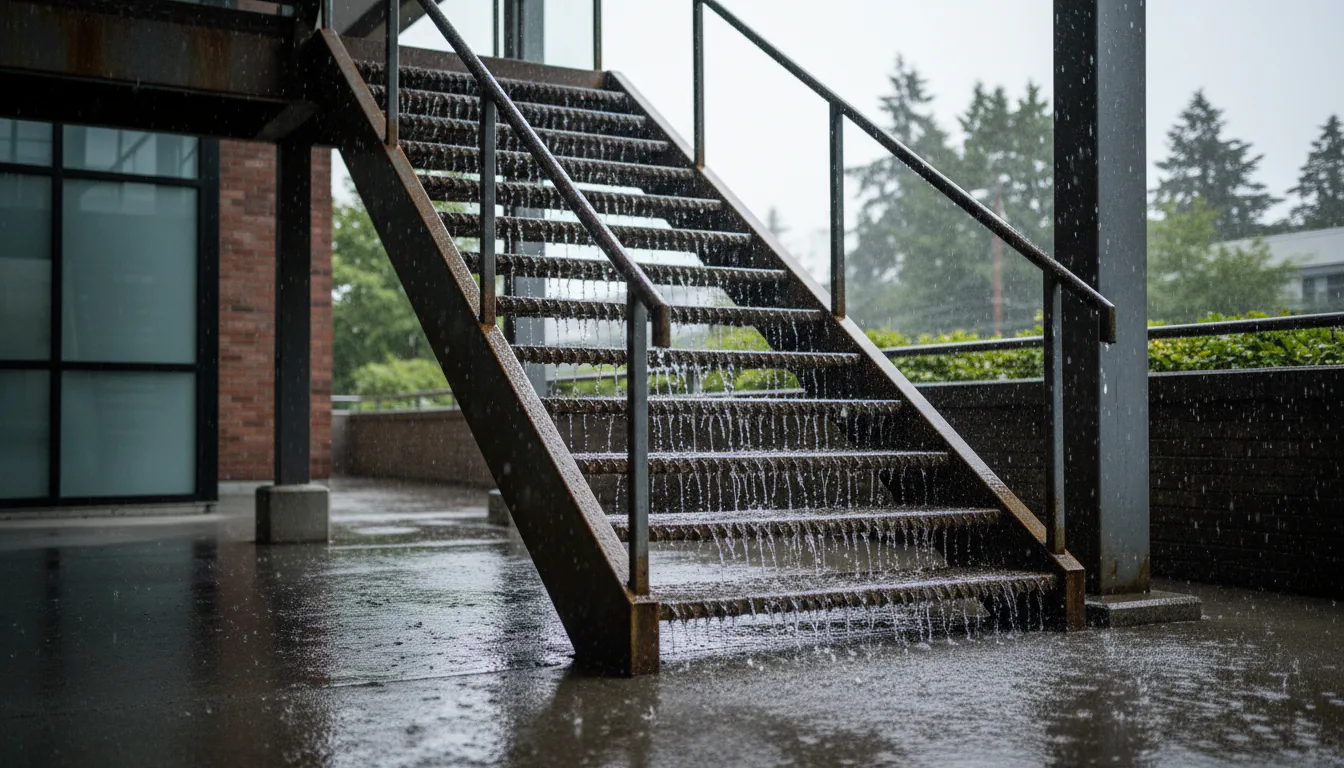
The second is a stair with localized corrosion that has progressed but not yet compromised the structure. A coastal stair where the original finish was inadequate for the exposure and the corrosion has eaten through the finish at one or two locations. The homeowner wants to address the corrosion before it spreads and refresh the finish in the process.
The third is a stair with no finish problems where the homeowner wants a design change. A polished brass railing that the new owner wants in matte black. A blackened steel stair that the homeowner wants in a designer colour. The decision is aesthetic rather than functional.
Each scenario has a different scope and a different cost.
Surface preparation, the work that decides everything
Whatever the finish system, the work that decides whether the refinishing lasts is the surface preparation. A new finish over poorly-prepared steel will fail in years, regardless of the finish system’s quality.
The right preparation depends on the substrate and the current finish:
- Existing failing paint, sand or media blast back to sound material. Remove all loose, chalking, or delaminating paint. Address any rust spots with rust converter or full removal to bare metal.
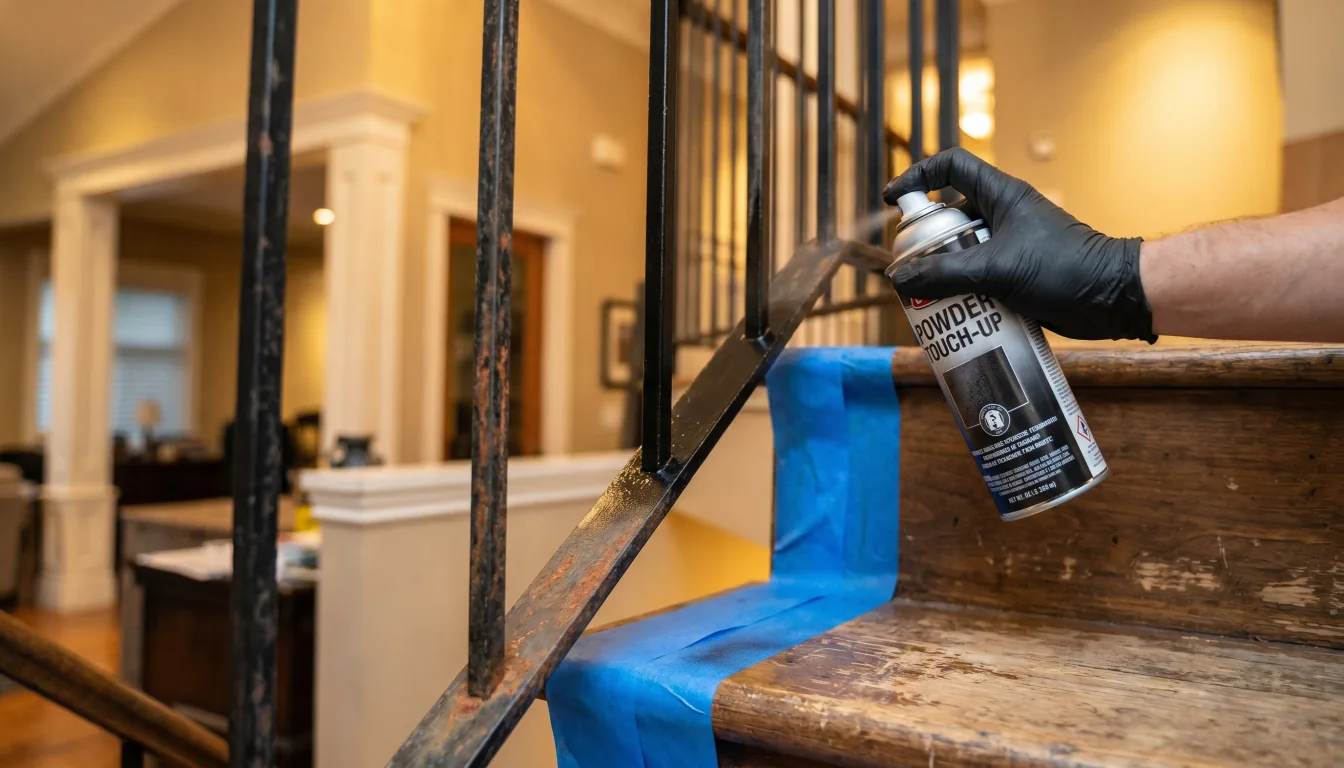
- Existing sound paint, design change desired, clean, scuff sand to provide tooth for the new finish, prime if changing finish family.
- Bare metal exposed by corrosion, remove corrosion completely (wire brushing, grinding, or media blast), prime immediately with a system compatible with the topcoat.
The SSPC surface preparation standards define the levels of preparation (commercial blast, near-white blast, white metal blast) and the appropriate level depends on the topcoat system and the exposure category.
In our shop we default to a near-white metal blast preparation on any stair where the existing finish is being completely replaced and a thorough scuff-and-clean on stairs where the existing finish is sound and being overcoated. The preparation level is documented in the project file so the finish warranty can reference it.
Chemical blackening, patina as a finish
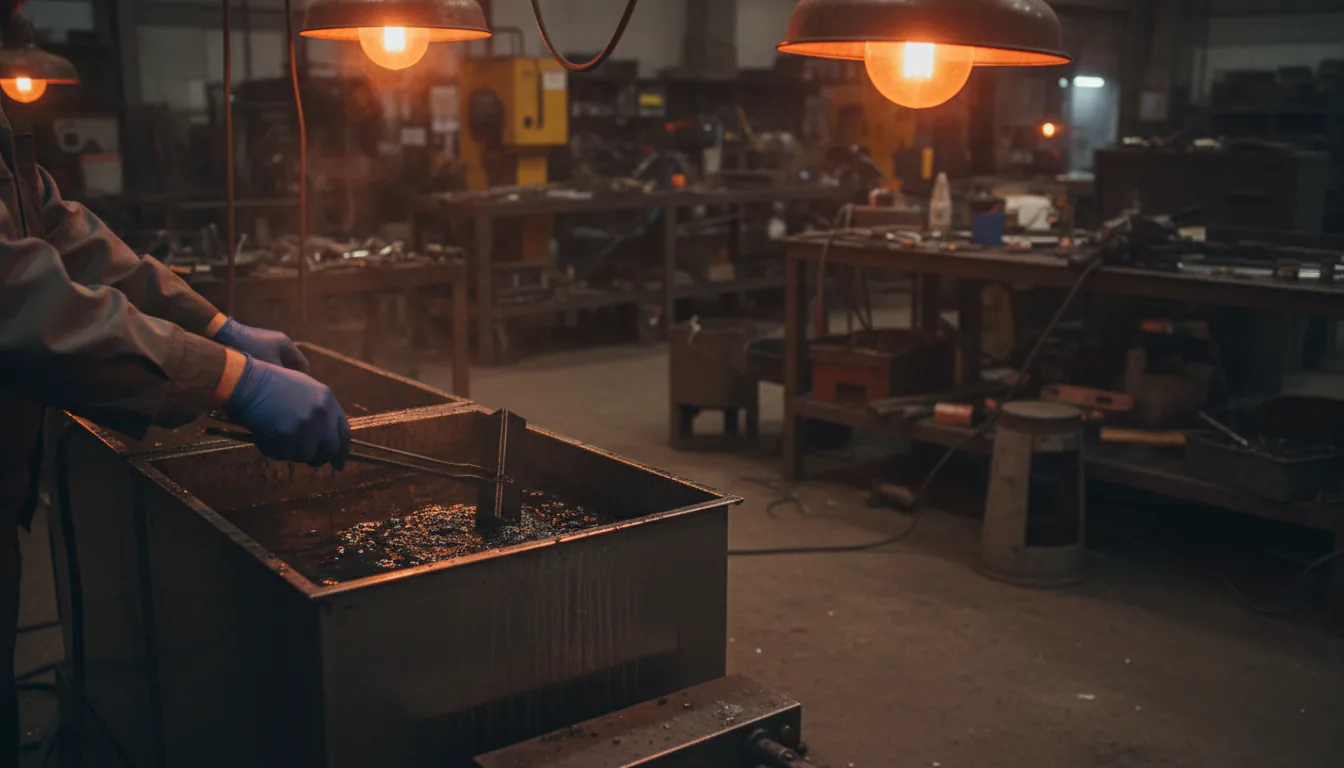
Chemical blackening (sometimes called gun blueing in different contexts) is a controlled reaction that converts the surface of carbon steel to a black iron oxide (magnetite) layer. The process uses a hot alkaline solution and produces a uniform, slightly variable black finish that reads as part of the steel rather than as a coating on top of it.
The advantages on the right project are real. The finish does not chip or flake because it is part of the steel surface, not a separate coating. The visual reading is patinated and fabricated rather than smooth and coated. The colour is uniform but with the slight surface variation that makes blackened steel feel hand-made.
The disadvantages are also real. The blackening provides minimal corrosion protection on its own. The finished surface needs ongoing protection with a wax or oil, particularly on stairs that see hand contact (the natural oils from hands gradually remove the surface wax). The colour can change over time as the wax wears off and the underlying oxide layer interacts with the environment.
Blackening is the right answer on:
- Stairs in dry interior environments where ongoing wax maintenance is acceptable
- Projects where the patinated reading is the architectural intent
- Heritage projects where the visual matches the original fabrication
It is not the right answer on:
- Exterior stairs (the oxide layer alone does not survive the exposure)
- High-touch stairs where ongoing wax maintenance is unwelcome
- Projects where a smooth, uniform finish is the design intent
Powder coat refresh, the standard refinish
Powder coat is the most common refinish system on interior steel stairs in our shop. The process applies a dry powder pigment electrostatically to a prepared substrate, then heats the assembly to cure the powder into a continuous coating.
The advantages are well known. The finish is durable, available in any colour, repeatable across multiple components, and resistant to UV and mechanical damage. The finished surface is smooth and uniform, which reads architectural on most modern projects.
The constraint on a refinish project is that the stair has to fit in the powder coat oven. Most fabrication-grade powder coat ovens can accept stair components up to a defined size; longer stringers may need to be cut down or refinished in pieces that are reassembled after coating.
We coordinate the disassembly, transport, coating, and reassembly with the customer. For most residential refinish projects this is a one- to two-week scope of work, depending on the stair size and the coating colour availability.
For a deeper look at the powder coat vs wet paint decision in different contexts, see our piece on powder coat vs wet paint for interior steel stairs.
Wet paint refinish, when the stair stays in place
For projects where the stair cannot be removed economically, wet paint is the only refinish option. Modern industrial wet paint systems applied with appropriate surface preparation can deliver a finish quality close to powder coat on the right substrate, although the durability over time is generally lower.
The wet paint refinish process on an installed stair requires:
- Containment and ventilation around the work area
- Floor and adjacent surface protection
- Surface preparation in place (typically by hand sanding rather than blasting)
- Multiple coat application with intermediate drying time
- Final cure time before the stair returns to service
The schedule on a wet paint refinish in place is meaningfully longer than a shop powder coat refresh because of the drying and curing time. The homeowner has to be without the stair (or with limited use) for the duration.
We use industrial-grade paint systems rather than standard interior paints because the durability matters on a stair that will see daily use. The system is documented in the project file with the manufacturer, product, dry film thickness, and topcoat colour for future reference.
When replacement is the right answer
Refinishing is not always the right answer. The cases where replacement makes more sense:
- Structural compromise from corrosion. When the steel section has lost meaningful material to corrosion, the structural performance is degraded. Refinishing the visible surface does not restore the lost section. Replacement is the correct path.
- Difficult access for refinishing. If the stair cannot be removed economically and the surface preparation in place is impractical (high ceilings, tight spaces, finishes that cannot be masked), the labour cost can approach replacement.
- Design changes that the existing structure does not support. A homeowner who wants to widen the stair, change the railing system, or convert from closed to open risers is asking for a different stair, not a refinish.
We provide a refinish quote and a replacement quote when the homeowner is undecided. The numbers usually tell the homeowner what to do.
The honest schedule conversation
A typical interior residential stair refinish on a stair that can be removed runs three to five weeks from initial site visit to reinstall. The breakdown is approximately:
- Site visit and quote: 1 week
- Removal and transport to shop: 1 day
- Surface preparation: 2 to 4 days
- Coating: 1 day
- Cure and inspection: 1 to 2 days
- Reassembly and reinstall: 1 day
For a wet paint refinish in place, the schedule is similar in total but the work happens at the home with the appropriate containment and access arrangements.
For a chemical blackening project, the schedule extends slightly because the chemistry requires more controlled conditions and a longer cure with subsequent wax application.
Refinishing decisions are easier when the stair was built well to begin with, see our overview of custom steel stair fabrication in Metro Vancouver.
Sources
- SSPC, Society for Protective Coatings surface preparation standards
- American Galvanizers Association, coating maintenance
Related reading: the powder coat vs wet paint for interior steel stairs piece, the steel staircase maintenance Vancouver piece, and the metal stair railing maintenance Vancouver piece.
Related questions
Can a steel stair be refinished in place or does it need to come out?
Depends on the finish system, the access, and the project. Some powder coat projects can only be done in a controlled shop environment, which means the stair has to come out. Some wet paint and oil-based finish projects can be done in place with appropriate masking and ventilation. Chemical blackening generally requires shop work. We evaluate per project.
What's chemical blackening and when does it make sense?
Chemical blackening is a controlled reaction that converts the surface of carbon steel to a black oxide layer. The result is a uniform black finish that reads as part of the steel rather than as a coating on top of it. It makes sense on stairs where the architectural intent calls for a patinated, fabricated reading rather than a smooth painted finish. It needs ongoing wax or oil maintenance.
When is replacement cheaper than refinishing?
When the stair has significant structural compromise from corrosion, when the access for refinishing is difficult enough that the labour cost approaches replacement, or when the homeowner wants design changes that the existing structure does not support. We do not push replacement when refinishing makes sense; we explain both options with honest costs and let the homeowner decide.