Staircase Renovation in Point Grey: Character Homes, Craftsman Framing, and Modern Steel
What Point Grey homeowners need to know before replacing a staircase in a pre-1950 character home, framing realities, permit path, finish strategy, and how the West Side renovation context shapes every decision.
Point Grey's housing stock, Craftsman bungalows, early Edwardian two-storeys, and mid-century infill on large lots, creates a specific set of staircase replacement challenges that differ from the rest of Vancouver.
Point Grey occupies the western tip of Vancouver’s peninsula, bounded by the University of British Columbia endowment lands to the west, the foreshore of English Bay and Burrard Inlet to the north, and the quieter residential streets of Dunbar and Kitsilano to the east and south. The neighbourhood’s first zoning bylaw, passed in 1922, restricted development to detached homes and outbuildings, and that restriction held. Most of what was built between the 1910s and the 1950s is still standing: Craftsman bungalows, California four-squares, early Edwardian two-storeys, and the occasional Samuel Maclure-era manor on a corner lot. The 2021 census recorded about 13,000 residents, roughly the same number as in 1996. Point Grey has grown outward in quality and value rather than inward in density.
That building stock creates a specific staircase replacement context.
What pre-1940 framing actually means for a stair scope
The majority of Point Grey’s pre-war homes use balloon framing or early platform framing. In balloon-framed houses, common before the late 1930s, studs run continuously from foundation to roof plate, with floor joists notched into the stud at the intermediate level rather than sitting on a separate platform. That matters for staircase work because the loadpath through the floor system is different from what a modern contractor expects.
The original stair openings in these homes were cut to fit a closed-stringer wood stair: a box of framing with the treads and risers enclosed between two finished side boards. The trimmer joists and double headers around that opening were sized for the dead load of that wood assembly. When the same opening has to carry a steel mono stringer, whose point loads at the top bearing and bottom bearing are concentrated, not distributed, the existing frame almost always needs to be evaluated and often strengthened before steel can be ordered.
The standard move is an engineer’s review of the existing floor system at the stair opening before shop drawings are issued. The engineer confirms whether the existing trimmers and header have enough capacity, or whether additional trimmer joists need to be sistered and new blocking installed. On a renovation with an open schedule that work is straightforward. On a project where drywall is already up and the scope was not anticipated, it becomes an expensive surprise.
Point Grey also carries a concentration of what the City of Vancouver classifies as character houses: residential buildings built before 1940 that retain most of their original exterior features. The City’s character house retention program allows these properties to be strata-titled, subdivided, or modified under streamlined rules in exchange for keeping the character exterior intact (vancouver.ca). Interior staircase replacements do not directly trigger heritage review under this program. But the permit application for the structural changes that make a modern stair possible, header modifications, opening changes, guard installation, still needs to go through the City’s standard review process, and the inspector on site will be looking at work inside a pre-war house.
The renovation context on the West Side
Point Grey renovation projects rarely happen in isolation. A staircase replacement in this neighbourhood is almost always embedded in a larger scope: open-concept conversion on the main floor, new kitchen, primary bedroom expansion, or a whole-house update that has been planned for several years. The stair is often the most architecturally prominent single element in the project, visible from the entry, from the living room, and from the upper hall, and it is also the one with the longest lead time and the most structural dependencies.
The sequencing problem is common. The stair gets confirmed late, after kitchens and bathrooms have been decided, because it feels structural and uncertain. But fabrication from shop drawing approval typically takes four to six weeks for a residential mono stringer, and the City of Vancouver’s building permit review adds time on top of that. A stair that should install at rough framing, before drywall, before flooring, ends up getting pushed to the end of the project, creating a sequencing problem that costs more than it would have if the conversation had started earlier.
On Point Grey custom homes working with an architect, that timeline is usually managed. On homeowner-directed renovations where the general contractor is managing multiple trades, the stair is sometimes the last thing confirmed and the last thing quoted. The result is a stair delivered to a site that is nearly finished, installed around completed drywall and millwork, and priced to reflect the access constraints that come with that sequence.
The strongest Point Grey projects bring the fabricator into the conversation at the framing stage, not at the finishing stage.
Structural options for an open-riser stair
Three structural approaches produce an open-riser stair in a Point Grey home. The right choice depends on the existing framing, the wall layout around the stair, and the look the project is after.
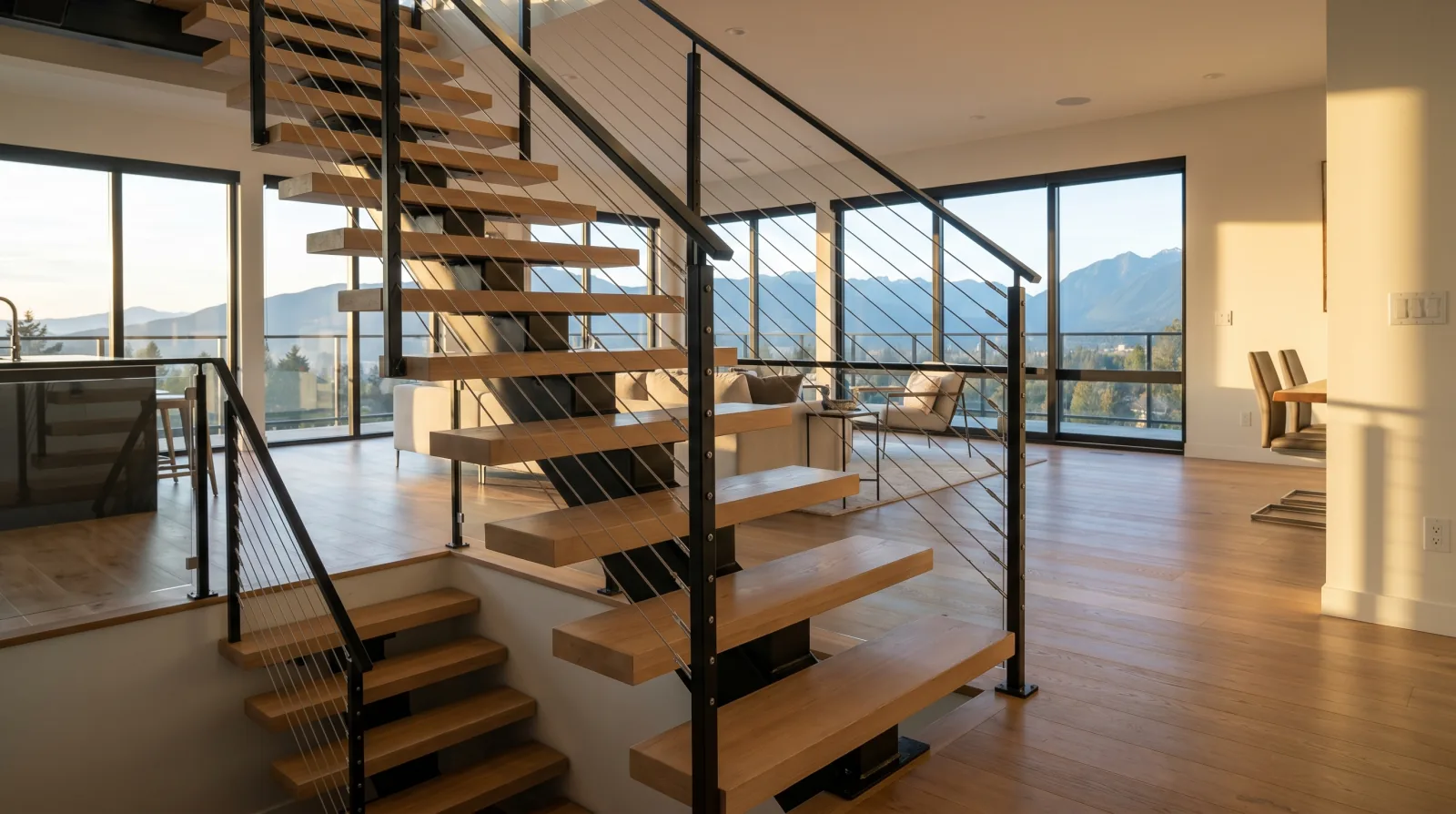
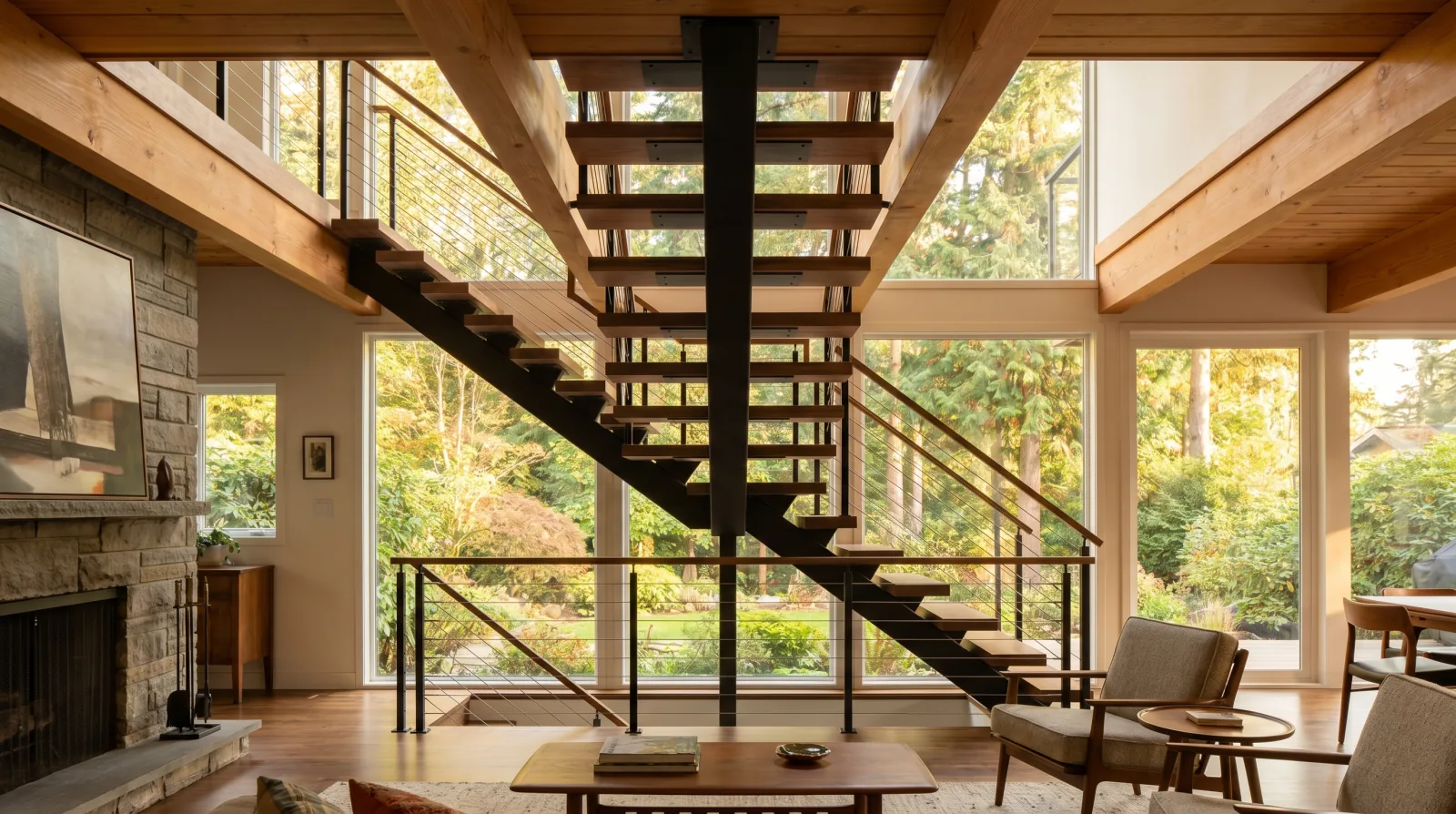
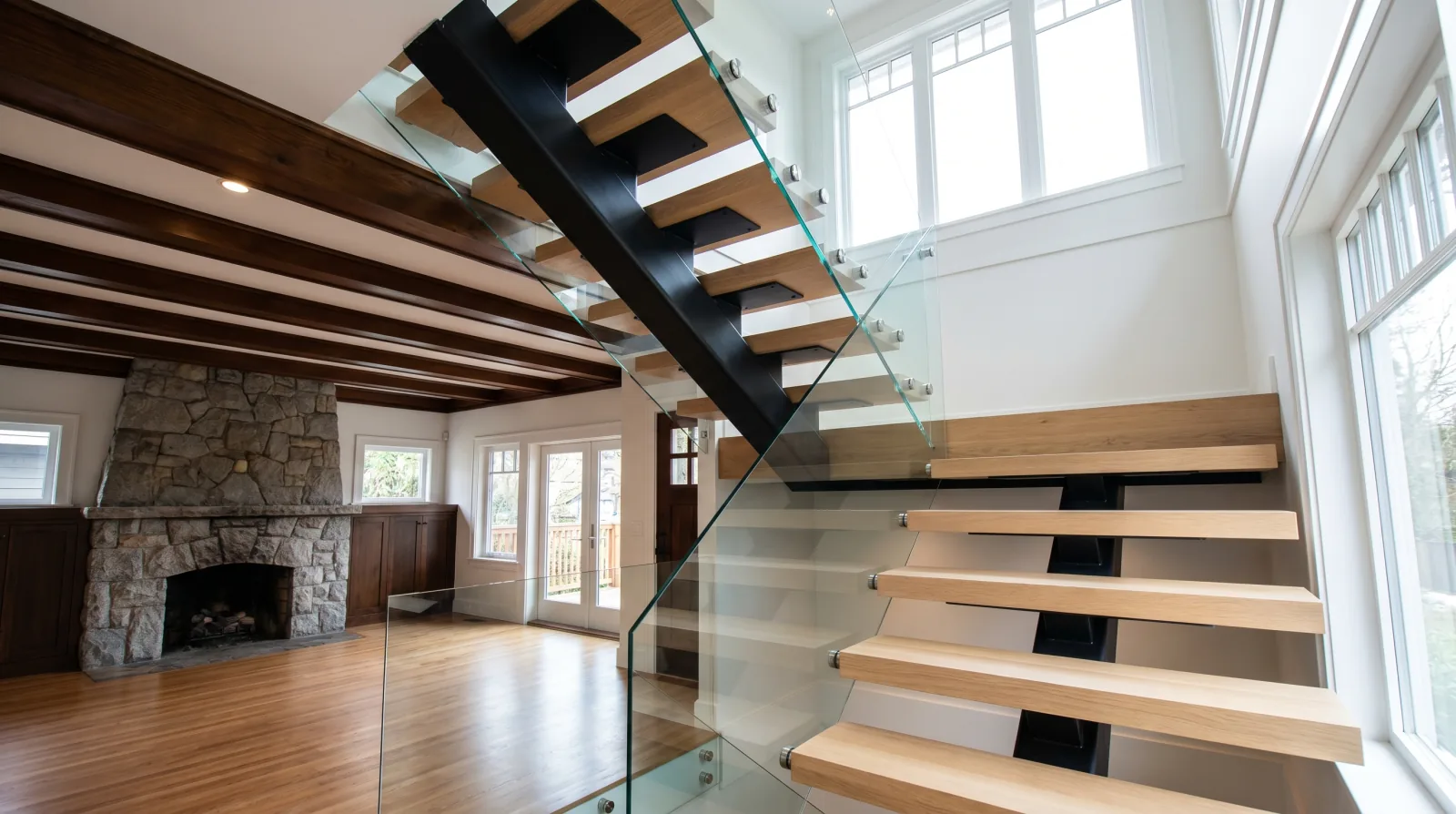
Mono stringer is a single central steel beam, typically an HSS tube section, that runs beneath the treads and bears at the top floor plate and the bottom slab or floor. Treads cantilever equally on both sides of the beam, which is what creates the visual impression of treads floating in space. This is the most common feature stair on residential West Side work. It does not require a structural wall at the stair run, which makes it the more forgiving option in older homes where wall locations are fixed. The stringer bears where the floor framing can accept the load, at the two endpoints, and the engineer sizes the beam section for the span and the cantilever depth of the specified tread.
Cantilevered wall-anchored treads eliminate the visible stringer entirely. Treads are embedded into a steel-reinforced stud bay or concrete wall via welded steel plates, and the entire tread load is carried laterally into that wall. The visual result is treads that appear to have no structure at all. The constraint is significant: the support wall must be designed and reinforced before drywall closes. It cannot be retrofitted to a finished wall. On a Point Grey renovation where the wall at the stair run is a candidate, has enough depth, sits on a load-bearing line, and is accessible during construction, the cantilevered option is worth pricing. On a project where the wall is an afterthought, it usually is not.
Hidden stringer is a middle option: a steel stringer is present but is concealed inside a drywall return that runs beside the stair. The visual reads similarly to a cantilevered stair but the structure is a standard stringer bearing at two points. This option is faster to engineer and easier to install than wall-anchored treads, and it avoids the framing complications of the mono stringer’s exposed beam. The trade-off is that the drywall return takes floor space and reduces the visual openness of the stair.
Guard design in a pre-war interior
Point Grey’s pre-war interiors are typically narrow by current standards. Rooms that were designed around a Craftsman floor plan, entry hall, living room, dining room running in a linear sequence, feel tight when a modern stair and guard consume the centre of the floor plan. The guard design choice matters more here than in a wide-open contemporary home.
Frameless glass is the dominant choice on West Side renovation projects for a reason: it visually disappears. A frameless glass guard uses 12mm tempered glass panels held by standoffs, with no visible intermediate posts. The guard is present, required by code at 900mm guard height for residential stairs, or 1070mm in some Part 3 occupancy conditions (bccodes.ca, confirm with the authority having jurisdiction), but it does not interrupt the sightline between the entry and the back of the house, or between the main floor and the view out the rear windows.
Cable railing is the other common option. Horizontal stainless cables between powder-coated posts read horizontally, which suits the low roofline and wide overhangs of Craftsman architecture. It requires more maintenance than glass, cables need periodic re-tensioning as the stainless stretches slightly, and the space between cables should be checked against code infill requirements, but it ages well against the warm, natural material palette of a 1930s interior.
Vertical picket guards are less common on design-led Point Grey projects, but they are not uncommon on budget-conscious renovations where the stair is a structural replacement rather than a feature element. A simple square-picket guard in black powder coat reads cleanly and meets code requirements without the premium cost of a glass or cable system.
Finish palette for the Point Grey context
Point Grey interiors tend to use a warm, natural material palette: white oak or Douglas fir on the floors, stone at the fireplace, painted millwork in a warm white or off-white, and large windows oriented toward the garden or the water. The steel finish has to work with that palette, not against it.
Black powder coat on structural steel is the near-universal choice. It is warm enough to sit against oak and stone, strong enough to anchor the stair as a visual element, and neutral enough to recede when the architect wants the tread material to be the focal point. A flat or satin sheen is the appropriate level for residential interiors, gloss reads as manufactured hardware rather than custom fabrication.
Bronze and warm charcoal come up on projects where the tread is a pale material, white oak with a light natural finish, for example, and the homeowner wants the steel to provide visual weight. Warm grey and anthracite appear on more contemporary interpretations of the same house type, where the renovation is treating the pre-war shell as a neutral container for a modern interior.
One finish question that comes up specifically on Point Grey properties near the waterfront, the beaches at Jericho, Locarno, and Spanish Banks are a short walk from most of the neighbourhood, is whether the salt-air exposure is significant enough to change the exterior hardware spec. The answer is usually no for interior steel in a sealed, heated house, but yes for any exterior landing, stair, or guard element on a property with direct exposure to the waterfront. Properties on Point Grey Road or on the bluffs above Spanish Banks should treat exterior steel as a coastal exposure situation and specify galvanized structural elements accordingly, even if the visual finish is powder coat.
Coordinating with the City of Vancouver permit process
Structural stair replacements in Vancouver require a building permit. The City of Vancouver reviews stair work under the Vancouver Building By-law, which references the BC Building Code with municipal additions. For residential renovations in Point Grey, the relevant review is a standard building permit application, not a heritage or design review panel process (unless the property carries a heritage designation or a heritage conservation area overlay, which is less common in Point Grey than in First Shaughnessy or Strathcona).
The application needs drawings, floor plan showing the stair location and the surrounding framing, elevations of the stair design, guard details, and for structural changes will typically require a Schedule B Letter of Assurance from a registered professional engineer. The Schedule B confirms the structural design and commits the engineer to field review of the stair as installed. A Schedule C-B is signed off after the final site review, before the permit file is closed.
The timeline for residential building permits in Vancouver varies. Current City of Vancouver targets for standard residential renovation permits are in the range of six to eight weeks for a complete application, though complex or heritage-sensitive files can take longer. Starting the permit application before fabrication, not after, keeps the project on schedule. The shop drawings can be developed concurrently with the permit review; fabrication should wait for permit issuance.
Getting started on a Point Grey staircase project
The inputs that make a Point Grey stair quote accurate: architectural drawings of the existing and proposed floor plan, structural drawings if any exist, the finished floor-to-floor dimension measured on site (not estimated from drawings), the existing floor build-up at top and bottom of the stair, photos of the existing stair opening and the surrounding framing, the preferred tread material and guard type, and the target install window.
The closer the fabricator is to the conversation at framing, before walls are closed, before floors are laid, before the permit is issued, the fewer the surprises. Point Grey renovation projects are typically well-resourced and design-led, which means they can absorb surprises better than most. But a stair that is sequenced correctly from the start costs less, installs faster, and finishes cleaner than one that is worked around completed construction.
Related reading: the Vancouver service area page, the mono stringer staircase deep dive, the staircase replacement permit guide, and the modern staircases in Kitsilano renovations post.
Related questions
Do stair replacements in Point Grey character homes need a permit?
Yes, in most cases. The City of Vancouver requires a building permit for structural stair changes, including modifications to the stair opening, changes to the load path, and alterations to the guard system. Point Grey homes built before 1940 may carry character or heritage designations that add a design review step for exterior changes. Interior stair replacements generally do not trigger heritage review, but the structural alterations that make them possible usually require a permit. Confirm the specific review path with the City before drawings are finalized.
Can a pre-1940 Point Grey home carry a mono stringer staircase?
Yes, but the existing framing usually needs to be assessed and often reinforced first. Original stair openings in Craftsman and Edwardian homes were sized for a closed-stringer wood stair, and the trimmer joists and headers were sized for that dead load, not for a mono stringer or cantilevered design. Re-framing the opening is a normal part of the scope before steel is ordered. An engineer's review of the existing floor system before shop drawings are issued prevents surprises mid-project.
What finish is right for a Point Grey interior staircase?
Black powder coat on structural steel is the most common choice. It sits naturally against the warm material palette typical of Point Grey renovations, white oak or Douglas fir treads, stone fireplaces, exposed fir beams. For the guard system, frameless glass reads cleanly in the narrow, light-filled living spaces of pre-war homes and does not interrupt the visual depth of the room. Cable railing is an alternative where the horizontal line suits the architecture.
How long does a Point Grey staircase fabrication project take?
From initial site visit to installation, a typical residential mono stringer stair takes 8 to 12 weeks. That includes structural assessment, engineer coordination, building permit review (which the City of Vancouver currently targets at 6 to 8 weeks for residential applications, though timelines vary), shop drawing approval, fabrication (typically 4 to 6 weeks), and finish. Starting the conversation before framing is complete, not after, keeps the stair on the renovation schedule rather than at the end of it.
What is the real difference between a floating stair and a mono stringer in a Point Grey home?
Both produce an open-riser stair with a clean profile. The difference is structural. A mono stringer uses a single central steel beam, the stringer, that runs beneath the treads and bears at top and bottom. A floating stair (in the wall-anchored sense) has treads embedded into a reinforced wall with no visible stringer at all. The mono stringer option is more forgiving in older homes because it does not require a structural wall at the stair run. The wall-anchored option works where the wall exists and can carry the loads, but needs structural confirmation before drywall is closed.