Stair Acoustics: Stopping Impact Noise in Vancouver Multifamily Buildings
Steel stairs and impact noise in Vancouver multifamily buildings: resilient pads, floating treads, and concrete topping details that reduce footfall.
An unisolated steel stair turns every footfall into a hammer strike for the unit below. The isolation detail is decided at the connection, not at the finish.
The complaint comes in the same way every time. A new Vancouver multifamily building has a steel stair that connects two levels of a townhouse-style suite, or a stair that runs through a shaft serving an upper unit. The stair is in, the building is occupied, and the unit underneath the upper landing reports that every footfall sounds like a hammer strike. The owner expected a steel stair to be quieter than the rental condo they used to live in. It is not.
The reason has very little to do with the tread material and almost everything to do with how the steel is connected to the structure around it. This post walks through where stair impact noise comes from, how the isolation detail is built, and what the architect and fabricator need to coordinate to keep the unit below quiet.
Why steel stairs transmit impact noise
When a heel hits a tread, the tread absorbs some of the impact and transmits the rest as vibration into whatever the tread is fixed to. On a steel stair the path is short and stiff: tread to stringer, stringer to bracket, bracket to floor structure. Each interface in that path is a chance to absorb or reflect energy. If every interface is rigid steel-to-steel or steel-to-concrete, almost all of the original impact energy reaches the structure of the suite below.
Building acoustics references on impact insulation describe this as structure-borne sound. It is fundamentally different from airborne sound, which travels through the air and is blocked by mass and seals. Structure-borne sound travels through the building’s solid materials and is blocked by breaking the path with a resilient layer or by introducing mass that lowers the resonant frequency.
A wood stair is naturally quieter because the wood damps vibration and the typical wood-to-wood connections include some compliance. A steel stair has neither of those advantages by default. The fabricator has to add them.
This article is not a substitute for code review by the authority having jurisdiction, an architect, or an engineer.
Resilient pads at every connection
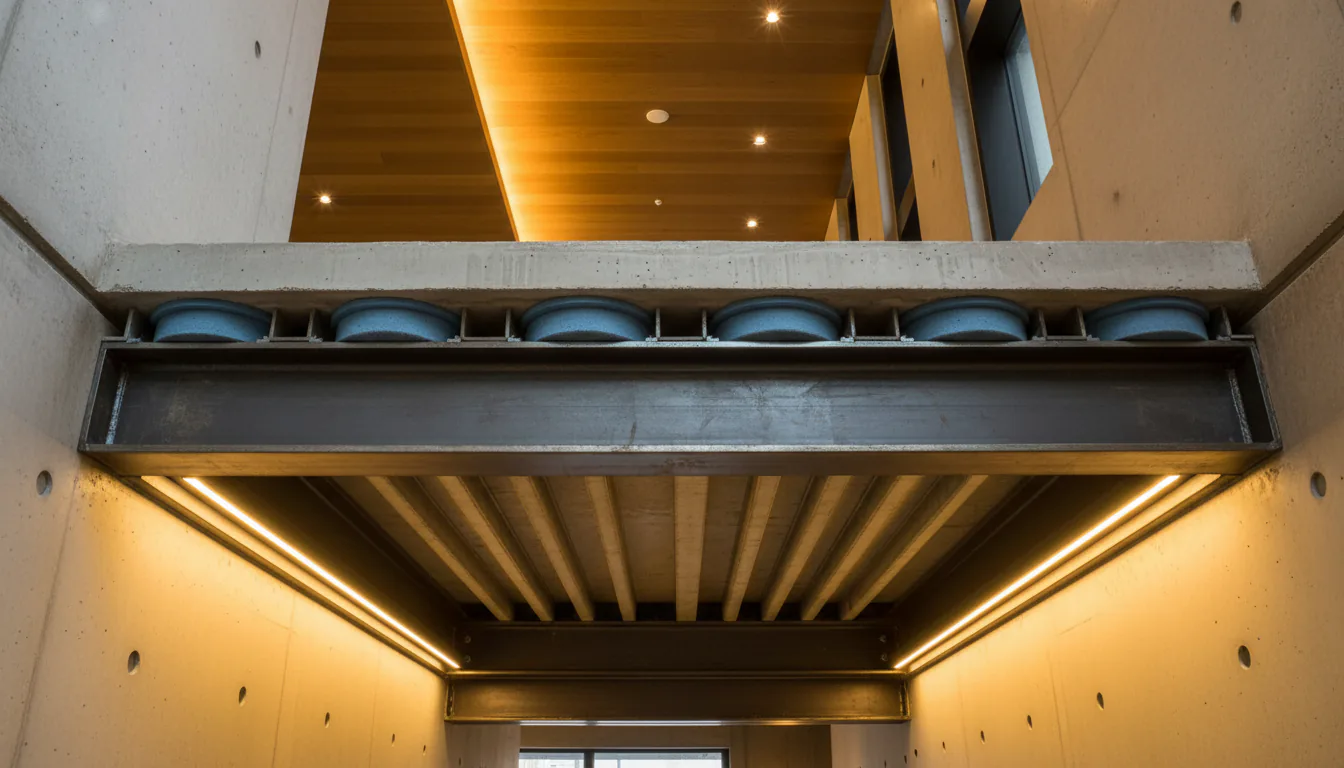
The single most effective change to a steel stair’s impact transmission is to insert a resilient pad, typically a neoprene or recycled rubber compound formed into a specific durometer, between the steel and whatever it bolts to. Every landing bracket, every base plate, every top connection becomes a sandwich: steel, pad, structure. The bolts are sleeved through the pad with isolation grommets so the bolt does not become a rigid bypass path.
The pad has to be selected for the load and the frequency content of the source. A pad that is too stiff does not isolate; a pad that is too soft sags under sustained load and stops being effective. Manufacturers like Mason Industries publish design guides for stair and pump isolation with the load and deflection curves the engineer needs to size the pad. The architect’s acoustic consultant typically specifies the pad family and the durometer, and the fabricator’s shop drawings show every place a pad is required.
The cost of the pads is small. The cost of installing them after the stair is finished is large, because the connection has to be unbolted, the pad inserted, and the stair re-tightened, usually with finishes already in the way. We add the pads at first fabrication every time on a multifamily project.
Concrete-filled or filled-pan treads add mass
After connection isolation, the next move is adding mass to the tread itself. A steel pan tread is light and rings when it is hit. The same tread filled with a poured concrete topping is heavy and damps the impact. The fundamental frequency of the impact shifts downward, which is heard by the listener as a softer, lower-pitched thud rather than a sharp click.
The tread topping is also the wear surface in many multifamily designs. A 30 to 50 mm concrete topping with a finish of the architect’s choice, broom-finish, exposed aggregate, troweled smooth, gives the stair a finished tread that resists wear, provides slip resistance, and reduces noise in one detail. The topping has to be specified at the fabrication stage because the steel pan has to be sized to support the topping load and the edge of the topping has to be detailed so it does not chip.
The landing is the loudest part of the stair
Most of the noise complaints in our portfolio trace to landings, not treads. A landing is a larger plate, supported on its perimeter, and it rings like a drum when someone steps onto it. The energy radiates into the structure through every support point at once.
The fix is the same family of details. Resilient pads at every landing support, mass added to the landing plate (concrete topping or a layered assembly with damping material between the steel and the finish), and a deliberate edge detail that does not couple the landing rigidly to the adjacent walls. The landing-to-wall connection in particular is often where the noise leaks out, because the architect detailed the stair as if the landing were just an extension of the floor.
The trim that closes the gap between the landing edge and the wall finish should be flexible, a soft sealant or a finish piece that is not rigidly fixed to both the wall and the landing. A hard trim coupling the two becomes a sound bridge that defeats the rest of the isolation.
Shaft separation in egress stairs
For egress stairs running through a shaft that passes upper units, the acoustic story extends to the shaft enclosure. A rated shaft wall is already a mass barrier for airborne sound. Impact sound from someone running down the stair still couples into the shaft structure and can reach the suites adjacent to the shaft if the connection details are rigid.
The same principles apply. The stair connections to the shaft wall, at intermediate landings, at top and bottom anchors, use resilient layers. The stair structure inside the shaft does not rigidly tie to the shaft walls more than the load requires. The architect’s acoustic consultant typically reviews the shaft details with the same attention as the suite separations.
For a related view on the structural and code side of the rated shaft, our piece on fire-rated steel stairs in BC multifamily buildings covers the shaft enclosure requirements.
Coordination matters more than product selection
A common pattern: the architect specifies a high-performance acoustic pad system at every connection and the noise complaints come anyway, because the framer added a structural blocking that bypassed the pad. Or the stair was modified in the field to fit an opening dimension change and the fabricator was not told to keep the pad in place. Impact isolation works only if every path is broken; one rigid bypass undoes the rest.
The shop drawings have to show every isolation pad, every grommet, and every flexible trim joint. The framer, the drywall sub, and the finish trades have to know which interfaces are intentional gaps and which can be tied. We mark the shop drawings, the install plan, and the as-builts with the isolation locations explicitly so nothing gets “fixed” in the field.
The architect’s acoustic consultant is the right specifier for the pad family, durometer, and topping mix. The fabricator’s job is to draw the details, fabricate them correctly, and protect them through install. The combination is what the suite below actually hears.
The honest cost conversation
The isolation package on a multifamily steel stair adds a measurable but contained cost, pads, grommets, topping concrete, and the design time to specify them. The cost of not specifying them is paid out later in homeowner complaints, retrofit attempts that rarely fully work, and the reputational cost of a building that sounds louder than its neighbours.
We default to a baseline isolation specification on any multifamily steel stair where a suite sits below the stair structure, even when the architect has not asked for it explicitly, and we flag the recommendation in writing in our quote. Most architects accept it. Most homeowners are glad they did.
For how isolation detailing fits the broader scope of our commercial and multi-family stairs, see the hub overview.
Sources
- NRC, Sound transmission in buildings (overview)
- Mason Industries, vibration isolation product literature
- BC Building Code Part 9, Housing and Small Buildings
Related reading: the fire-rated steel stairs in BC multifamily piece, the strata railing replacement guide for Burnaby towers, and the steel stair landing and half-landing piece.
Related questions
Why is a steel stair louder than a wood stair to the unit below?
Steel transmits impact energy efficiently. A footfall on a steel tread sends vibration through the stringer into whatever the stringer is bolted to, typically the floor framing or a structural wall. If that connection is rigid steel-to-concrete or steel-to-steel, the impact reaches the assembly below with very little loss. A wood stair has more inherent damping in the material and the connections.
Does BC code require a specific impact insulation class for stairs?
BC code references airborne and impact sound transmission for separations between dwelling units. The specific IIC and STC values that apply to stair shafts and stairs within suites depend on the building's classification under Part 3 and the AHJ's interpretation. The architect's acoustic consultant typically sets the target, and the fabricator detailing has to support it.
What's the most effective single change to reduce stair noise?
Adding a resilient pad or grommet at every steel-to-structure connection, landing brackets, base plates, top connection to the floor framing, breaks the direct transmission path. The pads cost very little and make a measurable difference. After that, a concrete topping on the treads adds mass and shifts the frequency content of the impact, which sounds quieter to the listener below.