Stair Budget Tiers in Vancouver 2026: What Each Range Actually Buys
Custom steel stair budgets in Vancouver 2026: entry, mid-range, and premium tiers, with what each includes and where the cost differences come from.
Every Vancouver stair budget tier buys something different. Understanding what each tier actually includes is the difference between a finished home and a regret.
The first conversation we have with most homeowners on a custom stair project is the budget conversation. The homeowner has a number in mind. The number is usually based on a casual estimate from somewhere, a builder’s rule of thumb, a number from a different project, a brochure figure that may or may not reflect current market conditions. The number is rarely the number that the project actually costs.
This post is a working framework for how Vancouver custom stair budgets actually break down in 2026, what each tier buys, and where the cost differences live between tiers. We do not publish specific dollar figures because the market moves and the project variables affect the number significantly. We provide the framework so homeowners can have a more informed conversation with us or with another fabricator.
The three tiers
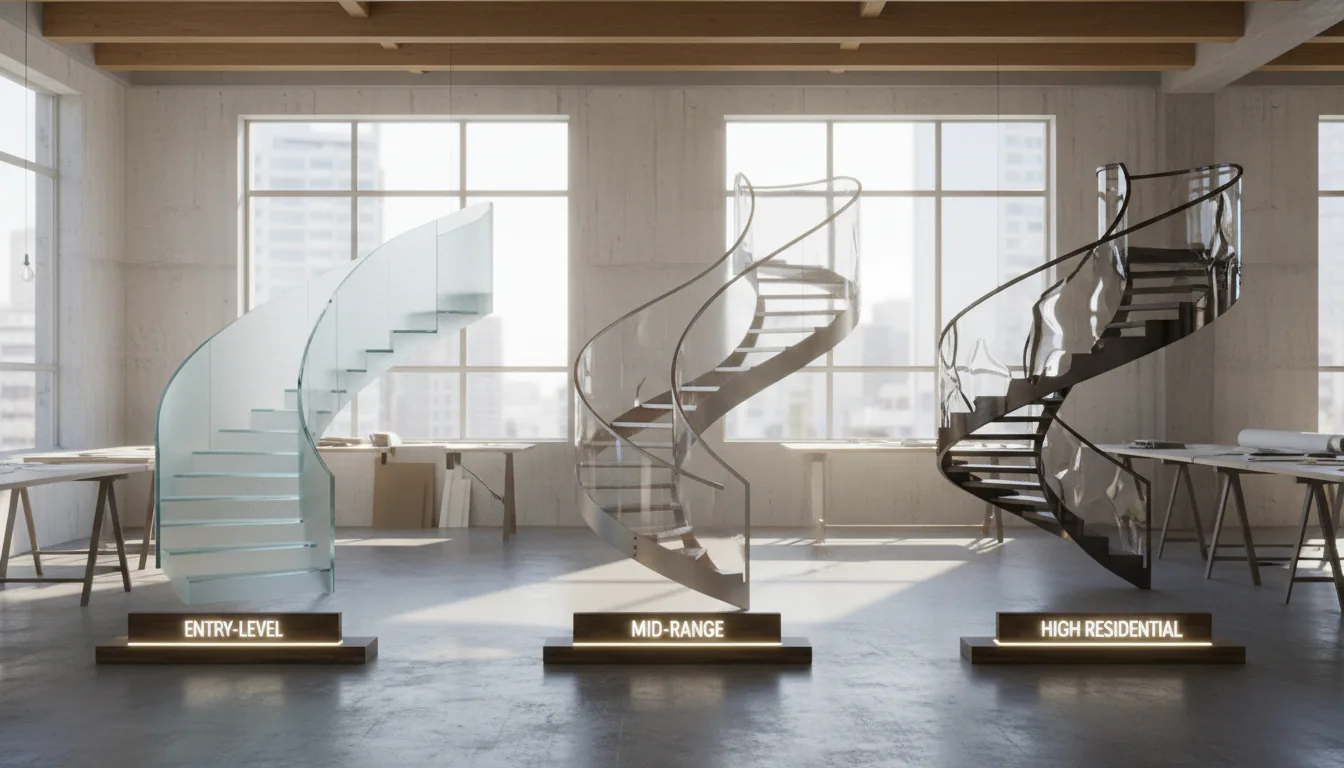
We think about residential stair budgets in three tiers: entry, mid-range, and premium. Each tier is defined by what it includes, not by an arbitrary dollar threshold.
The boundaries between the tiers are not bright lines. A project can sit between two tiers, with some entry-tier elements and some mid-range elements. The framework is descriptive, not prescriptive.
The entry tier
The entry tier covers code-compliant residential stairs with basic finish systems. The stair satisfies all code requirements, lasts the life of the home, and meets the basic functional and safety needs of the household. The visual reading is standard rather than custom.
What the entry tier typically includes:
- Structure. Carbon steel stringers in stock sections, standard connection details, painted or basic powder coat finish.
- Treads. Steel pan treads with concrete or wood topping, or pre-finished wood treads (typically oak or maple) in standard thickness.
- Railing. Square tube steel pickets with a basic top rail, or a basic cable system with stock hardware. Powder coat or paint finish in a standard colour.
- Hardware. Stock brackets, stock fasteners, basic mounting hardware.
- Finish system. Single-pass powder coat or wet paint in a standard architectural colour.
The entry tier is the right answer for:
- Investment properties where the homeowner is not the primary occupant
- Secondary stairs in homes where another stair is the feature
- Projects where the budget is genuinely tight and the homeowner accepts the trade-off
- Homes where the surrounding architecture is itself modest and a feature stair would look out of place
The mid-range tier
The mid-range tier covers custom-designed stairs with coordinated finish and railing packages. The stair is designed for the specific home, the finish is selected to coordinate with the surrounding architecture, and the visual reading is custom rather than standard.
What the mid-range tier typically adds beyond the entry tier:
- Structure. Custom-designed steel stringers, mono stringer or other designed structural premise (within standard parameters), engineered connection details where required.
- Treads. Solid hardwood treads in selected species (most commonly rift-cut or quarter-sawn white oak), shop-finished to a coordinated finish system, sized for visual proportion against the structure.
- Railing. Custom-designed picket pattern, premium cable system, or basic glass system. Hardware grade matched to the application (316 stainless on coastal projects, 304 on interior projects).
- Hardware. Coordinated bracket, post, and finish package matched to the rail and the structure.
- Finish system. Designer powder coat colour, often with custom colour matching to the architectural finish palette.
The mid-range tier is the right answer for:
- Most Vancouver custom homes where the stair is a meaningful part of the architecture but not the architectural centerpiece
- Renovations where the existing home supports a custom stair but does not have a feature stair as the focal point
- Projects where the homeowner wants a custom result but does not need a sculptural stair
This is the tier where most of our residential work sits.
The premium tier
The premium tier covers feature stairs with custom structural elements, premium materials, integrated lighting, and bespoke detailing. The stair is the architectural centerpiece of the home and the budget reflects that intent.
What the premium tier typically adds beyond the mid-range tier:
- Structure. Premium structural premise, true cantilever, suspended cable rod, curved or helical geometry, custom mono stringer with sculptural detailing. Engineering is more substantial.
- Treads. Premium wood species (rift-sawn white oak with selected figure, walnut with controlled grain matching, custom inlays, or other premium materials). Tread thickness sized for visual proportion against the structural premise.
- Railing. Custom-designed glass railing with coordinated hardware, premium cable system with custom post detailing, or fully custom-fabricated railing with bespoke hardware.
- Hardware. Custom-fabricated brackets, posts, and hardware. Material may include bronze, brushed nickel, or other premium metals beyond standard steel and stainless.
- Finish system. Premium finish with custom colour development, multiple coat systems, or specialty finishes (chemical blackening, patinated surfaces, custom coatings).
- Integrated lighting. LED tread lighting, accent lighting on structural members, or coordinated lighting integration that is part of the stair design.
The premium tier is the right answer for:
- Custom homes where the stair is the architectural centerpiece of the home
- Heritage projects where the stair restoration or replacement is a major design element
- Homes where the budget is generous and the homeowner wants the stair to be photographed and remembered
Where the cost differences live between tiers
The cost differences are concentrated in specific areas:
- Structural engineering and complexity. The premium structural premise (cantilever, curve, mono stringer) costs meaningfully more in engineering and fabrication than the standard stringer approach.
- Material grade and species. Premium wood species and premium hardware grades cost more per linear unit than standard materials.
- Finish coordination and quality. Custom colour development, multiple-coat finish systems, and shop finishing of all components cost more than standard single-coat finishes.
- Lighting integration. Adding integrated lighting at the design stage adds engineering, fabrication, and coordination cost.
- Custom hardware fabrication. Bespoke brackets and hardware add fabrication time and material cost over stock alternatives.
Each of these elements scales with the project size. A mid-range stair on a large home is more expensive in absolute terms than a mid-range stair on a small home, but the tier is the same.
The trap of matching the tier to the budget rather than the home
The most common mistake we see is homeowners who select a tier based on their budget without considering the home’s architecture. A premium feature stair in a home with modest surrounding finishes looks out of place. An entry-tier stair in a home with premium finishes looks like a missed opportunity.
The right move is to match the stair tier to the home tier. A home with a modest finish package supports an entry- or mid-range stair. A home with a premium finish package supports a mid-range or premium stair. The stair should feel like it belongs to the home, not like it was selected from a different price catalog.
The homeowner who wants a premium stair in a modest home is usually better served by stepping up the broader finish package, not just the stair. The homeowner who wants an entry stair in a premium home is usually better served by accepting the larger budget that the premium stair represents.
When the project sits between tiers
Many projects sit between tiers. A common pattern: entry-tier structural premise (standard straight stringer) with mid-range finish (designer powder coat colour, white oak treads). Or mid-range structural premise (mono stringer) with entry-tier finish (basic powder coat, pre-finished tread material).
These hybrid projects can work well when the homeowner understands the trade-offs. A homeowner who wants the visual reading of a mid-range stair but cannot afford the full mid-range package may choose to upgrade the most visible elements (finish, treads) while keeping the structure simpler. The result satisfies the visual intent within a contained budget.
The hybrid approach works less well when the homeowner is unaware of the trade-offs. A homeowner who expects mid-range performance from an entry-tier structure is going to be disappointed by what is actually a hybrid project.
The 2026 market specifically
The Vancouver custom stair market in 2026 is operating in a specific environment. Steel material costs have stabilized after several years of volatility. Labour costs continue to climb. The premium tier has seen the strongest growth in demand, driven by custom home and renovation activity at the high end of the market. The entry tier has tightened as smaller fabricators have left the market.
The practical implication for homeowners: the entry tier is available but the gap to mid-range is narrower than it was five years ago. The mid-range tier is well-served by multiple fabricators. The premium tier has fewer qualified fabricators and the lead times are longer.
We expect this pattern to continue through 2026 and into 2027.
Sources
- Statistics Canada, Industrial Product Price Index, Iron and Steel
- BC Building Code Section 9.8, Stairs, Ramps, Landings, Handrails and Guards
Related reading: the custom metal stair cost guide, the how to read a metal fabrication quote piece, and the luxury stair trends 2026 Vancouver piece.
Related questions
What does an entry-tier Vancouver stair cost in 2026?
The entry tier covers code-compliant straight stairs with basic finish systems. The cost varies with the stair size, the number of flights, and the railing complexity, but the entry tier is meaningfully less than the mid-range or premium tiers. We do not publish specific dollar figures because market conditions change; we provide project-specific quotes based on actual scope.
Why does a feature stair cost so much more than a basic stair?
The structural premise is more complex, the engineering is more involved, the materials are more premium, the finish coordination is more careful, and the install is more demanding. Each of these adds cost, and the total adds up. A mono stringer or floating stair in particular requires structural engineering and detailing that a basic straight stair does not.
Can a mid-range stair be upgraded to a premium stair later?
Generally no. The structural premise of the stair is set at the original design and is expensive to change after fabrication. A mid-range stair upgraded to a premium finish is still a mid-range structure with a premium finish, which usually does not satisfy the homeowner. The right move is to choose the tier that matches the home at original design.