The Stair Handover Punch List: What a Vancouver Fabricator's Walk Actually Covers
Custom stair handover in Vancouver: the punch list inspection items, documentation required, what gets signed off, and what the homeowner should expect.
A punch list is the moment the stair leaves the fabricator's responsibility and joins the home. Done right, it ends the project. Done wrong, it starts a six-month follow-up.
This article is a fabrication-focused overview; final structural sign-off belongs with the project engineer and the authority having jurisdiction (AHJ), not this checklist.
The handover is the moment a custom stair project shifts from the fabricator’s responsibility to the homeowner’s home. Everything before the handover is the fabricator’s work to finish. Everything after the handover is the homeowner’s stair to live with and maintain. The handover itself is the transition, and how it is run determines whether the project closes cleanly or leaves loose ends that drag the project on for months.
This post walks through how a Vancouver Stairs handover punch list is run, what the walk actually covers, and what the homeowner and the GC should expect at the closure of a typical custom stair project.
The walk, what gets checked
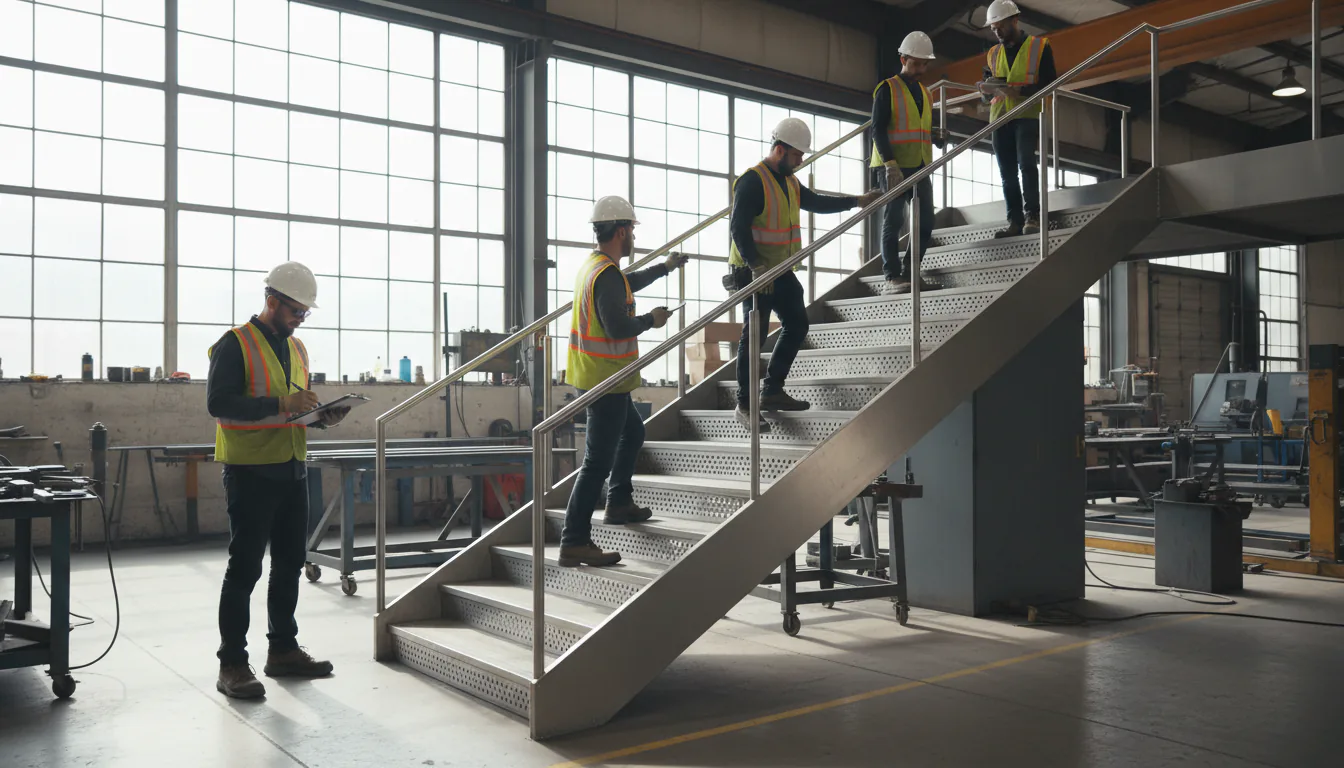
The handover walk follows a specific checklist that covers every aspect of the installed stair. We walk the stair from bottom to top, then top to bottom, then bottom to top one more time. Three passes catches more than two. Each pass is focused on a different aspect.
The first pass is the visual inspection. The foreman walks the stair looking for:
- Visible damage to any finished surface (scratches, dents, marks from install)
- Loose hardware on the railing, the brackets, or the connections
- Missing or improperly seated isolation pads (on multifamily and townhouse installs)
- Uneven tread surfaces or misaligned bracket details
- Incorrect tread spacing or rise variation across the run
- Railing geometry that does not match the shop drawings
The second pass is the structural check. The foreman verifies:
- Every bolt is torqued to the engineer’s specification (recorded in a torque log)
- Every weld location is clean and consistent (visual check; non-destructive testing if specified)
- The connection details at the upper and lower landings match the shop drawings
- The base plate is fully shimmed and grouted if specified
- The structural backup at the engineered locations is in place
The third pass is the finish check. The foreman verifies:
- The finish colour and texture match the approved sample
- The finish coverage is uniform across every visible surface
- Any touchups required from install damage have been completed
- The wood finish (where applicable) is correctly applied and cured
- Any specialty finish detail (chemical blackening wax, anti-slip insert) is in place
The written punch list
Anything that does not pass the three-pass walk goes onto a written punch list. We do not leave a verbal punch list. The list is documented with:
- The specific item that did not pass
- The location on the stair (which tread, which connection, which surface)
- The corrective action required
- Who is responsible for the corrective action
- The target completion date
The punch list moves with the project until every item is signed off. Items that require a return trip to the shop or a return visit to the site are scheduled before the install crew leaves. The homeowner and the GC both have a copy of the list.
The most common items that appear on punch lists:
- Touchup paint or powder coat at a small area of install damage
- A bolt that was tightened but not torqued to the final spec
- A finish inconsistency that requires a specific product to remediate
- A railing connection that has shifted slightly during the final tensioning
- An isolation pad that requires additional sealant at the perimeter
Each of these is small individually. The cumulative effect of leaving them unaddressed is a project that does not feel finished.
The documentation package
The documentation package is what the homeowner receives at handover. The package includes:
- Approved shop drawings. PDFs of the final shop drawings as approved by the architect and engineer.
- Engineering letter. The structural engineer’s stamped drawings and any related calculations or letters.
- Torque check log. The structural bolt connections with the recorded torque values.
- Finish system data sheet. The manufacturer, product number, colour reference, and application instructions for every finish on the stair.
- Maintenance recommendations. Our recommendations for the specific finish and material, cleaning products, cleaning schedule, recoating interval if applicable.
- Warranty terms. The fabricator’s warranty terms on the work, the duration, and what is and is not covered.
- Code disclosures. Any specific code-related notes (handrail height, guard opening test, slip resistance verification).
The package is delivered electronically as a single PDF folder and on paper for the homeowner’s records. We keep a copy in our project file indefinitely so the homeowner can request a replacement if needed.
What the homeowner should look for
The homeowner who participates in the handover walk should look for:
- Does the stair look like the renderings or the design intent? Not exactly (renderings are renderings) but in the overall reading.
- Does every surface feel finished? The visible surfaces should be smooth, the handrail should be continuous, the treads should be level.
- Does the stair feel solid under foot? No movement, no creaking, no flex on any tread or landing.
- Does the railing feel solid in the hand? No movement, no looseness at any bracket or post.
- Is the documentation complete? The package above, delivered at the walk.
Issues the homeowner notices at the walk go onto the punch list. Issues noticed later go to the warranty conversation, which is a different process.
For broader context on the install process that leads up to the handover, see our piece on the metal stair installation day Vancouver piece.
The GC sign-off
On a project with a GC, the GC walks the stair with the foreman and signs the written acceptance once the punch list is agreed. The sign-off is the project file’s confirmation that the stair work is complete.
The GC’s sign-off does not waive the warranty. Issues that emerge after sign-off are still covered under the warranty terms. The sign-off confirms that, at the moment of handover, the work was complete to the specified scope.
What can go wrong at handover
The most common failure modes at handover:
- Rushed walk. The install crew is tired, the schedule is pressing, and the walk gets compressed. Items that the slow walk would catch get missed. Two months later, the homeowner notices.
- Verbal punch list. No written record of what needs follow-up. The corrective work gets forgotten. The project never formally closes.
- Incomplete documentation. The package is missing the engineering letter, the finish data sheet, or the maintenance recommendations. The homeowner cannot reference the work in five years when a renovation question comes up.
- Disagreement on punch items. The fabricator and the GC disagree on whether an item is in or out of scope. The walk ends without sign-off and the project hangs open.
We protect against each of these by treating the walk as a separate, scheduled event rather than a tail end of the install day. The crew arrives rested, the checklist is followed, the documentation is delivered, and the sign-off is obtained.
The warranty conversation
The warranty terms are explicit at handover. Our typical warranty covers:
- Workmanship defects for a stated period after handover
- Material defects for the manufacturer’s warranty period on materials supplied by us
- Finish system defects per the finish manufacturer’s warranty (varies by finish)
The warranty does not cover damage from misuse, modifications by other trades, normal wear, or finish maintenance that the homeowner is responsible for.
A homeowner who calls us about a warranty issue six months after handover gets a response based on the documented warranty terms. The clear documentation at handover prevents disputes about what was and was not covered.
Sources
- BC Building Code Section 9.8, Stairs, Ramps, Landings, Handrails and Guards
- Engineers and Geoscientists BC, practice resources
Related reading: the metal stair installation day Vancouver piece, the steel stair shop drawings Vancouver piece, and the steel staircase maintenance Vancouver piece.
Related questions
What's actually on a stair handover punch list?
Visual inspection of every bolt, weld, tread, and railing connection. Torque verification on structural bolt connections. Finish inspection on every visible surface for damage from install. Confirmation that every isolation pad, grommet, and acoustic detail is in place. Confirmation that the documentation package is complete. Any item that does not pass goes on the written punch list with a corrective action and a target date.
Who walks the punch list, the fabricator, the GC, or both?
Both, ideally. The foreman walks the stair first to verify the install before handing off. The GC then walks with the foreman to confirm the work and sign the written acceptance. On premium residential projects, the homeowner or the homeowner's representative often participates in the walk.
What documentation does the homeowner get at handover?
Approved shop drawings (PDFs), engineering stamped drawings if applicable, torque check log, finish system data sheet with colour reference, maintenance recommendations, warranty terms, and any code-specific disclosures. The package is delivered electronically and on paper for the homeowner's records.