Steel Grades for Stair Stringers: What 350W Actually Means
CSA G40.21 grades used in stair fabrication, what the W designation guarantees, and why plate thickness changes the yield strength you can count on.
Two stringers can look identical and be made from different steel. The letter and the number stamped on the plate decide what the fabricator can do with it.
Two stair stringers can look identical, weigh the same, and be made from steel that behaves differently under load. The difference is in the grade, and the grade is set long before anything is cut.
The designation is a strength number and a promise about welding
Structural steel in Canada is generally supplied to CSA G40.21, and the grade designation packs two pieces of information into a short label.
The number is the specified minimum yield strength in megapascals. The letter describes the category. In 350W, the 350 is a minimum yield of 350 MPa, and the W identifies a weldable grade. According to Chapel Steel’s specification data for CSA G40.21, 350W is the metric designation of the grade also written as 50W, with a minimum yield of 50,000 psi and a tensile range of 65,000 to 90,000 psi.
The W is doing more work than it looks like it is. As Portland Bolt’s summary of CSA G40.21 sets out, the W grades come with guaranteed weldability, achieved by limiting the carbon equivalent of the steel. That limit is what makes the material predictable in a shop. Steel with uncontrolled chemistry can be welded, but the procedure has to account for it, and the results are less consistent.
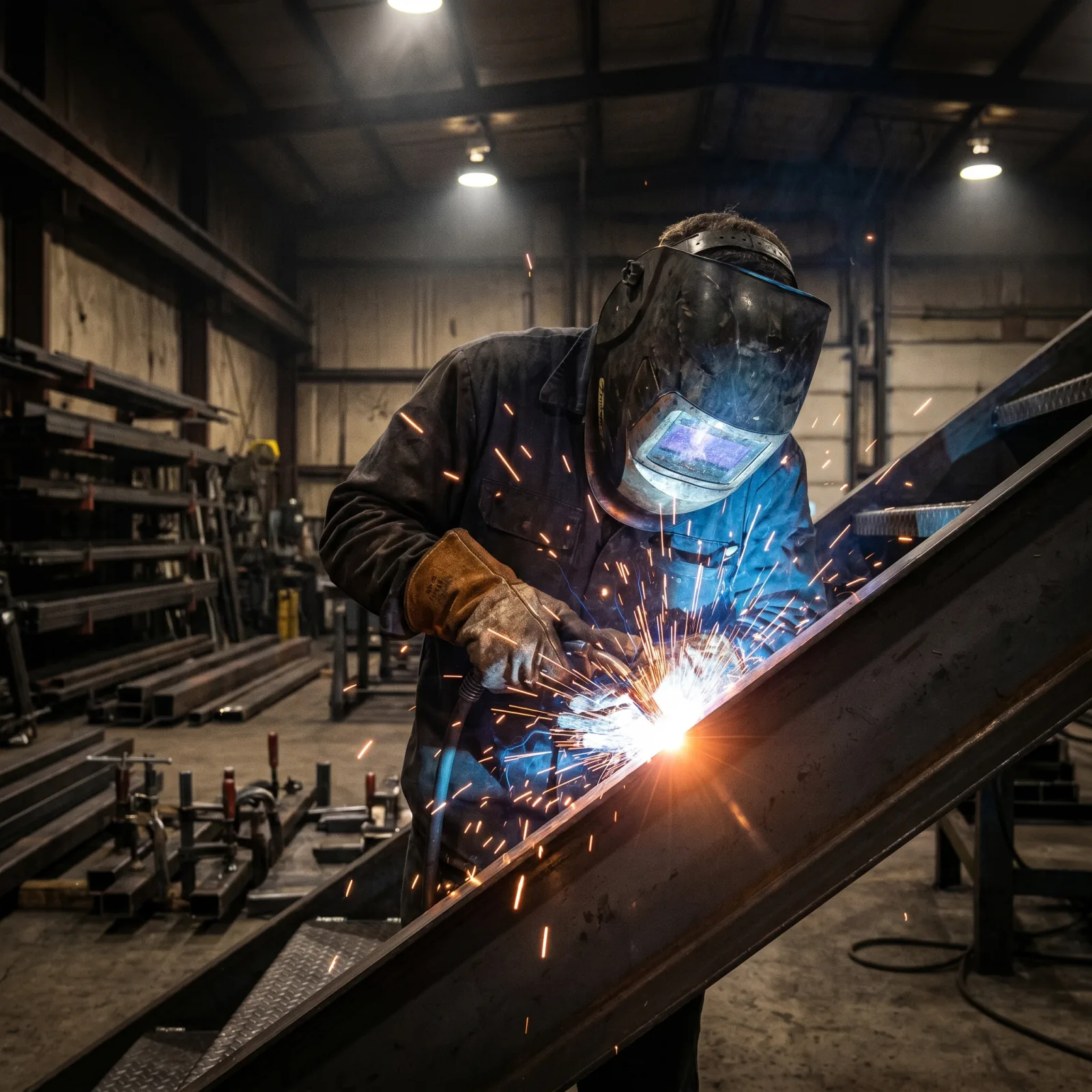
For stair work that matters constantly, because a stair is a welded assembly rather than a bolted one. Every tread bracket, every stiffener, and every connection plate is a weld into the stringer.
Thickness quietly changes the number
This is the part most commonly missed, including by people who know the grade designations well.
The specified minimum yield of a G40.21 grade is not constant across all plate thicknesses. Published property data for the standard shows the figure for 350W holding at 350 MPa through the thinner ranges and then stepping down as plate gets heavier, with reductions applying above 20 mm and further reductions in the heaviest ranges. Beam Dimensions’ CSA G40.21 material property tables set the thickness bands out.
Most stair stringers sit in thicknesses where the headline figure applies, so this rarely bites on a normal residential stair. It becomes relevant on heavy commercial stringers, on thick base plates, and on connection plates where a designer might reach for a heavier section to solve a bearing problem. Assuming one yield figure across every thickness in an assembly is the kind of small optimism that an engineer catches and a fabricator should not introduce.
A higher grade does not fix a bouncy stair
This is the single most useful thing to understand about grade selection, and it runs against intuition.
Strength and stiffness are different properties. Yield strength tells you when the steel starts to deform permanently. Stiffness tells you how much it deflects under a load it is comfortably within. Structural steels share essentially the same elastic modulus regardless of grade, which means a 350W beam and a 300W beam of identical geometry deflect the same amount under the same load.
So if a stair feels springy, moving to a higher grade changes nothing. The fix is geometry: a deeper section, a thicker web, a shorter span, or an additional support. The same logic applies to tread plate that flexes underfoot, where the answer is thickness, a stiffener, or a folded edge rather than better steel. That relationship between span and section is covered further in the notes on mono stringer span limits and on vibration and deflection in steel stairs.
Where a higher grade does earn its place is when the section is governed by strength rather than by deflection, which on stairs usually means connections, base plates, and short heavily loaded elements rather than the stringer span itself.
Section shape matters more than the label
Given that stiffness comes from geometry, the section a stringer is made from is the more consequential decision.
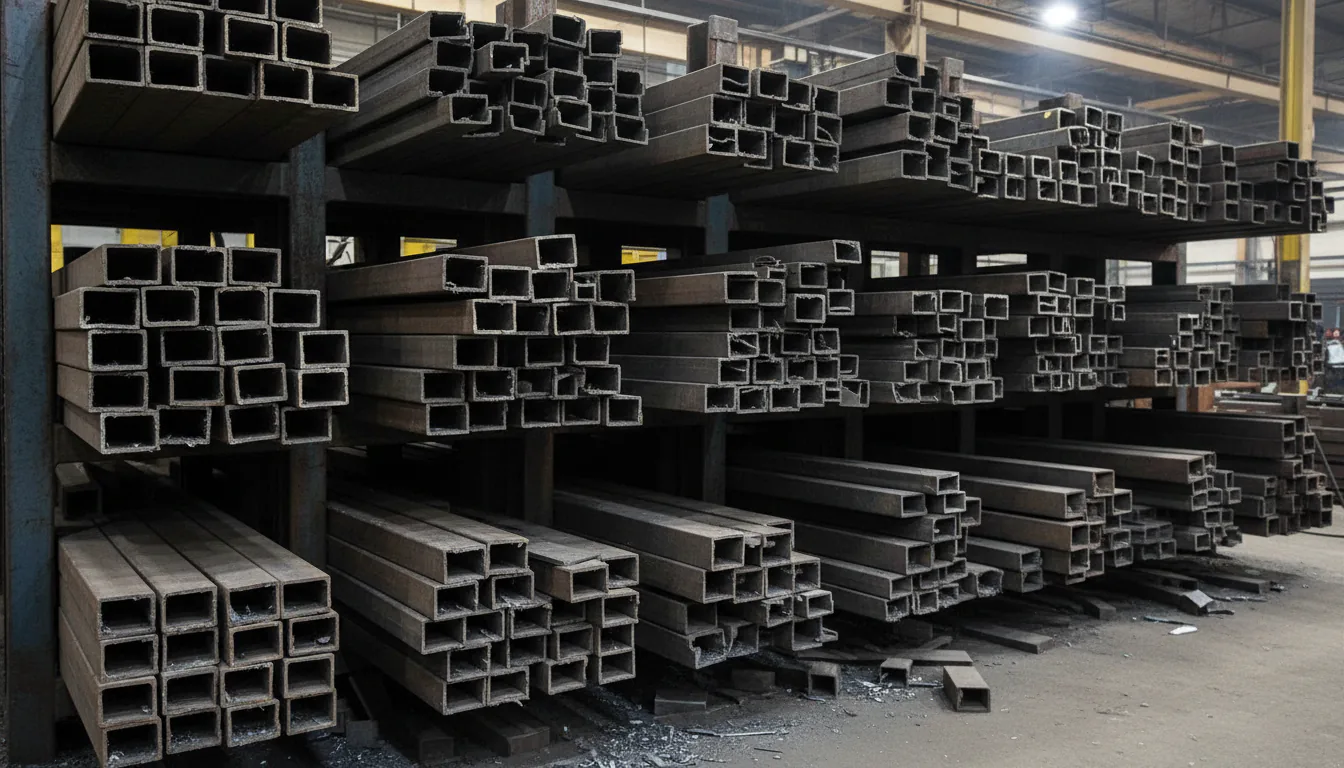
A flat plate stringer used on edge is efficient in the direction of bending and weak the other way, which is why plate stringers get stiffened, folded, or paired. A channel gives depth plus a flange that resists twisting. A rectangular hollow section is stiff in both directions and closes the profile, which suits an exposed mono stringer where the underside is visible from below.
Each of those changes the fabrication as much as the structure. Welding tread brackets to a closed hollow section is different from welding them to an open channel, and access for the welder inside a closed section is nonexistent, which pushes the detail to the outside. The choice between them belongs with the engineer and the designer together, since it is simultaneously a structural and a visual decision.
Finish interacts with material chemistry
The intended finish should be known when material is specified, not after the stair is welded.
The clearest case is hot-dip galvanizing. The silicon and phosphorus content of the steel influences how the zinc coating grows during immersion, which affects coating thickness and surface appearance. Two stringers of the same grade from different heats can come out of the same bath looking different, with one grey and matte and the other bright, and neither is defective.
For an exposed architectural stair that matters, because the finish is the product. Where appearance consistency is important, it is worth raising before material is purchased so pieces that will sit next to each other come from compatible material. The broader trade-offs are covered in the notes on hot-dip galvanizing for exterior stairs and on powder coat versus wet paint on interior steel.
Availability shapes the design more often than strength does
On paper a designer picks a section and a grade. In a shop the question is what can actually be bought, in the length required, without a mill order.
Common sections in common grades are stocked by Metro Vancouver suppliers and can be collected the same week. Unusual sizes, unusual grades, and long single lengths are a different proposition, and they can move a project’s schedule by weeks rather than days. A stringer specified as a single continuous length longer than what is stocked either gets spliced, which is a welded joint the engineer has to accept, or waits for a mill run.
That trade-off is worth surfacing early, because it is usually solvable at no cost during design and expensive during procurement. A section one size up that is stocked can beat a theoretically optimal section that is not. In our shop, a substitution request that arrives during shop drawings is routine and one that arrives after the schedule is committed is not.
Hollow sections deserve a specific mention. They are supplied in classes that reflect how they were formed, and the class affects both the corner geometry and how the section behaves, which in turn affects welding and appearance on an exposed stair. Where a mono stringer will be seen from below, the corner radius of the section is a visual decision as well as a structural one.
The practical version is simple. Give the fabricator the structural requirement and the visual intent, and let the shop confirm what is available before the section is locked. That single exchange during design removes most of the material surprises that otherwise appear once the drawings are approved and the steel is being ordered.
Documentation is a decision, not an afterthought
On engineered projects, the material’s paperwork is part of the deliverable.
Mill test certificates trace a piece of steel back to the heat it came from and record its chemistry and mechanical properties. Where a project requires that traceability, material has to be purchased, received, and tracked with that in mind, and offcuts from general stock cannot be substituted casually.
That is a purchasing and process requirement rather than a fabrication one, and it costs something. It is also very difficult to reconstruct after the fact. In our shop, the projects where documentation is straightforward are the ones where the requirement appeared in the enquiry rather than in a request during closeout. The shop drawings process is the natural place for it to be confirmed.
What actually needs deciding
For most residential stairs, grade is not a decision the client makes. The engineer specifies it, the fabricator supplies to it, and the conversation never surfaces.
It surfaces on projects with long spans, slender exposed sections, an exacting finish requirement, or a documentation requirement. On those, the useful information to give a fabricator early is the structural drawings and specification including the specified grade, any requirement for mill certificates or third-party inspection, the intended finish, and whether appearance consistency across adjacent pieces matters. Those four items decide how material is bought, and material is bought before anything is cut.
Sources
- CSA G40.21 50W / 350W structural steel plate specification, Chapel Steel
- CSA G40.21 specification summary, Portland Bolt
- CSA G40.21 material properties and thickness bands, Beam Dimensions
Grade is one of the few stair decisions made entirely before fabrication starts and impossible to revisit afterwards. Where a project has span, finish, or documentation demands, raising them at enquiry is what keeps the material choice from becoming a constraint later.
Related questions
What steel grade are stair stringers normally made from in Canada?
Most structural stair work in Canada uses steel to CSA G40.21, and 350W is the common general-purpose weldable structural grade. The engineer of record specifies the grade for a given project, and the fabricator supplies material with mill documentation matching it.
What does the W in 350W mean?
W designates a weldable grade. According to CSA G40.21 supplier data, the W grades carry guaranteed weldability with limits on carbon equivalent, which is what makes the steel predictable to weld without special procedures. The number is the specified minimum yield strength in megapascals.
Is 350W the same as 50W?
They are the metric and imperial designations of the same grade. As Chapel Steel's specification data sets out, CSA G40.21 50W corresponds to 350W, with a minimum yield of 350 MPa, roughly 50,000 psi. Drawings and mill certificates may use either label.
Does thicker plate have the same yield strength?
No, and this catches people out. Published CSA G40.21 property data shows the specified minimum yield for 350W dropping as plate thickness increases beyond 20 mm. A design that assumes one yield figure across all thicknesses can be optimistic on the heaviest sections.
What is the difference between 300W and 350W?
The number is the specified minimum yield strength in MPa, so 350W is the stronger of the two. Both are weldable grades under CSA G40.21. Which one a project uses is the engineer's call, and availability in the required section can also influence it.
Does the grade affect how the stair is welded?
It affects the welding procedure. A weldable structural grade with controlled carbon equivalent behaves predictably with standard procedures, which is why W grades dominate stair work. Welding two different grades together, or welding a grade outside the procedure's qualified range, is a procedure question rather than a shop-floor decision.
Can I specify stainless steel for a stringer instead?
You can, and it is done on exposed exterior work, but it is a different material with different structural properties, different welding requirements, and a substantially higher cost. Stainless is more commonly used for railings and fittings than for the primary structure. The choice belongs with the engineer and the budget together.
How do I know what grade my stair was built from?
From the mill test certificates the fabricator holds for the material. On engineered projects those certificates are part of the documentation package. If your project needs traceability to the mill, say so at quotation stage, because it affects how material is purchased and tracked.
Does grade matter for a small residential stair?
Less than it does on a commercial project, but it is not irrelevant. A residential feature stair with long spans and slender sections can be working the material harder than a heavier commercial stair with short spans. In our shop the span and the section drive the conversation more than the building type does.
Is higher-strength steel always better?
No. Higher yield lets a section carry more load, but it does not make the section stiffer, so a stair sized by deflection rather than by strength gains nothing from a higher grade. Bounce and deflection are stiffness problems, and stiffness comes from geometry.
Does the grade change the finish options?
Not usually for the common weldable structural grades. What does affect finishing is the steel's surface condition and its chemistry where hot-dip galvanizing is involved, since silicon content influences coating thickness and appearance. Raise the intended finish with the fabricator when the material is being specified.
What should I send a fabricator about material?
Send the structural drawings and specification, including the specified grade and any requirement for mill test certificates or third-party inspection. If the project has a documentation requirement, it needs to be known before material is ordered rather than after the stair is welded.