Why Custom Steel Stairs Take Longer Than Clients Expect in Vancouver 2026
What drives the schedule of a custom steel stair in Vancouver 2026: design, engineering, permits, fabrication, and coordination overhead explained.
A custom stair is not a kitchen appliance with a published lead time. It is a coordinated project, and projects move at the pace of their slowest decision.
The first conversation we have with most homeowners on a custom stair project includes some version of “how long will this take”. The expected answer is usually a single number, six weeks, two months, something concrete and short. The actual answer is more complicated, and the gap between expectation and reality is the most common source of frustration on the projects we work on.
This post walks through the actual phases of a custom steel stair project in Vancouver, what each phase typically takes, and where the schedule can and cannot be compressed.
The headline number
A typical custom residential steel stair in Vancouver runs four to six months from first design conversation to install. Larger or more complex projects (multi-storey stairs, feature stairs with cantilever or curved elements, commercial stairs with rated assembly coordination) take longer, six to twelve months is common for those.
The four-to-six month timeline surprises first-time clients who expected the project to move on the fabrication timeline alone. The fabrication is a meaningful portion of the schedule but not the largest portion.
For broader context on the timeline on related projects, see our piece on the custom staircase timeline Vancouver piece.
This article is not a substitute for code review by the authority having jurisdiction, an architect, or an engineer.
Phase 1, design iteration (4 to 8 weeks)
The design phase covers the conversations between the homeowner, the architect, and the fabricator about what the stair will be. The conversations include:
- The structural premise (mono stringer, switchback, floating, cantilever)
- The material palette (steel grade, finish system, tread material, railing material)
- The architectural integration (how the stair sits in the floor plan and reads against the surrounding architecture)
- The lighting integration (whether and how lighting is built into the stair)
- The budget and the priority decisions about what to spend on and what to keep simple
The design phase moves at the pace of decisions. A homeowner who is decisive and an architect who is responsive can complete the design phase in four weeks. A homeowner who wants to iterate on multiple options or an architect who is busy with other projects can stretch the design phase to eight weeks or longer.
We typically have two to four design conversations during this phase, including at least one shop visit to look at samples and existing work.
Phase 2, engineering review (2 to 6 weeks)
The structural engineering review applies to most custom stairs and to all stairs with engineered structural elements (mono stringer, cantilever, suspended, multi-storey). The engineer:
- Reviews the design for structural feasibility
- Calculates the loads and the structural member sizing
- Designs the connection details
- Stamps the structural drawings for the permit submission
The engineering review moves at the pace of the engineer’s availability. Engineers we work with regularly have a queue, and a new project typically takes two to four weeks to reach the front of the queue. Once in review, the actual engineering work is fast on a typical residential project.
Complex projects (commercial stairs, monumental stairs, custom structural geometry) take longer because the engineering review is more substantial.
Phase 3, permit submission and review (2 to 12 weeks)
The permit pathway depends on the AHJ and the project complexity. The published timelines vary significantly.
The City of Vancouver permit review typical timeline for a residential project varies with the current submission queue. The published timeline is the starting point; complex projects (heritage, structural modifications, multi-storey) can take longer.
The District of North Vancouver, the City of Burnaby, and surrounding municipalities each have their own timelines and processes. The architect or the permit consultant manages the submission and the response to AHJ questions.
The permit schedule generally cannot be compressed beyond the AHJ’s published timelines. The exception is small projects (some renovation work, some single-component fabrication) that may be exempt from the full permit process; those are handled differently.
Phase 4, shop drawings (2 to 4 weeks)
The shop drawings translate the architectural and structural design into the specific fabrication instructions. The drawings include every dimension, every connection, every weld, every bolt, every finish.
The shop drawing phase includes:
- Fabricator produces the initial drawings (1 to 2 weeks)
- Architect reviews and provides comments (1 week)
- Fabricator revises (3 to 5 days)
- Architect approves (a few days)
- Engineer reviews structural details and stamps (in parallel with architectural review)
The phase can be compressed if the architect and the homeowner are responsive to the revision cycle. The phase extends if revisions take multiple rounds or if the design is still being refined during shop drawing review.
For broader context on the shop drawing process, see our piece on the steel stair shop drawings Vancouver piece.
Phase 5, fabrication (4 to 8 weeks)
The fabrication phase is the one most homeowners think of as “how long the stair takes”. It is the visible work of cutting, welding, finishing, and assembling the steel.
The fabrication moves at the pace of the shop’s capacity. Our shop schedule is typically set six to eight weeks in advance, so a project that has its shop drawings approved is scheduled into the queue at that distance. Projects approved earlier get scheduled earlier; projects approved later get scheduled later.
Within the fabrication phase, the work breakdown is approximately:
- Cutting and material preparation: 1 week
- Welding and assembly: 1 to 2 weeks
- Finishing (powder coat, paint, or galvanizing): 1 to 2 weeks
- Quality control and pre-shipment inspection: 1 week
Premium finishes (specialty colours, custom matching, complex multi-coat systems) add time. Standard finishes are faster.
Phase 6, install and handover (1 to 3 days for install, plus follow-up)
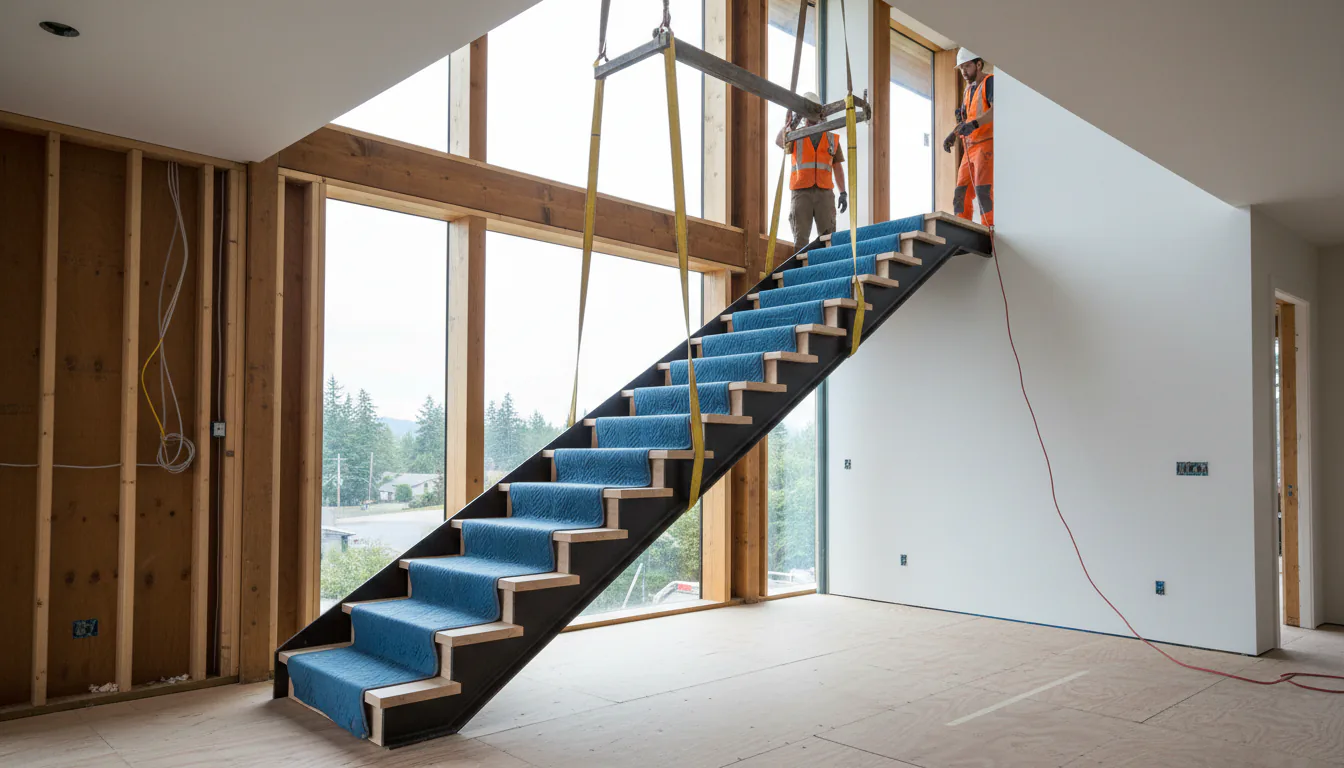
The install is the shortest phase. A typical residential stair installs in one to three days, depending on the complexity. The railing install often happens the day after the structural install. The handover walk and punch list close the project.
For broader context on install day, see our piece on the metal stair installation day Vancouver piece and the stair handover punch list Vancouver piece.
Where the schedule actually gets stuck
Across the projects we run, the schedule gets stuck most often at these specific points:
- Design decisions not being made. The architect or the homeowner cannot commit to a finish, a tread material, or a structural premise. The project sits waiting for a decision.
- Engineering review queue. The engineer is busy with other projects and the stair review takes longer than expected.
- Permit review delays. The AHJ has questions that require revisions, and the revision cycle adds weeks.
- Site coordination issues. The opening on site is not the dimension the shop drawings showed, and the framing has to be modified before install.
- Trade coordination. The stair install depends on the radiant floor being complete, the floor finish being installed at the right elevation, or some other trade being on schedule.
Each of these is preventable with up-front planning. We flag the risk points at the project kickoff and check them at each milestone.
What the homeowner can do to keep the schedule
The homeowner has more influence on the schedule than they realize. The actions that help:
- Make decisions promptly. The schedule pauses every day a decision is pending.
- Engage the architect and engineer early. Their availability is the rate-limiting factor on the first half of the project.
- Approve drawings without delay. A drawing that sits with the architect for two weeks loses two weeks on the back end.
- Coordinate with the GC. The stair install depends on site conditions, and the GC’s coordination affects whether install day goes smoothly.
- Trust the process. The four-to-six month timeline is realistic. Pushing for a compressed schedule usually adds risk without meaningfully reducing the timeline.
The 2026 specific market
The Vancouver custom stair market in 2026 is operating with a few specific dynamics. The permit review timelines at the major AHJs have stabilized after the volatility of recent years. Engineering capacity is constrained in some specialty areas. Shop capacity at the qualified fabricator level is reasonably available but the lead time has extended slightly compared to a few years ago.
The practical implication for homeowners starting a project in mid-2026 is that the four-to-six month timeline is a reasonable expectation. Larger or more complex projects should plan for six to twelve months.
Sources
- City of Vancouver, Building Permits
- District of North Vancouver, Building Inspections
- Engineers and Geoscientists BC, practice resources
Related reading: the custom staircase timeline Vancouver piece, the metal stair installation day Vancouver piece, and the steel stair shop drawings Vancouver piece.
Related questions
What's a realistic timeline for a custom steel stair in Vancouver?
Four to six months from first design conversation to install on a typical residential project. Larger or more complex projects take longer. The fabrication itself is four to eight weeks within that overall timeline; the rest is design, engineering, permit, and coordination.
Why does the permit take so long?
The local AHJ reviews the submission against the current code, structural requirements, and any applicable architectural overlays (heritage, character area, environmental). The review queue depends on the AHJ's current volume. The City of Vancouver and surrounding municipalities have published timelines that vary with project complexity and submission volume.
Can the schedule be compressed?
Sometimes, in specific areas. The fabrication schedule can sometimes be expedited if the shop has capacity. The permit schedule generally cannot be compressed beyond the AHJ's published timelines. The design and engineering schedules can be shortened if the homeowner is decisive and the architect and engineer are available, but cannot be compressed beyond a realistic minimum.