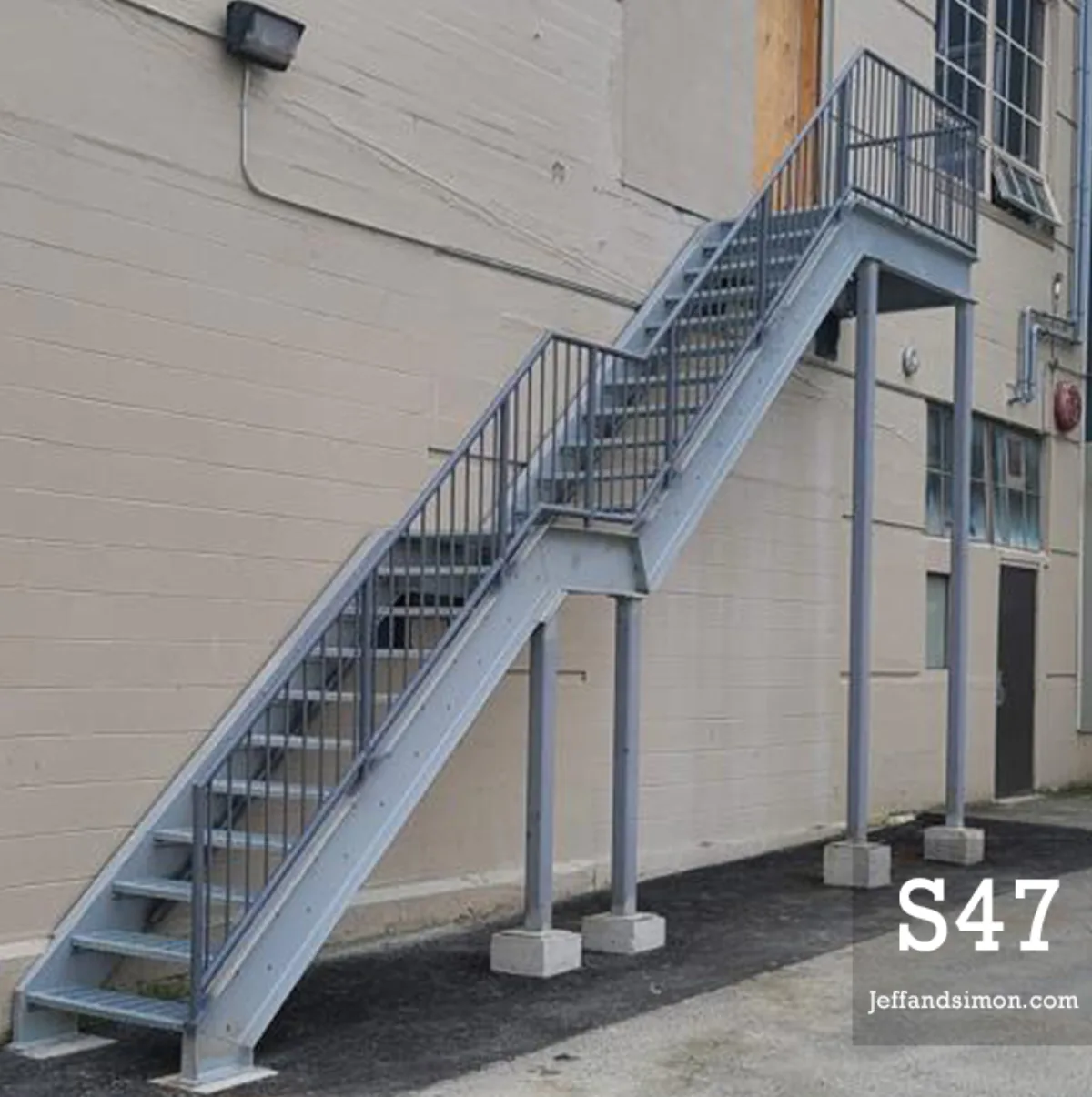
Industrial and mezzanine stairs serve warehouses, production floors, equipment platforms, and back-of-house access in commercial buildings. They live under different rules than a public-egress stair. Geometry, guards, treads, and finish are all driven by occupancy, the workers using the stair, and the equipment around it. The detail decisions are made before fabrication starts.
Industrial stairs are not public-egress stairs
An industrial access stair that serves only workers can be steeper and narrower than an egress stair in the same building. The British Columbia Building Code and the WorkSafeBC Occupational Health and Safety Regulation both recognize industrial-access categories that allow steeper run and narrower width when the stair is not part of the required means of egress. The category has to be declared on the drawings and signed off by the architect or engineer of record, not assumed by the fabricator.
- Confirm whether the stair is an egress stair or an industrial-access stair under the project's code package.
- Declare the category on the architectural and structural drawings before fabrication.
- Industrial-access geometry is steeper and narrower; egress geometry follows BCBC Part 3 or VBBL.
- WorkSafeBC OHSR Part 4 covers workplace stairs that serve work areas, including guard and handrail requirements.
Mezzanine stairs ride on the mezzanine structure
A mezzanine stair lands on a structural platform built by another trade. The connection, bolted to a mezzanine beam, anchored to a column, or seated on a poured pedestal, has to be coordinated with the mezzanine designer before the stair is drawn. Mezzanines that are added to an existing building also need engineer sign-off on the floor below for the new combined loads, which can change the stair's footprint on the slab.
Grating, checker plate, and perforated treads
Industrial stair treads almost always drain. Galvanized bar grating is the default for exterior platforms, parkades, and washdown areas. Checker-plate pan treads work indoors where dust and slip resistance matter more than drainage. Perforated steel treads sit between the two and look cleaner in semi-public industrial settings, equipment showrooms, food-grade clean areas, breweries with a public tasting floor.
- Bar grating drains, dries, and resists ice buildup outdoors.
- Checker-plate pan treads stay clean indoors and accept anti-slip coatings.
- Perforated treads balance drainage with a tighter visual pattern.
- Nosings need contrast (yellow paint or tactile inserts) where workplace safety rules require it.
Guards, handrails, and toe boards
Workplace stairs and mezzanine edges carry guard, handrail, and toe-board requirements that go beyond what a residential interior stair would need. WorkSafeBC's OHSR sets minimums for guard height and infill at work areas, and the BC Building Code adds requirements where the stair serves a public path. Pipe-rail guards with steel mesh or steel picket infill are common on industrial stairs because they meet the rules and tolerate impact from carts, lifts, and equipment.
Finish that survives the work environment
Industrial stair finishes match the environment. Hot-dip galvanizing is the default for exterior, parkade, washdown, and corrosive environments. Galvanized-plus-powder-coat is used where the building owner wants a colour. Bare steel with industrial primer and topcoat is used indoors in dry environments. Stainless components show up in food, pharma, and clean-room work where the finish has to be cleanable and corrosion-resistant.
Coordination with equipment, sprinklers, and racking
Industrial stairs share the room with racking, conveyors, sprinkler mains, ductwork, and electrical conduit. Confirm clearances around the stair, the headroom under any landing or floor opening above, and the swing of any door at the top or bottom of the stair before the stair is fabricated. Sprinkler heads near the landing have to be coordinated with the sprinkler designer so the stair does not block coverage.
Documentation for WorkSafeBC and the AHJ
Sealed structural drawings, the engineer's connection schedule, mill certs for structural steel, and weld documentation where the project requires it are part of an industrial stair package. WorkSafeBC inspectors and the building's AHJ both can ask to see this documentation during an inspection. Build the closeout package as the stair is fabricated and installed, not after the fact.
Related questions
How steep can an industrial-access stair be?
Steeper than a public-egress stair, with the steepness governed by the code path declared on the drawings. BCBC and the referenced industrial-stair standards allow a steeper run and narrower width for stairs that serve work areas only. Confirm the specific geometry with the architect or engineer of record before fabrication, the steepness is not a fabricator decision.
What is the difference between an industrial stair and a mezzanine stair?
An industrial stair is a category defined by use, access to a work area rather than public egress. A mezzanine stair is defined by what it connects, a mezzanine platform within a building. The two often overlap. A mezzanine stair that serves only workers can be drawn as an industrial-access stair; a mezzanine stair that serves a public area is held to public-egress rules.
Do industrial stairs need a sealed engineering drawing?
Most do. The structural connection to the mezzanine, slab, or building frame typically needs an engineer's seal. The stair itself often falls under the project's engineer of record. Where a fabricator-supplied industrial stair drops into a building without a project engineer, the stair is usually engineered separately and sealed by a BC-licensed structural engineer.
Can industrial stairs be installed inside an operating warehouse?
Yes, with planning. Most installs happen during a planned shutdown, an overnight window, or in a phased section of the warehouse. Forklift and pedestrian routes around the install zone, sprinkler isolation if required, and coordination with the warehouse manager are all part of the install plan. Pre-assembled sub-modules shorten the install window.
Continue planning
- Commercial stairs hub overview
- Commercial egress stairs (single page)
- Commercial stair services
- Commercial staircase design (Trends)
Plan industrial and mezzanine stairs for a real Vancouver project
Send drawings, photos, or a rough scope and we will help define the practical next step.