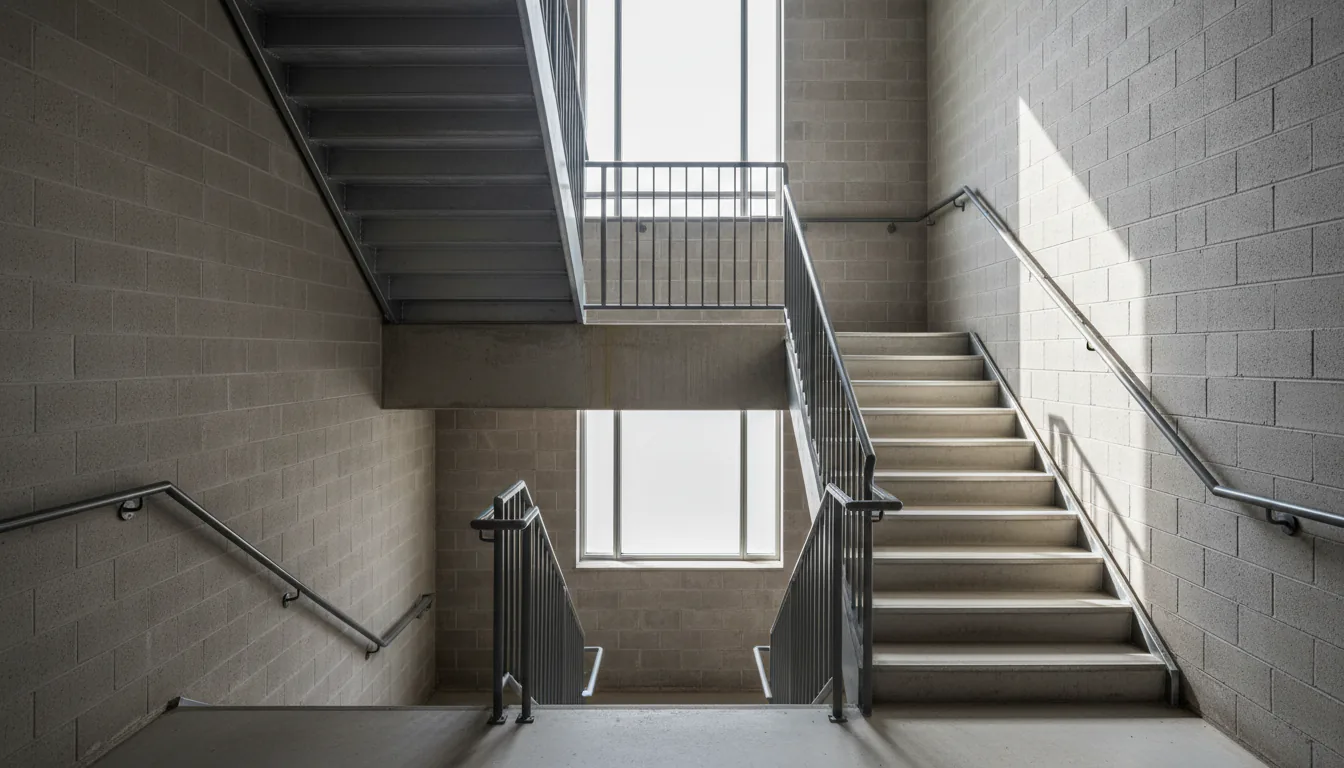
A monumental stair in a commercial lobby, atrium, or amenity floor is a hybrid scope, it is structural steel with the engineering rigour of a commercial assembly, and it is finish-grade architectural metal that has to meet the design intent. The package usually lives in parallel with the building's required egress stairs but is sequenced very differently. This page covers the decisions that shape the feature-stair scope on a Metro Vancouver commercial project.
Feature stair vs egress stair
A required egress stair in a commercial building is governed by the BC Building Code and the Vancouver Building By-Law where applicable ([BC Building Code Part 3](https://free.bcpublications.ca/civix/document/id/public/bcbc2024/bcbc_2024dbp2s3), [VBBL](https://vancouver.ca/your-government/vancouver-building-bylaw.aspx)), width, headroom, guard, fire-separation, and discharge requirements are non-negotiable. A monumental feature stair connecting two floors of an open lobby or atrium is often not a required egress stair, which gives the design team more latitude on geometry, open risers, guard system, and finish. The first decision on a feature-stair scope is always confirming whether it is a required exit or a non-required architectural stair.
- Required egress: code provisions dictate width, run, guard, fire separation, discharge.
- Non-required architectural stair: design intent dominates, code still applies to guards and slip.
- Mixed-use floors may force the architectural stair to also serve egress, confirm with the code consultant.
Structural strategy
Monumental stairs span large openings, often two storeys with no intermediate landing, and frequently have a curved or switchback geometry. Common structural strategies are an exposed pair of plate stringers (architectural twin-stringer), an exposed mono stringer for shorter runs, or a hidden steel truss inside a finished stringer enclosure for very long or curved runs. The decision is engineering-led; the architect proposes the visual, and the engineer confirms whether the strategy can carry the span and the live load.
Treads, finish, and detail-level fabrication
Tread material on a monumental stair is usually solid hardwood, stone, terrazzo, or steel, and each has a different dead-load implication for the stringer engineering. Slip resistance has to meet commercial occupancy requirements; on stone or terrazzo this is a nosing detail, on steel it is a finish step. Welds and finishes on a monumental stair are inspected at a higher standard than a typical commercial stair, the work is visible, often at eye level, and inspected in raking light from the lobby.
- Solid hardwood: warm-modern visual, finish supplier coordinated separately from steel.
- Stone or terrazzo: heaviest dead load, longest schedule, anchored to a steel sub-tread.
- Solid steel: tightest weld and grind tolerance, blackened or powder-coat finish.
Guards and railings
Commercial monumental stairs almost always use a structural glass guard or a glass-with-cap-rail system. The glass is engineered as the guard against the BC Building Code commercial guard loads. Cable railings are used less often on commercial monumental stairs because the open-cable visual can read residential. Steel picket and rod work is used where the design brief calls for an architectural metal aesthetic. The handrail return at top and bottom is a code-compliance detail that has to be drawn before fabrication.
Schedule and coordination
A monumental stair on a commercial project usually shows up in the schedule as its own package with its own sealed shop drawings, structural review, fire-separation review (if it penetrates a fire-rated assembly), and finish-coordination meetings. The stair install is sequenced after structural steel is topped out and before interior fit-out begins around the stair. In our shop we treat the monumental stair as a stand-alone delivery package, not part of the general fabrication scope.
Related questions
Does a monumental lobby stair count as a required exit in a commercial building?
Sometimes, it depends on the floor area being served, the number of required exits, and the building's egress strategy. In many lobby and atrium designs the monumental stair is supplementary to the building's required egress stairs and is treated as an architectural element. The code consultant confirms the classification at the start of the project, and that classification changes the scope substantially.
Can a monumental commercial stair use open risers?
If the stair is not a required exit, open risers are easier to justify. If the stair is a required exit, the BC Building Code provisions on open risers in commercial occupancies are stricter and the answer is often no. Confirm with the AHJ and the code consultant before drawing open risers on any commercial stair.
How is a monumental stair installed in a finished lobby?
Most monumental stairs are sequenced into the building before finishes go down, after structural steel, before drywall and stone finishes. Late installation into a finished lobby is possible but means craning the stair through a large opening, protecting finishes through the install, and accepting a longer site coordination window. We discuss the install sequence at the shop-drawing stage.
What documentation does a monumental stair package include?
Sealed engineered shop drawings, structural calculations against the BC Building Code loads, finish schedules, weld procedure documentation under CSA W47.1, and installation drawings showing the connections to the surrounding structure. On larger projects the package also includes a finish-coordination drawing showing how the stair meets the floor, the wall, and any millwork at the top and bottom landings.
Continue planning
- Commercial stairs hub overview
- Commercial egress stairs (single page)
- Commercial stair services
- Commercial staircase design (Trends)
Plan monumental & feature stairs for a real Vancouver project
Send drawings, photos, or a rough scope and we will help define the practical next step.