Square vs Round Tube Railings: Which to Choose
Square vs round tube railing on Vancouver stairs: structural performance, graspability, visual reading, and how the choice shapes the full railing detail.
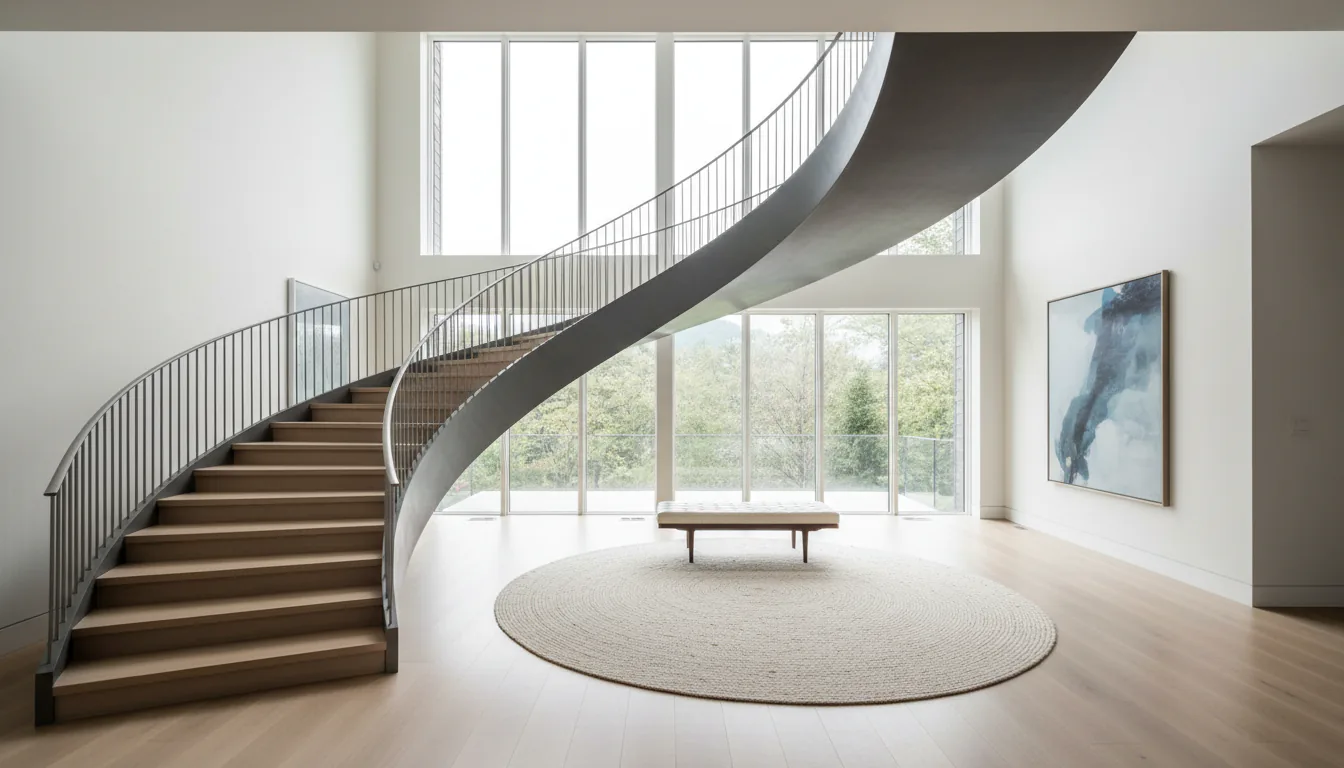
Square reads architectural, round reads traditional, and both have their place. The choice shapes every other railing decision.
The square vs round tube railing question is one of the smaller decisions on a stair project and one of the most visually consequential. The decision affects how the railing reads from across the room, how comfortable the handrail is in service, how the finish system behaves at the corners, and how the railing coordinates with the rest of the home’s architectural vocabulary. It is also a decision that homeowners often default into without thinking through, which is why we walk through it on most projects.
This post compares the two profiles on the specific dimensions that matter, structure, graspability, finish, and visual reading, and offers a working framework for choosing between them.
The structural performance
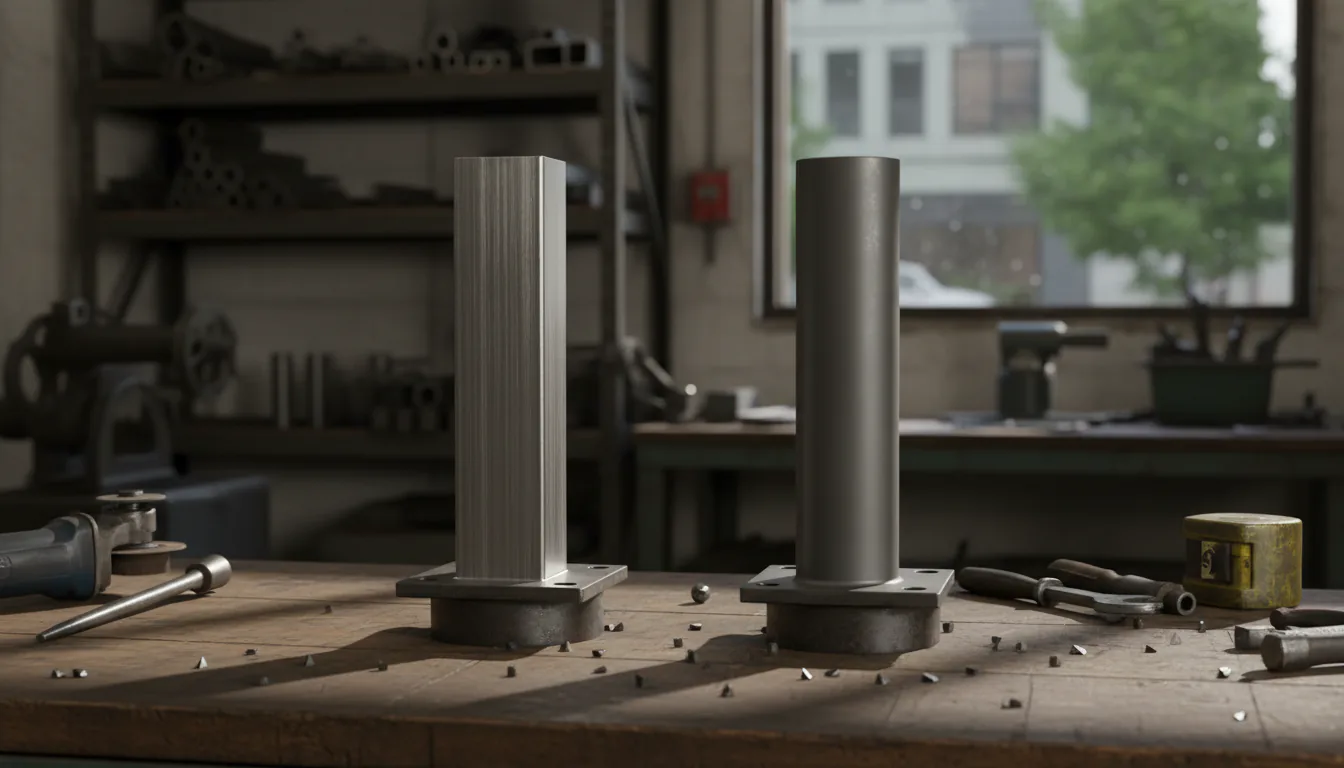
For a tube section, the bending strength is determined by the moment of inertia of the cross-section, which depends on the wall thickness and the outer dimension. At equivalent wall thickness and outer dimension, round and square tube have similar moment of inertia and produce similar bending strength.
The structural steel design references in CSA S16 address both hollow structural section (HSS) families. The published section properties allow direct comparison of moment of inertia, area, and section modulus.
In practice, the structural choice is rarely the deciding factor on residential railings. Both profiles are structurally adequate for the typical lateral load applied at the top of a residential rail. Specific high-load applications (commercial railings in higher-occupancy spaces, exterior railings under wind load) may favour one profile over the other based on the specific load case, but most residential applications are not load-driven decisions.
This article is not a substitute for code review by the authority having jurisdiction, an architect, or an engineer.
The graspability difference
BC Building Code Section 9.8 sets graspability requirements for handrails. Round handrails are governed by a diameter range; non-circular handrails are governed by perimeter and shape provisions.
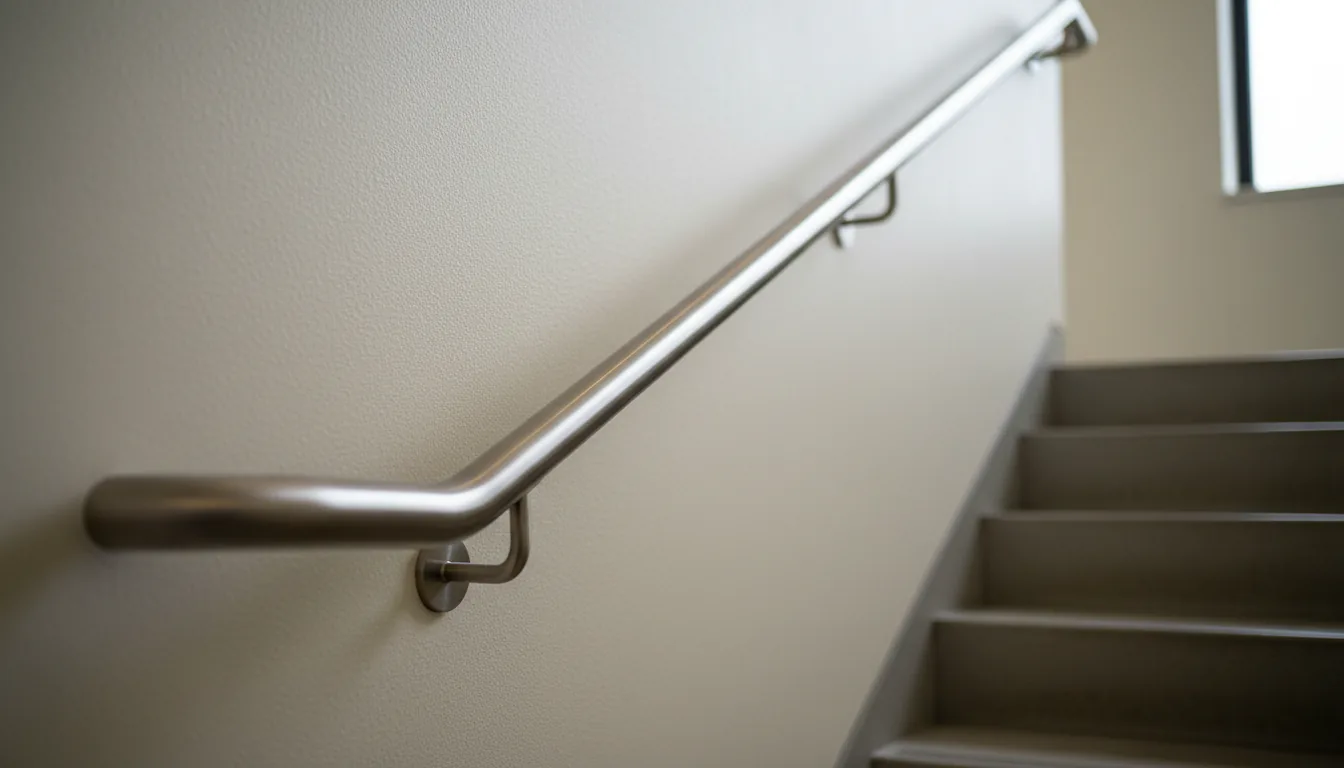
A round 38 mm diameter handrail is the published graspable default. The hand closes around the profile naturally and the inspector’s test (the hand-around-the-rail test) passes without question.
A square handrail at the same outer dimension passes the perimeter test in most cases (the perimeter of a 38 mm square is meaningfully larger than the perimeter of a 38 mm round), but the sharp corners reduce the effective grip during a fall. The user’s hand does not close around the corners as comfortably as around a smooth profile. Some AHJs treat this as an acceptable graspable rail; some flag it and request modification.
The practical fix is to bevel or radius the corners on square top rails. A 2 to 4 mm radius on each corner improves the graspability without significantly affecting the visual reading from a normal viewing distance. We default to a small radius on every square top rail because it eliminates the AHJ concern and improves the user experience.
For broader context on the handrail provisions, see our piece on the handrail continuity under BC code piece.
The finish behaviour
Powder coat and wet paint finishes behave differently on the two profiles.
On a round tube, the finish lays continuously around the circular surface without any corners. The coating thickness is uniform, the finish reads smooth from any angle, and the visual result is consistent. Powder coat in particular benefits from the round profile because the electrostatic spray pattern wraps the round surface evenly.
On a square tube, the finish lays on the flat faces and has to navigate the four corners. The coating tends to be slightly thinner at the corners than on the flat faces. On powder coat, the difference is usually invisible to the eye but measurable with a coating thickness gauge. On wet paint, the difference can be visible at the corner edges if the application is not carefully controlled.
The fix on square tube is a careful application with attention to the corner coverage. The coater applies extra material at the corners or uses an application technique that ensures even coverage. The result is a finish that performs equivalently to the round tube but requires more attention at fabrication.
The visual reading
The visual reading is where the two profiles genuinely differ.
Round tube reads more traditional, more universal, and more residential in vocabulary. The smooth profile has a visual lineage that runs back through every traditional residential railing vocabulary, wrought iron picket railings with round bar, brass or chrome modern handrails, contemporary stainless tube. The reading is timeless rather than tied to a specific era.
Square tube reads more architectural, more contemporary, and more industrial. The crisp corners create a precise visual line that suits modern and contemporary projects. The reading is more clearly of a specific era, typically post-2000 contemporary, and works less well in vocabularies that predate that era.
The choice should follow the architectural vocabulary of the rest of the home. A square tube railing in a heritage character home reads wrong. A round tube railing in a strictly contemporary modern loft reads conservative.
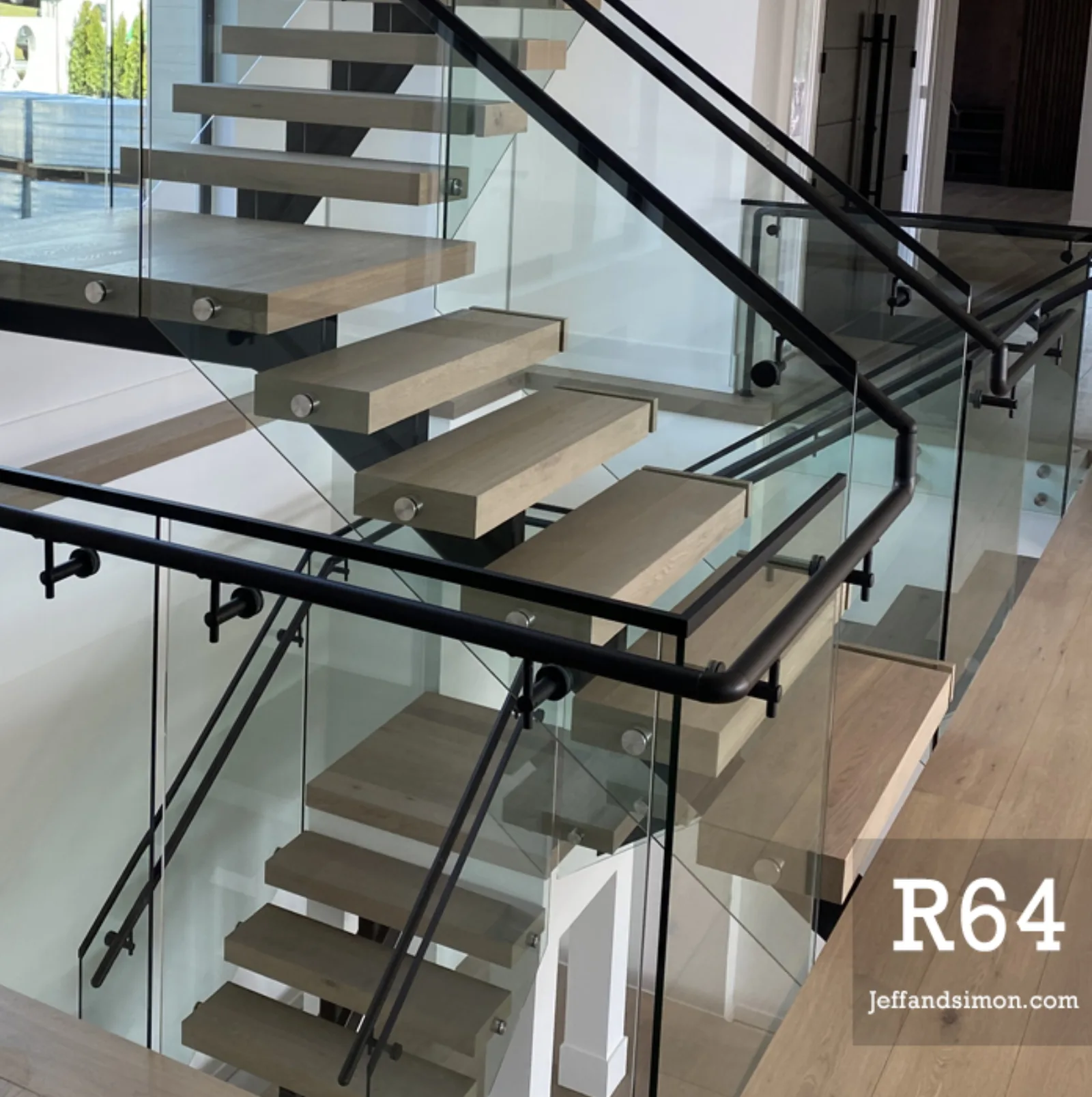
The intermediate option, mixing the two profiles (square pickets with a round top rail), works on transitional projects where the architectural vocabulary mixes contemporary and traditional elements. The combination is common and the connection detail between the two profiles can be handled cleanly with appropriate fabrication.
Picket vs top rail, different decisions
The square vs round choice can be made independently for the picket and the top rail. The common combinations:
- Square pickets, square top rail. The fully contemporary architectural reading. Best on modern homes.
- Round pickets, round top rail. The fully traditional reading. Best on heritage or transitional homes.
- Square pickets, round top rail. Mixed reading combining architectural pickets with graspable handrail. Common on transitional projects.
- Round pickets, square top rail. Less common but appears on some projects. The round pickets read soft against an architectural top rail.
The picket choice mostly affects the visual reading. The top rail choice affects both the visual reading and the graspability. The two decisions are usually made together at the design stage.
For broader context on picket selection, see our piece on the stair railing baluster spacing BC code piece and the picket railing vs cable railing cost Vancouver piece.
Hardware coordination
The hardware (brackets, end caps, fittings) for the railing has to coordinate with the tube profile. Round tube brackets and fittings are widely available in stock from multiple suppliers. Square tube brackets and fittings are less standardized and often require custom fabrication or selection from a more limited range.
The practical implication is that round tube railings are slightly easier to fabricate from stock components, while square tube railings often require more custom fabrication of the hardware. The cost difference is small but measurable.
For coastal projects where the hardware grade matters, both profiles can be specified in grade 316 stainless, but the round profile has a wider selection of stock 316 hardware available.
The cleaning and maintenance difference
In service, round tube is slightly easier to clean than square tube. The smooth surface has no corners where dust collects, and a single wipe with a cloth covers the entire surface. Square tube has corner edges where dust accumulates and requires a more careful cleaning pass.
On commercial railings in high-traffic environments, this maintenance difference matters. On residential railings cleaned infrequently, the difference is rarely noticed.
When the architectural intent decides
When the architect’s design clearly favours one profile over the other, the choice is straightforward. A modern minimalist project with square tube structural elements throughout the home should have square tube railings. A heritage restoration project should have round bar or round tube railings to match the period vocabulary.
When the architectural intent is ambiguous, we recommend round tube as the safer default because of the graspability advantage and the broader stylistic compatibility. A round tube railing rarely reads wrong in any context, while a square tube railing reads wrong in the wrong context.
Sources
- BC Building Code Section 9.8, Stairs, Ramps, Landings, Handrails and Guards
- CSA S16, Design of Steel Structures (HSS section properties)
Related reading: the handrail continuity under BC code piece, the stair railing baluster spacing BC code piece, and the stainless steel railing 304 vs 316 piece.
Related questions
Is one profile stronger than the other?
At equivalent wall thickness and outer dimension, both square and round tube provide similar bending strength. The choice is rarely structural. Specific high-load applications may favour one over the other, but on a typical residential railing the structural performance is comparable.
Does the corner on a square tube affect graspability?
Yes, in a way that the AHJ may flag. A square tube passes the perimeter test in most cases but the sharp corners reduce the effective grip during a fall. We bevel or radius the corners on square top rails to improve graspability and reduce the inspector's concern. The radius is small and does not affect the visual reading from a normal viewing distance.
Can I mix square pickets with a round top rail?
Yes, and it is a common combination on transitional projects. Square pickets with a round top rail combine the architectural reading of the square infill with the traditional graspability of the round rail. The connection detail between the pickets and the top rail has to be carefully designed because the two profiles do not naturally meet at a clean joint.