Stair Guards and Small Children: What the Code Covers and What It Does Not
The 100 mm sphere rule, climbability, and the practical gaps parents find on stair guards in Vancouver homes, plus what can be changed after the fact.
A guard can meet every provision in the code and still be the thing a determined three-year-old climbs. Those are two different tests.
This article is fabrication context, not engineering or permit advice. Code interpretation belongs with the authority having jurisdiction (AHJ) and the project’s licensed professionals. Confirm applicability with the local building department before finalizing design or permit submissions.
A guard can satisfy every provision that applies to it and still be the thing a determined three-year-old climbs. Compliance and child-proofing overlap, and they are not the same test.
The sphere rule is the provision that does most of the work
Sentence 9.8.8.5.(1) requires openings through guards to be of a size that prevents the passage of a spherical object having a diameter of 100 mm.
That single sentence is what sets picket spacing on every residential guard, and it is a genuinely useful child-safety provision because it is sized around a small body. It also applies more broadly than people assume. The space beneath a bottom rail is an opening through the guard. So is the triangular gap where an angled guard meets the treads on an open stair. So is a gap at a post or where a guard returns to a wall.
The everyday test is exactly what the wording suggests. A rigid object 100 mm across, tried at every gap in the assembly rather than only between the pickets in the middle of a run, finds the places where a guard is weakest. The detail is covered in baluster spacing under BC code.
The climbability rule is narrower than people expect
This is where the code and parental instinct diverge most sharply, and it is worth being precise about it.
Sentence 9.8.8.6.(1) states that except for guards in industrial occupancies, guards required by Article 9.8.8.1 that protect a level located more than 4.2 m above the adjacent level shall be designed so that no member, attachment or opening located between 140 mm and 900 mm above the level protected by the guard facilitates climbing.
Read the trigger carefully. The level being protected has to sit more than 4.2 m above the level below. Inside a typical house, an upper floor guard is frequently below that threshold, which means the climbability provision does not apply to it on its terms.
The practical consequence is that a horizontal rail or cable guard on an interior stair or landing can be entirely code-compliant and also perfectly climbable by a small child. That is not a loophole being exploited. It is the code addressing a fall-from-height hazard rather than a general child-safety objective. The full scope is set out in guard climbability under BC code.
So the useful question for a household with young children is not whether the guard passes. It is whether a compliant guard is what you want in your house.
Where children actually get through compliant guards
In our shop, the same three locations come up repeatedly, and none of them is the middle of a picket run.
The gap under the bottom rail is first. Guards are sometimes held up off the floor for cleaning, or a bottom rail sits on a base that leaves a gap at one end where the floor is uneven. That gap is an opening in the guard and it is at exactly the height a crawling child uses.
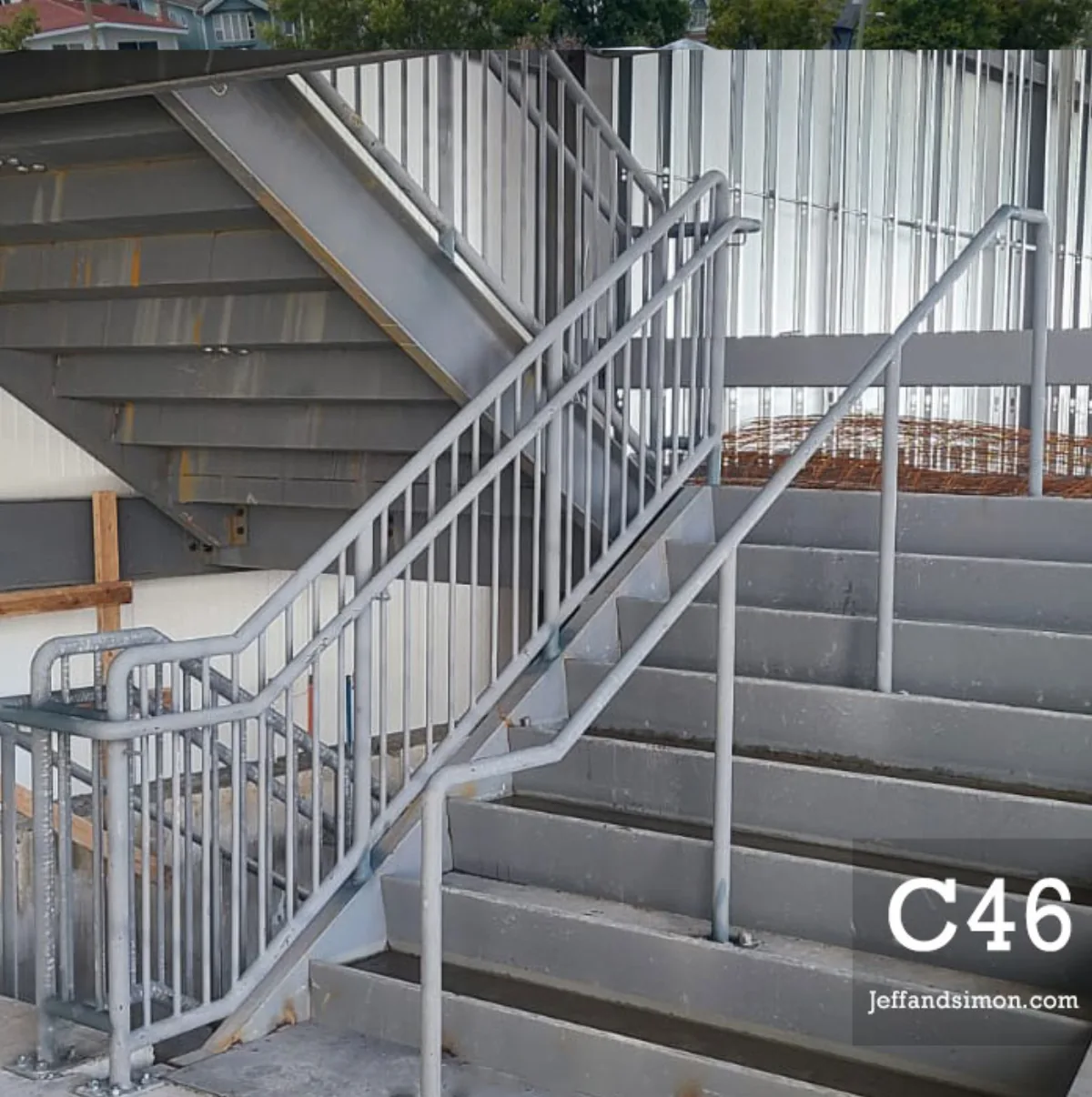
The triangle at the treads is second. On an open stair where the guard follows the pitch, the space between the underside of the angled bottom rail, the tread, and the riser line forms a triangle that grows toward the outside edge. It is easy to overlook because it is not between two pickets.
The junction at the top of the flight is third. Where a raked stair guard meets a level landing guard, the geometry changes, picket spacing that divided evenly along the flight does not divide evenly along the landing, and the corner where they meet often ends up with a wider gap than anywhere else. It is also, unhelpfully, at the top of the stair.
Vertical infill is the practical answer
Given that the climbability provision may not apply, the decision becomes one about design rather than compliance.
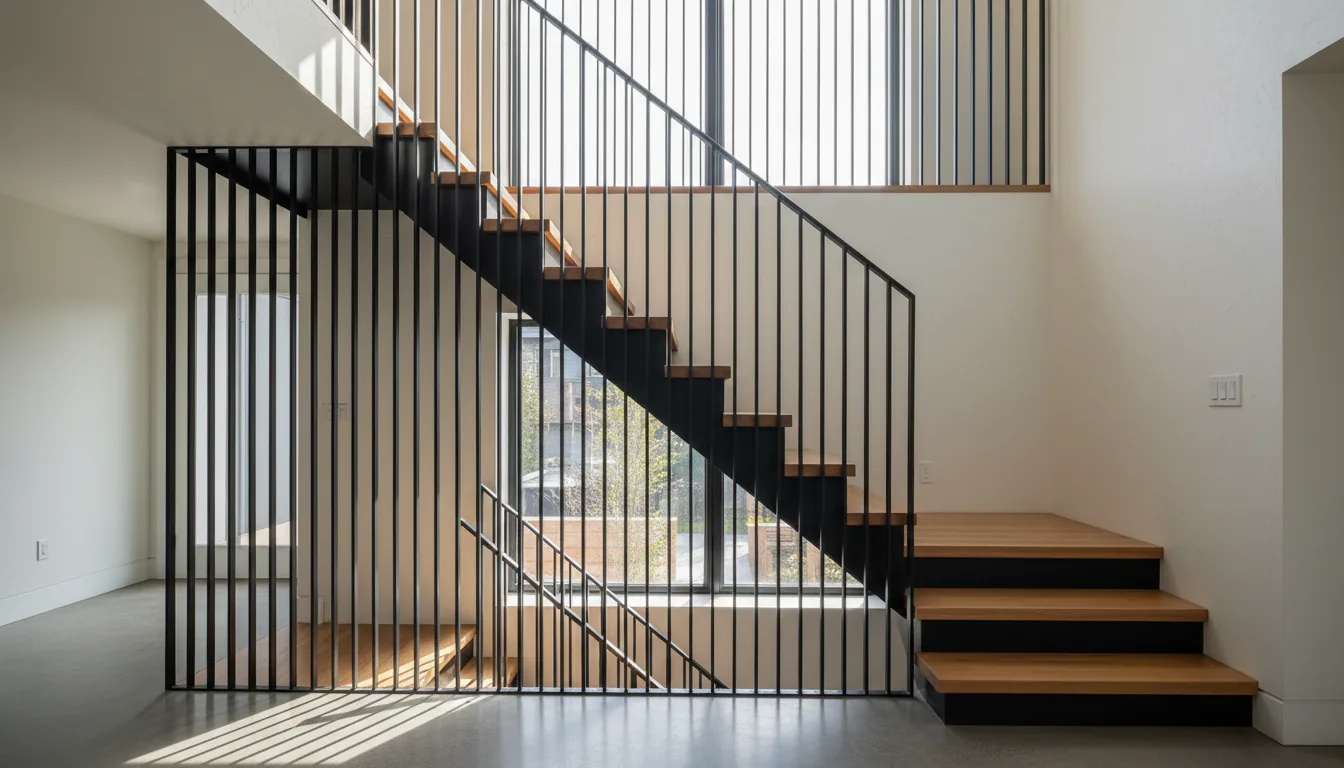
Closely spaced vertical pickets give a small child nothing to stand on and nothing to get through. They are usually the least expensive infill, they are simple to fabricate, and they suit most house styles. Full glass panels do the same job while letting an adult see a child on the stair, which is a real advantage, at higher cost and with more maintenance.
Horizontal rails and cable systems are the ones to think hard about. They look excellent, they are legitimate on many interior guards, and they present a ladder to a toddler. If the design intent is horizontal and there are small children in the house, that tension is worth naming out loud at design stage rather than discovering after installation. The comparison of infill types is in stair guard infill options.
Build the gate mounting in, rather than clamping to a finished guard
Almost every household with a toddler ends up wanting a gate at the top of the stair, and almost none of them mention it before the guard is fabricated.
A gate mounted with hardware into a purpose-made point on a steel post is tidy, solid, and removable later without damage. Adding that mounting point during fabrication costs very little. Adding it afterwards means drilling and refinishing a coated guard, and the touch-up rarely disappears completely.
The alternative that most people reach for is a pressure-mounted gate, which relies on friction between two opposing surfaces. Those work reasonably well in a doorway with solid jambs. They are less reliable bearing against a slim steel post, and at the top of a stair the consequence of a gate moving is worse than anywhere else in the house. Where a gate is likely, hardware mounting is the arrangement worth planning for.
Retrofits are possible and rarely invisible
Guards can be modified after the fact, and it is worth knowing what that involves before relying on it.
Intermediate pickets can be added to widen-spaced guards. A panel of mesh, perforated sheet, or acrylic can be fitted behind an existing guard as a temporary measure while children are small, then removed. A bottom rail gap can be closed. All of these are practical.
What is difficult is matching the finish. A powder-coated guard cured in an oven cannot be matched exactly by touch-up on site, and welding onto a finished guard damages the coating locally. Retrofits therefore tend to look like retrofits, which is fine for a temporary measure and less satisfying as a permanent one. Deciding the spacing at fabrication is considerably cheaper than changing it later.
Open risers are a separate question
Parents frequently raise the gap between treads on an open-riser stair, and it is governed by its own provision rather than by the guard rules.
Where it is a concern, a removable infill fitted between treads while children are small, and taken out afterwards, is a reasonable approach that preserves the design intent for the long run. The applicable requirements are covered in open riser stairs under BC code, and they should be confirmed with the AHJ for the specific building.
What sits next to the guard matters as much as the guard
A guard is only as unclimbable as the things beside it, and this is where a compliant design gets defeated by furniture.
A console table against a landing guard, a toy box, a plant stand, a radiator cover, or a window seat all provide a step up. From the top of any of them, a guard that was well out of reach becomes something a child can get over. The guard has not changed; the effective floor level has.
Built-in elements deserve particular attention because they are permanent. A window seat running up to a guard, a stair with storage drawers built into the side, or a shelf detailed into a landing all create a raised surface adjacent to a fall hazard. Those are worth identifying at design stage, when the guard height relative to the raised surface can be checked rather than assumed.
The same applies to the stair itself. On an open stair, the treads are climbable by definition, and a guard running alongside them is measured from the tread nosings rather than from the floor. A child standing on a tread is already elevated relative to the surface the guard protects further along.
None of this is a reason for alarm about ordinary houses. It is a reason to walk the finished space looking at it from about a metre off the ground, and to notice what could be stood on. That takes a few minutes and it finds things a drawing review does not.
Say it at design stage
The single most useful thing a client with young children can do is mention it before anything is drawn.
It changes the recommended infill, the bottom rail detail, whether gate mounting points are built into the posts, how the junction at the top of the flight is set out, and whether a removable infill is worth designing in from the start. Every one of those is inexpensive at design stage and awkward once a guard is coated and installed.
The code sets a floor for guard safety, not a recommendation for a house with a toddler in it. Take the 100 mm object round the finished guard yourself, look at the three places gaps hide, and decide separately whether a compliant guard is the guard you want.
Related questions
What is the 100 mm sphere rule?
BC Building Code 9.8.8.5.(1) requires openings through guards to be of a size that prevents the passage of a spherical object having a diameter of 100 mm. It is the provision that sets how closely pickets or balusters have to be spaced, and it applies to the gap under the bottom rail as well.
Does the code require guards to be unclimbable?
Only in specific circumstances. Sentence 9.8.8.6.(1) restricts members that facilitate climbing between 140 mm and 900 mm above the protected level, but it applies to required guards protecting a level more than 4.2 m above the level below, and it excepts industrial occupancies. Many interior house guards fall outside that trigger.
So horizontal railings in a house are allowed?
Often yes, as a matter of code, because the drop from an interior guard is frequently 4.2 m or less. Whether that is the right choice with a toddler in the house is a separate judgment. The code sets a floor, not a recommendation for your particular family.
What is the safest guard infill for young children?
Closely spaced vertical pickets and full glass panels both avoid giving a foot anything to stand on. Vertical pickets are usually the less expensive option and are simple to detail. Glass adds the benefit of visibility, so an adult can see a child on the stair.
Where do children actually get through a compliant guard?
Usually at the gap beneath the bottom rail, at the open triangle where an angled guard meets the treads on an open-riser stair, and at the junction between a stair guard and a landing guard where the geometry changes. Those are the places worth checking with a 100 mm object in hand.
Are open risers a problem with small children?
The gap between treads on an open-riser stair is governed by its own provision rather than by the guard rule, and it is a common parental concern. Where it matters, a temporary infill can be fitted and later removed. Confirm the applicable requirement with the authority having jurisdiction.
Can I add a gate to an existing steel guard?
Usually yes. A gate can be mounted to a steel post or to the wall, and a fabricator can add a proper mounting point to an existing guard. In our shop this is a common small job, and it is far tidier than a pressure-mounted gate clamped to a finished guard.
Will a pressure-mounted gate work on a steel guard?
It depends on what it can bear against. Pressure gates need two solid opposing surfaces, and a slim steel post is not always adequate. At the top of a stair in particular, a hardware-mounted gate is the safer arrangement than one held by friction.
Can picket spacing be tightened on an existing guard?
It can, by adding intermediate pickets or fitting a panel, though matching the original finish exactly is difficult once a guard is installed and coated. Where children are anticipated, specifying the tighter spacing at fabrication is much cleaner than retrofitting it.
Does the handrail height affect child safety?
The required handrail is set at a height for adults, so it is above where a small child can reach. Some families add a second lower rail for children. That is an addition rather than a substitution, since the required rail still has to be present at its required height.
Does a guard that meets code protect against falls entirely?
No, and it is not intended to. The provisions address specific hazards: passage through openings, and in some cases climbability. Supervision, gates, and how a household uses the stair do the rest. Treat compliance as the starting point rather than the conclusion.
What should I tell a fabricator if we have young children?
Say it explicitly at design stage. It changes the recommended infill, the bottom rail detail, whether gate mounting points get built in, and how the junction at the top of the stair is detailed. All of those are inexpensive during fabrication and awkward afterwards.