Stopping Squeaks and Rattles on a Steel Stair
Why steel stairs squeak or rattle, how welded and bolted construction change the risk, and the isolation and thread-locking details a shop uses to stop it before install.
A steel stair should be silent. When it squeaks, the cause is almost always a loose bolt or bare metal rubbing on metal, and both are cheaper to prevent in the shop than to chase after install.
This guide covers routine noise diagnosis. Any finding that suggests structural movement, weld failure, or load-bearing component damage should be assessed by a qualified professional, do not attempt structural repairs without a CWB-certified welder.
A steel stair should be silent to walk on. When it squeaks, the noise almost never comes from the steel itself. It comes from a bolt that has worked loose or from two bare metal surfaces rubbing together under load, and both of those are decided in the shop long before anyone steps on the stair.
This post explains where stair squeaks and rattles actually start, how welded and bolted construction change the risk, and the two details a fabricator uses to keep a stair quiet: thread-locking at the fasteners and isolation at the contact faces. The theme is simple. Quiet is designed in early, not chased later.
A squeak is friction, a rattle is a loose part
A squeak and a rattle are different problems with different causes, and telling them apart is the first step. A squeak is a friction sound. Two surfaces are pressed together, they flex a small amount under load, and they grind against each other. On a stair, that is usually a tread bracket, a stringer connection, or a wood tread rubbing on the steel it sits on.
A rattle is a loose part with room to move and knock. A guard picket that was never fully welded, a bracket bolt that never got its final turn, or a cover plate left half-fastened will all rattle when the stair moves. The part is not grinding. It is knocking against something nearby.
The reason the difference matters is that the fixes are different. A squeak points to isolation and thread-locking at a tight joint that still has a little movement. A rattle points to a specific fastener that needs to be found and tightened. Chasing a squeak by tightening random bolts, or chasing a rattle with a rubber pad, wastes time on the wrong cure.
The tread joint is where most stair noise starts
On most steel stairs, the treads carry the load and take the most flex, so the tread connection is where noise usually begins. Every step puts a small downward force on the tread, the tread deflects a tiny amount, and that movement transfers into the bracket or stringer connection. Repeat that a few thousand times and any weakness in the joint starts to show up as sound.
Two things go wrong at that joint over time. The first is that a bolt loses tension. A fastener under repeated small shocks slowly backs off, and once it is loose the tread can rock, so the faces of the joint grind. The second is bare metal contact. If the tread sits directly on a steel bracket with no separating layer, the two steel faces rub every time the tread flexes, and steel on steel is a loud, high-pitched squeak.
This is why the tread joint gets the most attention in the shop. It is the joint that moves the most, so it is the joint most likely to loosen or grind. Our overview of steel stair connection details covers how these joints are drawn and sized, which is the same drawing stage where the noise prevention gets built in.
Welded joints are quiet, bolted joints need detailing
How a stair is put together changes how much noise prevention it needs. A fully welded joint has no fastener to loosen and no two separate faces to rub, because the steel is fused into one piece. A welded tread-to-stringer connection, done well, is about as quiet as steel gets. That is one reason a shop-welded stair often arrives silent.
A bolted stair is different. Bolted construction carries more mechanical joints, and each bolted joint is a place a squeak can start if it is not detailed for it. That is not a reason to avoid bolts. Bolted connections are often the right call for a stair that has to be shipped in pieces, carried up a tight stairwell, or assembled on site where a welder cannot easily work. The tradeoff between the two is covered in our comparison of welded and bolted stair stringer connections.
The point is that a bolted stair needs the noise details and a welded stair needs fewer of them. When a fabricator chooses bolted construction for good site reasons, the thread-locking and isolation at every bolted joint is what keeps that choice from turning into a squeak later. The decision to bolt and the decision to keep it quiet are made together, on the same drawing.
Thread-locking keeps the fastener from backing off
The fix for a loosening bolt is a threadlocker, a liquid adhesive put on the thread that cures inside the joint and holds the fastener in place. On a stair, a medium-strength product is the right choice. According to the Loctite Threadlocker Blue 242 technical data sheet, a medium-strength threadlocker prevents the loosening of metal fasteners caused by shock and vibration, seals the threads against corrosion, and can still be removed later with hand tools.
That last part matters on a stair. A tread sometimes has to come off, for a refinish, a repair, or a change, so the fastener cannot be locked so hard it has to be cut out. A medium-strength product holds against the small daily shocks of footsteps but still releases with a normal wrench when someone needs it to. The same datasheet notes the product is sized for fasteners from 6 mm to 19 mm, which covers the bolt sizes a residential steel stair typically uses.
Thread-locking is applied at assembly, not after install. Once the tread is bolted down and the joint is buried behind a finished surface, reaching the fastener to treat it is far harder. Doing it in the shop, on the bench, is a few extra seconds per bolt. The same discipline shows up later in routine metal stair and railing maintenance, where checking that fasteners are still tight is part of keeping a stair quiet over years of use.
Isolation pads stop steel from grinding on steel
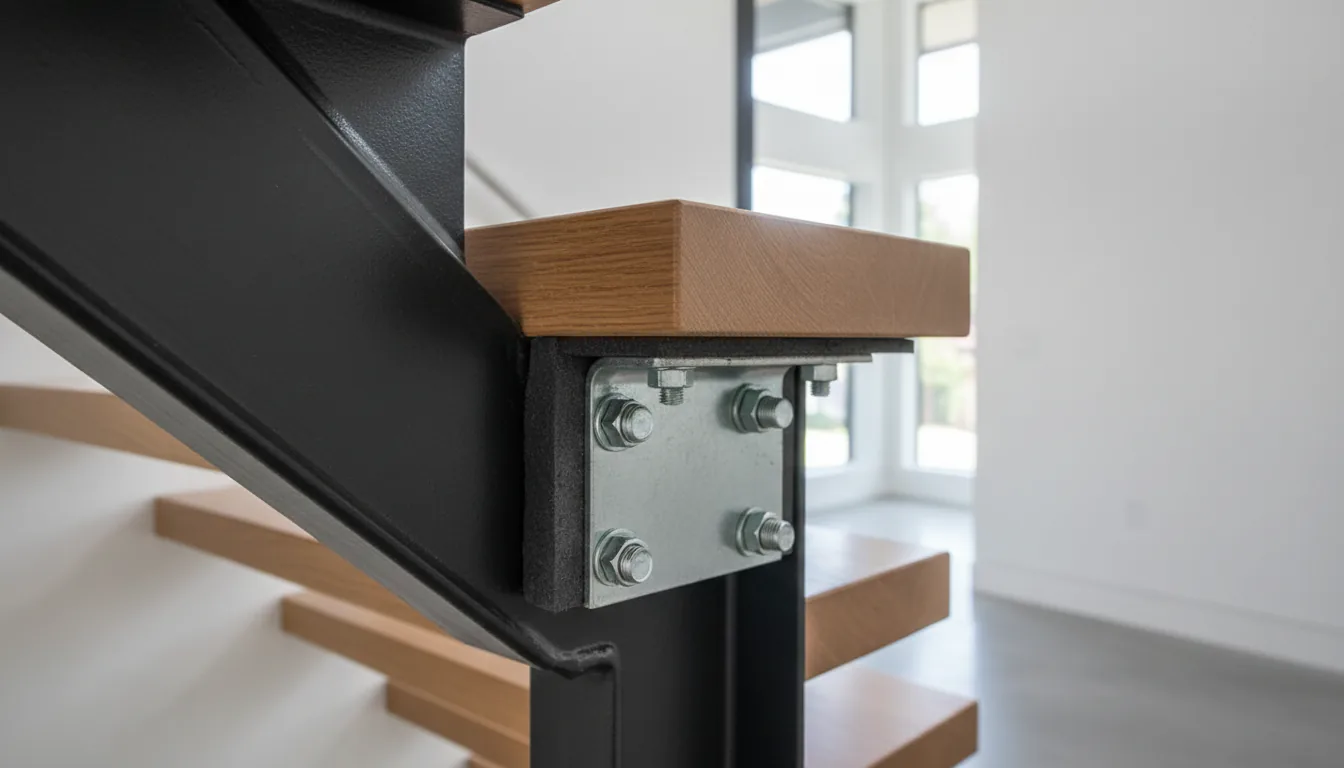
The fix for bare metal contact is isolation: a thin layer of resilient material placed between two steel faces so they never touch directly. Neoprene and EPDM rubber are common choices because they hold up under compression and resist water and oils. On a stair, an isolation pad sits between the tread and its bracket, or between a wood tread and the steel plate it bolts onto.
The pad does two useful things. It keeps steel from touching steel, so when the tread flexes the joint moves against a soft, quiet layer instead of a hard, grinding one. It also takes up small differences in how the two parts meet, so the load spreads across the face rather than concentrating on one high spot. A joint that would have squeaked with metal on metal stays silent with a resilient layer in between.
Wood treads on steel are a specific case worth naming. Wood moves as humidity changes through the year, so a wood tread bolted hard onto steel with no give will loosen and rub as the wood shrinks and swells. A resilient layer between the wood and the steel absorbs that seasonal movement and keeps the contact face quiet. In Vancouver’s damp climate, that seasonal wood movement is real, and it is one reason the wood-to-steel joint gets an isolation layer as a default rather than an option.
Quiet is a shop decision, not a site repair
The through-line in all of this is timing. Every one of these fixes, thread-locking the fasteners and isolating the contact faces, is easiest and cheapest to do on the bench in the shop, before the stair is assembled and installed. Once the treads are down and the finished floor and walls are around the stair, the same joint is hard to reach, and the fix turns into a repair.
A shop that builds for quiet resolves it at the drawing and assembly stage. Bolted tread and bracket joints get medium-strength threadlocker. Contact faces that would be steel on steel get a neoprene or EPDM layer. Fasteners are torqued to a consistent value rather than by feel, so no joint is left under-tightened. Where the assembly can be walked and loaded in the shop, it is, so a squeak shows up on the bench instead of in the client’s home.
If you are speccing a steel stair, the useful question to ask a fabricator is direct: how do you keep it from squeaking? A specific answer, thread-locking on the connections and isolation at the contact faces, tells you the detail is planned. On an open stair with exposed treads, where there is little structure to hide a rattle, that planning matters even more. Our look at impact noise and stair acoustics in multifamily buildings covers the related question of sound traveling through a structure, which is a separate problem from the squeak at a single joint but shares the same lesson: it is solved in the design, not after move-in.
Sources
A steel stair that squeaks is not a stair that was built wrong in some deep way. It is almost always one loose fastener or one bare contact face, and both are small details that were skipped at the bench. The stairs that stay silent for years are the ones where the fabricator decided, on the drawing, how each bolted joint would stay tight and how each contact face would be kept apart. Ask that question before the steel is ordered, and the answer usually tells you how the whole stair will be built.
Related questions
Why does a new steel staircase squeak?
A new steel stair usually squeaks for one of two reasons: a bolted joint has worked slightly loose, or two bare steel surfaces are rubbing under load. Both happen because the tread flexes a little every time someone steps on it, and that tiny repeated movement either backs off a bolt or grinds metal on metal. A stair built without thread-locking and isolation at the tread joints is the one most likely to make noise.
Is a squeaking steel stair a structural problem?
Not usually, but it is worth checking. Most squeaks come from a loose fastener or bare metal contact, which is a noise problem, not a strength problem. If a tread also feels loose, rocks underfoot, or the noise came with visible movement, that points to a connection that needs attention and possibly review. When in doubt, have the fabricator or an engineer look at the joint rather than guessing.
Do welded steel stairs squeak less than bolted ones?
Generally yes, because a fully welded joint has no fastener to loosen and no separate faces to rub. A bolted stair carries more mechanical joints, and each one is a place a squeak can start if it is not thread-locked and isolated. Bolted construction has real advantages for shipping and site access, so the answer is not to avoid bolts. It is to detail every bolted joint so it stays tight and quiet.
What is thread-locking and does it stop stair squeaks?
Thread-locking is a liquid adhesive applied to the bolt thread that cures in the joint and keeps the fastener from backing off under vibration. A medium-strength product prevents loosening from shock and vibration and still comes apart with hand tools later. On a stair, it keeps tread and bracket bolts from working loose over thousands of footsteps, which is a common source of squeaks that appear months after install.
What are isolation pads on a steel stair?
Isolation pads are thin pieces of resilient material, often neoprene or EPDM rubber, placed between two steel parts so they do not touch directly. On a stair they sit between the tread and its bracket, or between a wood tread and the steel it bolts to. The pad lets the joint move a little without steel grinding on steel, which is what stops the squeak. It also spreads the clamping load slightly and takes up small tolerances.
Can you fix a squeaky steel stair after it is installed?
Often yes, but it is more work than preventing it. The fix depends on the cause. A loose bolt can be re-tightened and thread-locked, if it can be reached. A metal-on-metal contact point may need the tread pulled so an isolation pad or shim can be added. Some joints are easy to reach after install and some are buried behind finished treads, which is why building it quiet the first time is cheaper than chasing it later.
Why does a stair start squeaking months after it was installed?
A delayed squeak usually means a fastener worked loose over time. When a tread flexes slightly under every step, an untreated bolt loses a small amount of tension each time, and after enough cycles it backs off enough for the joint to move and grind. This is exactly what medium-strength threadlocker is designed to prevent. A stair that was quiet at handover and noisy later almost always has a loosening fastener behind it.
Does wood on a steel stair cause the squeak, or the steel?
Either can, and the joint between them is a common culprit. Wood treads bolted directly to steel can rub at the contact face, and wood also moves seasonally as humidity changes, which loosens a joint that had no give in it. A thin resilient layer between the wood and the steel absorbs that movement and keeps the two materials from grinding. The steel structure itself rarely makes noise on its own.
Do floating or mono stringer stairs squeak more?
They can be more noticeable because there is less structure to dampen sound and the treads are often more exposed. An open-riser stair with cantilevered or single-beam treads has each tread doing more work, so a loose or unisolated tread joint is easier to hear. The prevention is the same as any steel stair: thread-lock the connections and isolate the contact faces. On these stairs the detailing just matters more because there is nowhere for a rattle to hide.
How does a fabrication shop stop a stair from squeaking before it ships?
The shop resolves it at the drawing and assembly stage. Bolted tread and bracket connections get medium-strength threadlocker so they hold under vibration. Contact faces that would otherwise be steel on steel get a neoprene or EPDM isolation layer. Fasteners are torqued consistently rather than by feel, and the assembly is walked and loaded before it leaves the shop where possible. Quiet is designed in, not added at the end.
Is a rattle different from a squeak on a steel stair?
Yes. A squeak is a friction sound from two surfaces rubbing, usually a tight joint that has just enough movement to grind. A rattle is a loose part with room to move and knock, like a guard picket, a loose bracket, or a cover plate that was never fully fastened. A squeak points to isolation and thread-locking; a rattle points to a fastener that needs to be found and tightened. Both are fixable, and both are easier to prevent in the shop.
Will powder coating or paint stop a squeak?
No. A powder coat or paint finish protects the steel and looks good, but it is a thin, hard film that does not isolate a moving joint. Two coated steel faces pressed together and flexing will still rub and can still squeak once the coating wears at the contact point. The noise fix is a resilient isolation layer and a thread-locked fastener, not the finish. Finish and noise control are separate decisions.
Should I ask my fabricator how they prevent stair noise?
Yes, and a good shop will have a specific answer. Ask how bolted tread and bracket joints are kept from loosening and how metal-on-metal contact is handled. Answers like thread-locking on the connections and isolation pads at the contact faces show the shop has thought about it. A vague answer, or surprise at the question, is a sign the detail may get skipped, and that is the stair most likely to develop a squeak later.