Staircases in West Vancouver: British Properties, Chartwell, and the View Home Market
What West Vancouver homeowners need to know about custom stair design and fabrication, hillside sites, view corridors, architect-led projects, and the permit reality in one of BC's most complex residential markets.
West Vancouver's residential staircase market is shaped by hillside access, premium specification expectations, and properties where the view corridor dictates every design decision. Here is what that means for a fabricator.
West Vancouver is a distinct residential market. It is not just “expensive North Shore”, it is a specific combination of steep hillside lots, Burrard Inlet views, architect-driven design expectations, and a property stock that ranges from mid-century ranch houses in Ambleside to contemporary glass-and-concrete estates in the British Properties and Chartwell. That combination shapes stair projects in ways that differ from every other municipality in Metro Vancouver.
The two questions we hear most often from West Vancouver homeowners and their designers: what kind of stair keeps the view open, and how do we get a custom steel stair onto a property where the driveway is at a 20 percent grade?
Both have answers. They just require planning earlier than most projects demand.
The view corridor shapes every design decision
Most residential stairs in Metro Vancouver are specified around interior layout, code compliance, and budget. In West Vancouver, particularly in the British Properties, Chartwell, and on Marine Drive waterfront properties, the stair specification starts with the view.
The view corridor in a British Properties home on a south-facing lot looks across Burrard Inlet toward Downtown Vancouver, the Lions Gate Bridge, and UBC Point Grey. On a clear day it is one of the most recognisable urban views in Canada. The interior design of these homes is frequently built around preserving and framing that view from as many points as possible, the kitchen island, the living room sofa, the master bedroom.
A stair that sits between a living space and a view window is either transparent or opaque to that view. This is not an aesthetic preference, it is a functional constraint that drives specification:
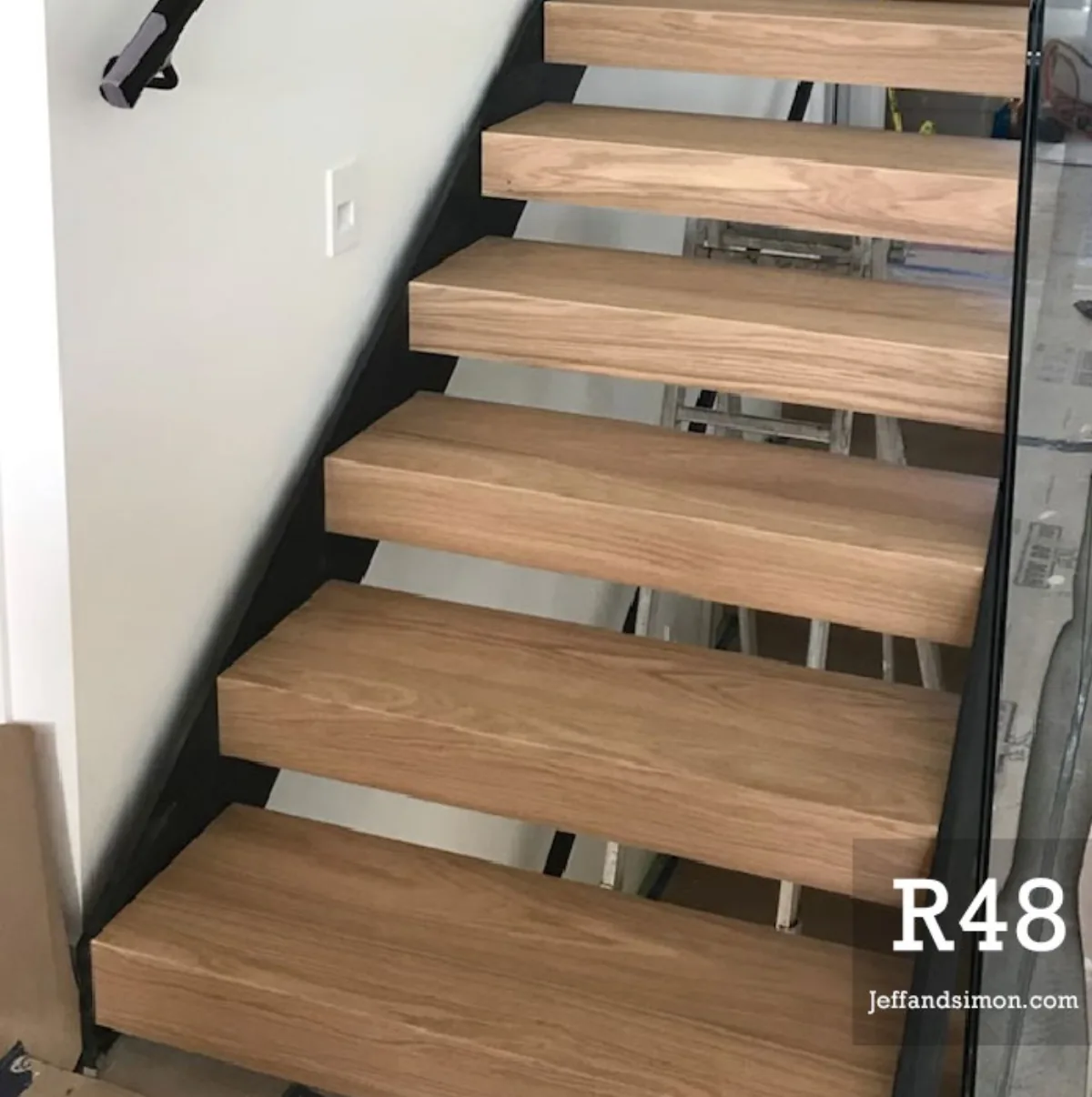
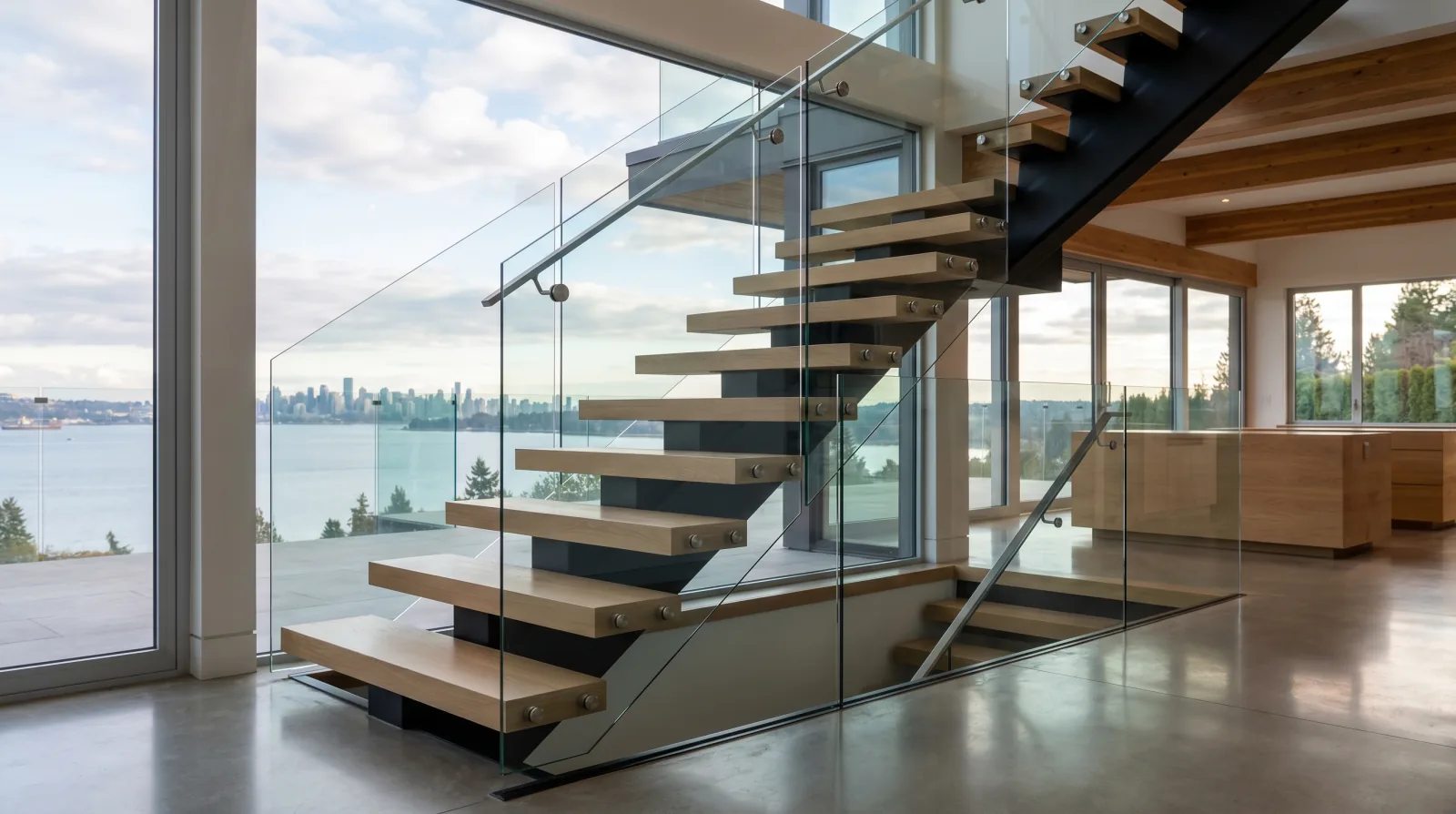
- Mono stringer with frameless glass guard: the single central spine supports the treads; the frameless glass panels on the guard let the view pass through without interruption. From the living level, a person’s sightline crosses the stair and arrives at the window. This is the most common choice in view-sensitive West Vancouver interiors.
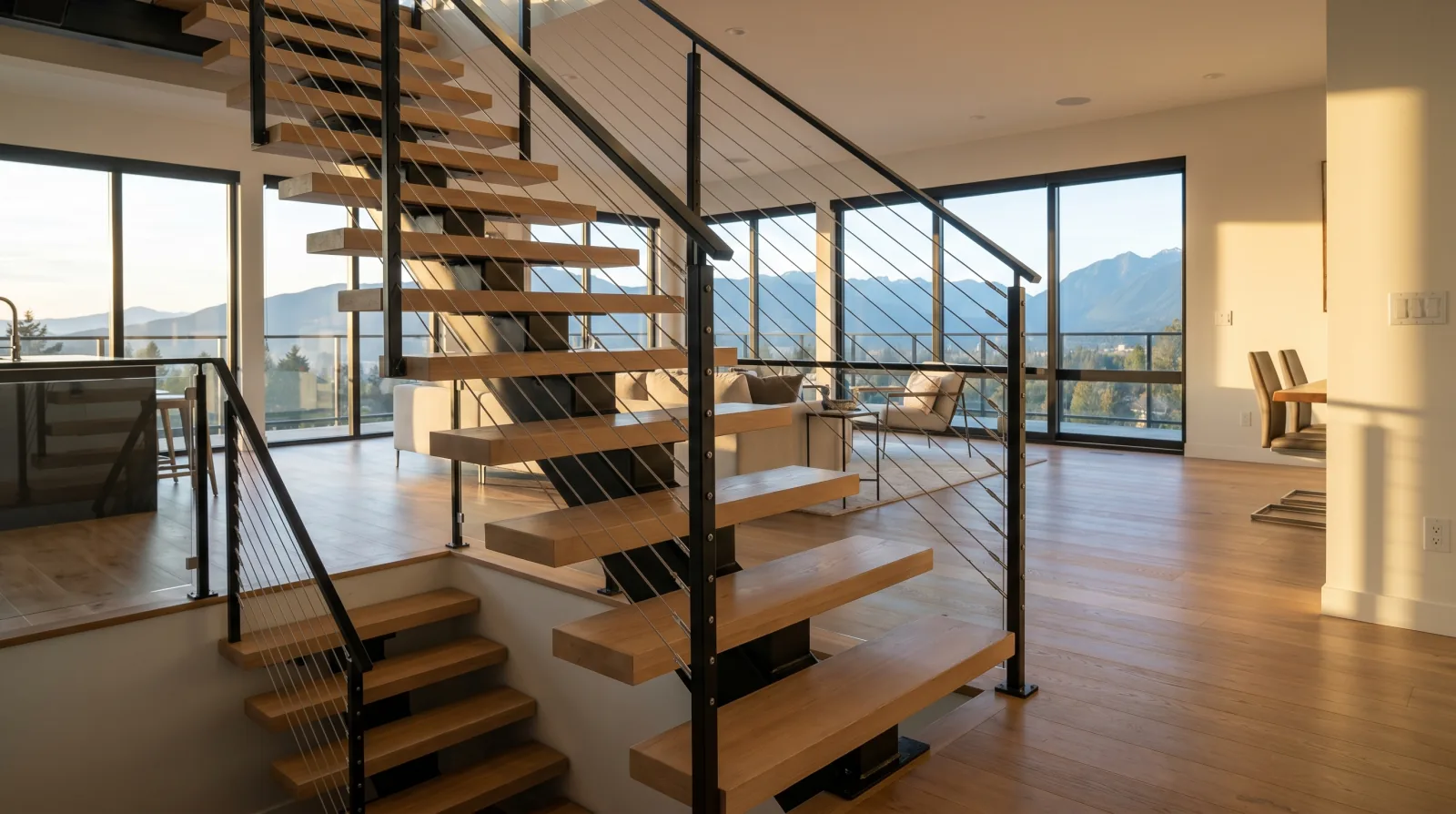
- Cable railing with open risers: horizontal stainless cable allows views through but creates a horizontal pattern that reads more strongly than glass. Some architects prefer it for the industrial honesty; others find it too present against a water view. It is a design call.
- Solid guard panels or pickets: these block the view, which is rarely acceptable in a property where the view is the primary value driver. Solid guards are used in lower-level applications or on exterior stairs where they do not sit in the view axis.
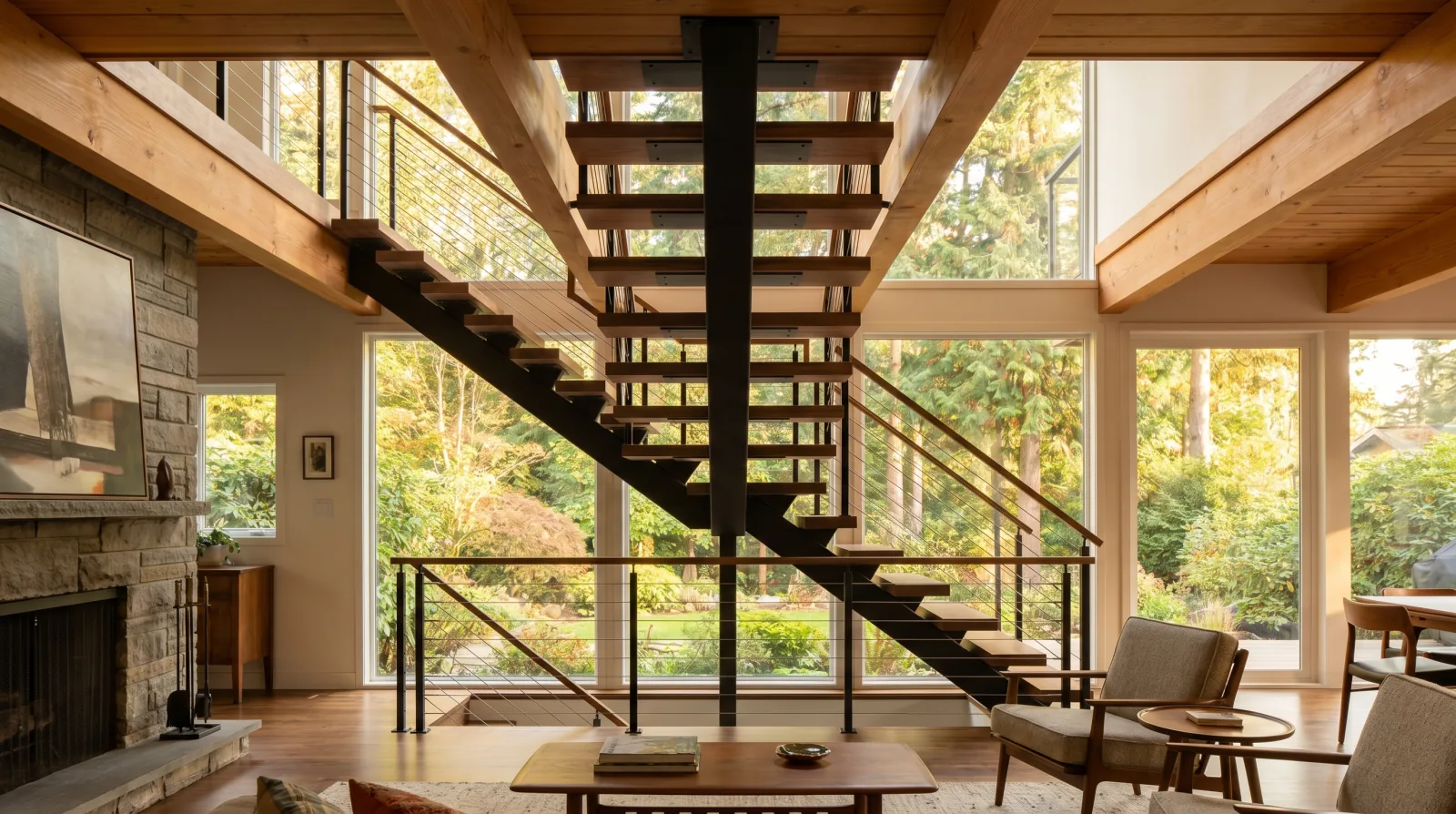
The choice between mono stringer and floating stair on a view property often depends on floor structure. A floating or cantilevered stair, where treads attach to a wall rather than a central spine, requires walls capable of carrying the load. West Coast Modern homes in the upper British Properties and Chartwell often have large open spans with few interior walls, which makes the mono stringer the more structurally straightforward choice. The cantilevered approach is absolutely achievable in the right structure; it requires earlier engineering review.
British Properties and Chartwell: the residential context
The British Properties is a residential estate area in the municipality of West Vancouver occupying the mountainside south of Cypress Provincial Park. Development began in the 1930s when the British Pacific Properties company cleared and subdivided the land after completing the Lions Gate Bridge. The housing stock is a mix of the original estate homes from the 1940s and 1950s, generous lots, traditional forms, often with significant renovation history, and newer construction from the 1980s through the 2010s that responded to the south-facing views with larger glazing and open floor plans.
Chartwell, north of the British Properties above the Upper Levels Highway, is where some of West Vancouver’s most substantial residential properties sit. Lots run larger, the elevation is higher (views extend further east and west along the inlet), and the architecture tends toward contemporary, glass, concrete, steel, and natural stone in combinations that require fabricators comfortable working with architects who have strong design intent.
For staircase fabrication, the British Properties and Chartwell differ in one practical way: elevation and access. A property at 1,000 feet in Chartwell has longer site travel from the valley floor and, in winter, more ice and snow to manage during delivery and installation. Scheduling should build in weather flexibility for upper-elevation sites that lower properties do not need.
Ambleside and Dundarave: the older residential stock
Ambleside, the established residential area between Marine Drive and the waterfront, has a different character from the Properties. The housing stock here includes Craftsman and colonial revival houses from the 1920s and 1930s, post-war bungalows, and a significant number of character homes that have been renovated multiple times over their lives. The lots are smaller and the streets are flat or gently sloped, which removes the access challenge that the upper municipality presents.
Staircase replacement in Ambleside character homes follows a pattern similar to other established Metro Vancouver neighbourhoods: the original stair is steep, narrow by modern code standards, and enclosed between walls that may be structural. The replacement conversation typically involves:
- Headroom: older homes in Ambleside often have floor-to-floor heights of 2,700–2,900mm, and the original steep stair (200mm risers, tight run) was built for that envelope. A modern code-compliant stair with a gentler pitch needs more horizontal run, which means the opening may need to extend.
- Wall structure: Ambleside character homes have plaster-on-lath or early drywall interiors with framing from an era before platform framing was standardised. Finding structural blocking or posts to attach a mono stringer requires a thorough site measure before shop drawings commit to an attachment point.
- Heritage character: Ambleside and Dundarave have concentrations of character homes, not all heritage-designated, but many with architectural features the owners want to preserve. A custom metal stair can be specified to complement rather than contrast with a 1930s character home; it is a question of profile, finish, and railing detail.
Horseshoe Bay: the marine exposure context
Horseshoe Bay, at the western edge of West Vancouver where the BC Ferry terminal operates, has waterfront and near-waterfront properties with direct Howe Sound exposure. This is the most aggressive marine corrosion environment in the municipality, Howe Sound funnels northwest winds, and salt-laden air moves further inland here than anywhere else in West Vancouver.
For stairs and railings on Horseshoe Bay properties, and for any property within 200 metres of the water on the Dundarave and Ambleside waterfront, material specification should treat marine exposure as a baseline assumption:
- Structural steel: standard mild steel powder coated in interior applications. For exterior stairs and any railing within marine-air reach, hot-dip galvanizing as the base coat under paint or powder coat significantly extends service life. See the hot-dip galvanizing guide for the specification rationale.
- Hardware and fasteners: 316 stainless steel, not 304, for anything exposed. The molybdenum content in 316 is what resists chloride pitting, the corrosion mechanism that causes 304 hardware to pit within a few seasons on an exposed waterfront site.
- Cable railing on exterior stairs or decks: stainless cable and stainless swage fittings are the only system that performs without accelerated corrosion. Standard zinc fittings corrode quickly in marine salt environments.
The distinction between the upper British Properties (where marine exposure is minimal and standard powder coat holds well for decades) and the lower Ambleside waterfront (where 316 hardware is not optional) is real and worth making clear at the specification stage.
Working with architects and designers
West Vancouver residential projects more commonly involve architects and interior designers than projects in most other Metro Vancouver municipalities. The stair fabricator is often not the first call, they are brought in after the architect has established the design intent and the structural engineer has reviewed the floor and wall system.
This sequence works, but it works better when the fabricator is engaged early enough to influence three things:
Panel and component sizing. Glass panels and structural steel sections have practical size limits for site access, crane or manual carry, and installation. A design that specifies a continuous glass panel running 3,000mm uninterrupted may be structurally correct but logistically impossible on a Chartwell site where no vehicle can reach the upper deck. The fabricator’s input on practical sizing prevents rework at the drawing stage.
Connection point coordination. Mono stringers connect to the floor structure at the base and either to the floor structure or a wall at the upper landing. Floating treads connect to walls. Both require confirmed structural capacity before shop drawings are issued. The fabricator’s drawing shows the connection; the engineer of record confirms the structure can carry it. This conversation needs to happen before fabrication begins, not during installation.
Finish consistency across trades. West Vancouver interiors frequently have multiple metal elements: window hardware, door hardware, light fixture trim, plumbing fixtures, stair rail. When the design intent calls for a consistent metal finish, brushed stainless, matte black, oil-rubbed bronze, the stair fabricator needs to match or complement what the other trades are supplying. Agreeing on the finish family early prevents the stair showing up in a slightly different black than the door hardware.
The District of West Vancouver permit process
The District of West Vancouver operates its own building department with requirements that match or exceed provincial BC Building Code minimums. For stair replacement and modification work, the practical permit implications are:
- Structural changes, modifying the stair opening, altering the loadpath, changing the guard system, require a permit. There is no “like-for-like” exemption for structural stair work in West Vancouver that removes the permit requirement.
- Engineer of record involvement is common on hillside sites and properties with complex connection conditions. The building official may request engineer-stamped drawings for stair connections in situations where the same project in Burnaby or Vancouver might not require them.
- Permit timelines. West Vancouver’s building department is smaller than Vancouver’s or Burnaby’s. Review times can run longer. For projects with tight schedules, a new construction project targeting a move-in date, or a renovation with a contractor timeline, permit lead time should be built into the schedule early. Ask the building department for current review times at the pre-application stage.
The municipality’s requirements for guard height, handrail graspability, riser and tread dimensions, and headroom follow BC Building Code. There are no material preferences embedded in the code, steel, wood, concrete, and glass are all acceptable when properly specified and installed to code.
What a West Vancouver stair project typically looks like
Most West Vancouver staircase projects follow a consistent arc regardless of neighbourhood:
Design stage. The architect or interior designer establishes the stair type and guard concept. The fabricator is contacted to confirm structural feasibility and to flag any site access or sizing constraints. Shop drawings are issued and reviewed by the designer and engineer.
Fabrication. The stair structure is built in the shop, typically three to six weeks for a standard residential mono stringer, longer for complex configurations or projects with tight drawing review cycles. Glass panels are templated on site after the structure is installed, not fabricated from the drawing, this is standard practice to account for site tolerance.
Installation. The structural stair goes in first. On sites with difficult access, the installation sequence is planned for two-person manual carry from the staging point. Glass panels follow once the steel is secured and confirmed plumb and level.
Inspection. The building official inspects the completed stair and guard before the permit closes. On projects with engineer involvement, the engineer may also review the as-built before signing off.
The full timeline from first contact to permit close on a standard West Vancouver custom residential stair runs 12 to 18 weeks. Projects requiring structural engineer review, permit approval, and complex installation logistics at upper elevation sites can run longer. Starting the conversation during the design development phase, before construction drawings are issued, gives the project the most flexibility.
Related reading: glass railings for West Vancouver view homes, the mono stringer staircase deep dive, the North Shore exterior stair and deck guide, and the West Vancouver service area page.
Related questions
What stair type works best in a British Properties view home?
Most British Properties projects choose a mono stringer or floating stair with frameless glass guard. The design priority is preserving sightlines, a glass guard between the kitchen or living level and the view window keeps the view open from any angle. Mono stringer is the most common structural choice because the single spine allows the guard to run in a straight plane uninterrupted by side stringers or panel breaks.
Does West Vancouver's steep terrain affect how a stair is fabricated?
Yes, indirectly. Steep driveways and limited staging areas in the British Properties and Chartwell affect delivery and installation planning, not the fabrication itself. Glass panels need to be sized for two-person carry if vehicles cannot access the deck or upper level directly. The stair structure is fabricated in the shop, but the installation sequence must account for site access from the start.
Do stair replacements in West Vancouver need a permit?
Structural changes do, yes. The District of West Vancouver requires a permit for work that modifies the stair opening, changes the structural loadpath, or alters the guard system. On hillside and view-sensitive properties, the review can involve both a building official and an engineer if the connection details are complex. Permit timelines in West Vancouver can run longer than on the south side of the inlet, building this into the project schedule is worth doing early.
What finish is right for a West Vancouver interior staircase?
Black powder coat on structural steel is the most common interior choice. It reads well against the natural material palette, white oak, Douglas fir, stone, that dominates West Vancouver modern interiors. For properties within direct salt-air exposure of Burrard Inlet (waterfront Marine Drive, lower Ambleside, Horseshoe Bay), galvanized or stainless hardware on exposed elements is worth specifying even for interior stairs where air circulation brings in marine moisture.
Can Vancouver Stairs work with my architect on a West Vancouver project?
Yes. West Vancouver residential projects frequently involve architects, interior designers, and structural engineers. The fabricator's role is to translate the architect's design intent into shop drawings and fabricated steel. We engage at the drawing stage to confirm connection details, panel sizing, and site access, not after design is locked. The earlier the fabricator is brought into the conversation, the fewer surprises at installation.