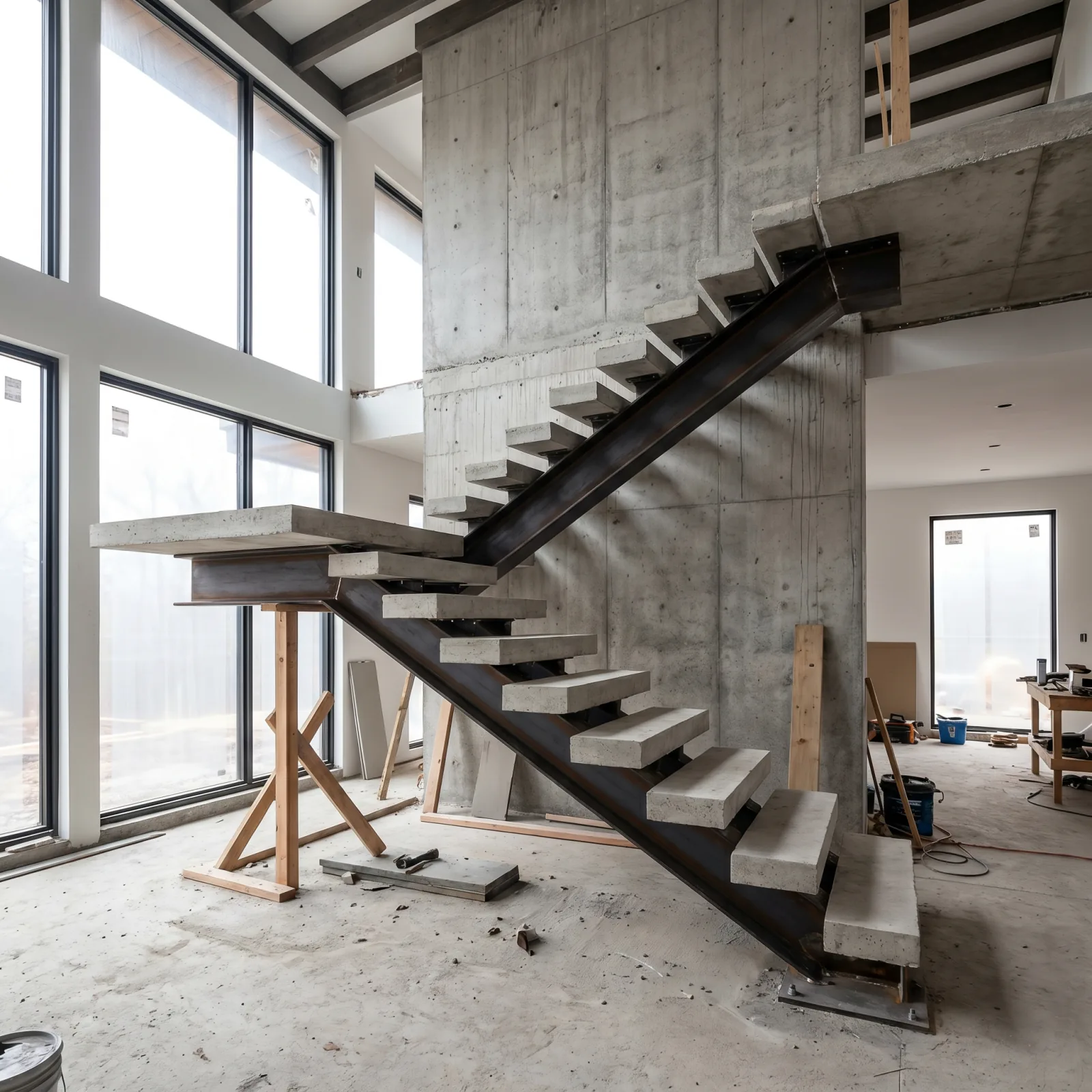
The best mono stringer designs resolve five decisions before the shop drawing starts: beam profile and finish, tread material and thickness, railing system, base and cap plate design, and how the railing returns to the upper floor. Deferring any one of these into the field usually costs money.
Beam profile: the visual spine of the stair
Most residential mono stringers use an HSS (hollow structural section) rectangular tube, commonly 8×3 inches (203×76 mm) or 10×3 inches (254×76 mm) in wall thicknesses from 3/16" to 1/4". The beam size is driven by span, tread load, and code deflection limits, but the profile choice also changes the visual character. A wider, flatter beam reads more substantial; a narrower, taller beam reads more like a knife-edge. Confirm the structural size with the engineer first, then choose the profile within that range.
- HSS 203×76 mm (8×3"): standard span, moderate visual weight.
- HSS 254×76 mm (10×3"): longer spans, more substantial profile.
- Custom profiles (round HSS, I-beam, box weld): available, higher fabrication cost.
- Always specify wall thickness, it changes weight and weld detail.
Tread material and thickness
Tread material is the biggest visual decision after the beam. Solid white oak or walnut (50–75 mm thick) is the residential default and ages well in BC's climate. Steel treads, flat plate or pan-formed, work for contemporary and industrial interiors. Stone or large-format porcelain on a steel pan gives a heavier, more monolithic look. Glass treads are possible but demand engineered support points and a specified glass build-up. Decide tread material before the bracket geometry is finalized.
Railing design and code compliance
Three systems dominate Vancouver custom residential work: frameless glass, cable, and steel picket. Frameless glass keeps the opening visually clear but requires a top-mounted or side-mounted handrail, the glass panel itself is not a code-compliant handrail. Cable railing (horizontal stainless cables) is cost-effective and durable; cable spacing must comply with the BC Building Code sphere-passage rule. Steel picket or rod-infill adds vertical rhythm and is the most code-straightforward option. Confirm guard height (typically 36" on residential floors, 42" for higher fall hazards) with your AHJ.
- Frameless glass: needs separate handrail. Post spacing typically 1200–1500 mm.
- Cable railing: cable spacing to satisfy sphere-passage rule, per BCBC clause.
- Steel picket or rod: confirm picket spacing, handrail profile, termination at top and bottom.
Base plate and cap plate: where design meets structure
The base plate connects the beam to the lower landing; the cap plate (or top weld plate) connects the beam to the upper floor edge. Both are structural and both are visible on most open-riser designs. A flush base plate recessed into a concrete reveal reads cleaner than a surface-mounted plate. A cap plate welded to a steel header and detailed with a weld-fill grind can disappear into the floor edge. Design the plates to solve both the structural and the visual problem.
Finish: interior vs. exterior
Interior mono stringers almost always get shop powder coat, a phosphate pre-treatment, then a thermoset powder applied to the bare steel, then baked. The finish is durable, can match any RAL colour, and is available in flat, satin, and gloss sheens. Blackened steel (hot bluing or wax finish) is an option for interiors where the raw steel look is part of the design intent, it is not a protective coating and requires maintenance. Exterior stairs need a duplex system: hot-dip galvanized to ASTM A123, then powder coated over a sweep-blast surface prep.
Related questions
What railing looks best with a mono stringer?
Frameless glass keeps the stair visually open and suits contemporary interiors. Cable is lighter, practical, and durable in BC's climate. Steel pickets add rhythm and are the most straightforward code path. The right choice depends on the architecture, the view you want to preserve, and the budget, glass guard is typically the most expensive per linear foot.
Should the stringer be powder-coated or blackened?
Powder coat is the durable, low-maintenance finish for interior stairs and the only practical option for exterior. Blackened steel is a raw-steel aesthetic that suits certain interiors but is not a protective coating, it requires maintenance and is not suitable for humid or exterior environments.
Can a mono stringer beam be curved?
Yes, but curved beams require either a section roll or a welded curving process, both of which add cost and lead time. A curved mono stringer staircase is one of the most complex fabrication scopes in residential metalwork. Budget and schedule accordingly.
How do I show a mono stringer stair to my architect or designer?
We can work from architectural drawings, sketch designs, or a site meeting. We prepare shop drawings for design review, section views through the beam, tread, and railing, before fabrication starts. Most architects want to see those drawings before the shop order is placed.
Discuss mono stringer stair design guide for a real project
Send drawings, photos, or a rough scope and we will help define the practical next step.