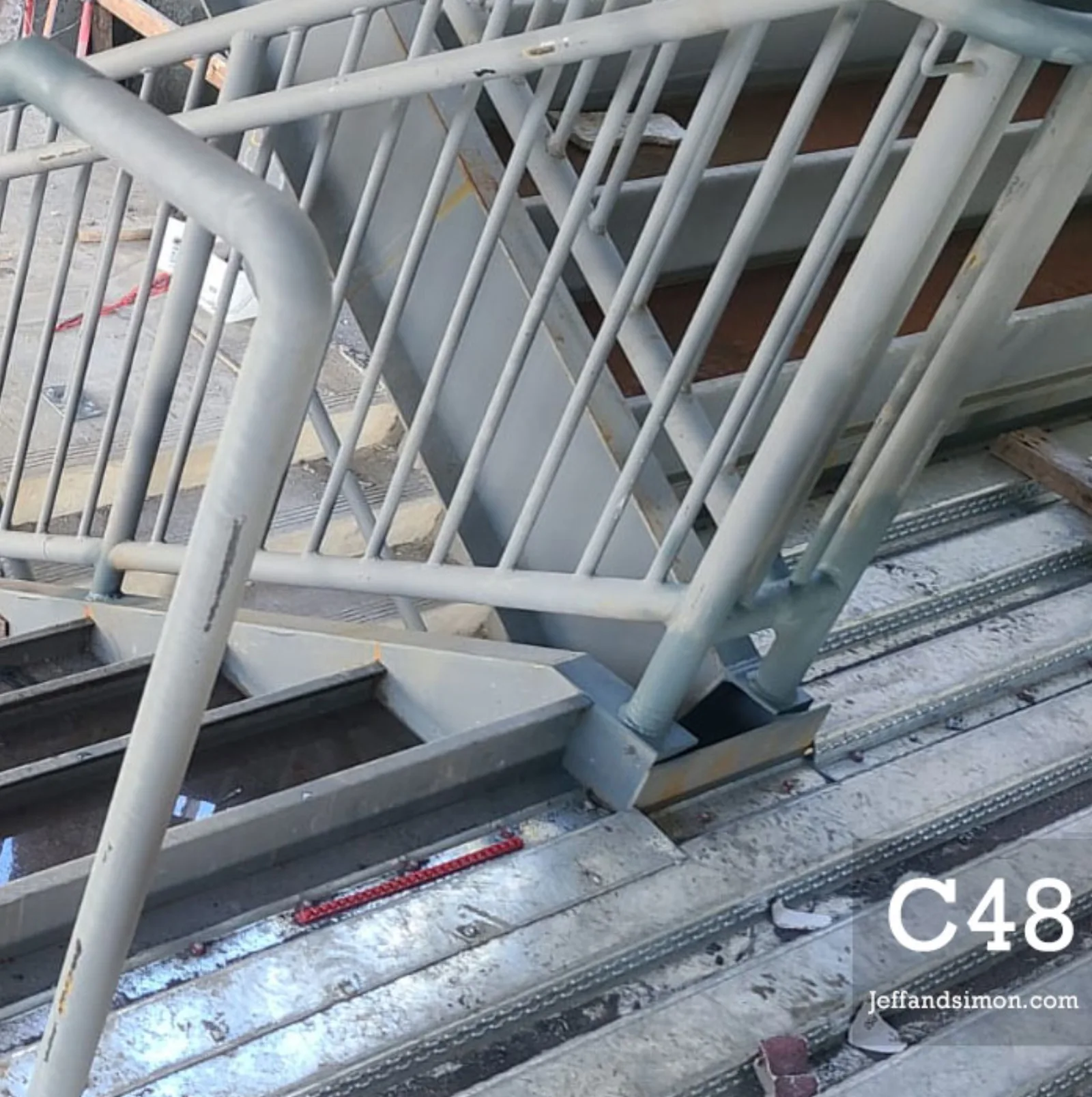
On a commercial project, the stair width is not a design choice, it is a calculation. The architect of record assigns an occupancy classification, determines the occupant load served by each stair, and works back to a required clear width and a required number of exit stairs. By the time the fabrication scope arrives in the shop, those numbers are baked into the structural drawings. The job at fabrication is to deliver the clear width that the code review approved, not to second-guess it. This page is a fabricator's view of how that calculation flows downstream into shop drawings, structural sizing, and install. It is not a substitute for review by the architect of record, the structural engineer, or the authority having jurisdiction (AHJ).
Two numbers drive every commercial stair: occupant load and required clear width
Occupant load is the number of people the code assumes a space will hold. The BC Building Code Part 3 (and the Vancouver Building By-law inside the City of Vancouver) tabulate occupant load factors by occupancy type, office, assembly, mercantile, residential, industrial, and the architect of record applies those factors to the floor areas served. The resulting headcount flows into the required exit stair width through a width-per-occupant ratio that varies with occupancy. Designers should pull the current width-per-occupant factor from the relevant section of the active code edition rather than relying on a remembered number, because the value has been revised across editions.
- Occupant load factor: set by occupancy type and code edition, confirm with the architect of record.
- Width-per-occupant ratio: tabulated in BCBC Part 3 / VBBL, depends on occupancy and whether sprinklers are present.
- Clear width: measured between handrails or between guard faces, fabrication must hit this dimension, not the rough opening.
- Capacity stacks down the stair: the lowest run carries all upper floors that exit through it.
Why fabricators care: clear width vs. rough opening
The number that ends up on the building permit is a clear width between the inside faces of the handrails (or between guard faces where no handrail interrupts the clear path), not the structural-to-structural rough opening. A stair with a stringer profile, a wall-mounted handrail, and a guard on the open side can lose 100–200 mm from the rough opening before the clear width is measured. If the shop drawing does not subtract the handrail projection, the guard offset, and the stringer thickness from the rough opening, the installed clear width can finish short, which is a code failure, not a finish issue. Settle the clear-width math at shop drawing review, before the steel is cut.
- Handrail projection from the wall: typically 38–100 mm depending on profile and mount.
- Guard face offset from stringer: depends on guard type, glass shoe, picket base, cable post.
- Stringer wall thickness: subtract from rough opening on both sides where stringers are exposed.
- Verify clear width at shop drawing, fabrication, and post-install measurement.
Multiple exits and the capacity calculation
Most commercial floors over a certain occupant load need at least two independent exits, each sized to a share of the total occupants. The split between exits is set by the code based on travel-distance rules and exit-remoteness rules, the architect of record assigns occupants to exits during code review. The recent 2024 BC amendment permitting single-exit stair (SES) designs in residential buildings up to six storeys is a narrow exception that does not apply to most commercial occupancies without AHJ review. Treat the exit count as a code output the fabricator receives, not a value to optimize at fabrication.
Sprinklered vs. non-sprinklered stairs change the math
BCBC Part 3 has historically applied a smaller width-per-occupant ratio to sprinklered buildings than to non-sprinklered ones, which reduces the required clear width for the same occupant load. The exact ratio depends on the active edition. A late change to the sprinkler scope can therefore push the required stair width up, a structural change, not a finish change. Lock the sprinkler scope before stair shop drawings are released to fabrication.
Stringer sizing follows clear width, run length, and tread load
Once the clear width is set, the structural engineer sizes the stringers against the run length, the dead load of the tread system, the live load specified by code for the occupancy, and the deflection limit for stair stringers in the active code edition. Wider stairs usually need deeper stringers or a third intermediate stringer at the centreline; longer runs need deeper sections; pan-formed concrete-fill treads add significant dead load over open grating. The fabricator builds to the engineer's section, not to a target weight.
Tread depth, riser height, and run length connect to capacity
Commercial stair tread depth, riser height, and the relationship between them are tighter than residential rules. The number of risers in a run is set by floor-to-floor height divided by allowable riser height; the total run length is set by the number of risers minus one, multiplied by tread depth. Landing depth is also code-driven, usually at least the stair width. On wide stairs with long runs the landings dominate the floor plan and have to be coordinated with the structural grid early. Pull the exact dimensions from the current code edition for the project.
Where occupant load shows up on the shop drawing
A clean commercial stair shop drawing names the occupant load served, the required clear width, the achieved clear width, and the riser/tread geometry on the cover sheet, usually as a code-compliance block referenced back to the architect's permit drawings. Including those numbers on the shop drawing protects every party in the chain. If the AHJ inspector flags a clear-width issue at occupancy, the fabricator can point to a stamped drawing that documented the dimension at shop-drawing approval.
What we ask for before the shop drawing starts
On a commercial stair scope we ask the design team for the occupancy classification used in the code review, the occupant load assigned to each stair, the required clear width, the structural stringer specification from the engineer of record, and the sprinkler status. Without those five inputs the shop drawing is a guess. With them, fabrication can proceed against a documented code path.
Related questions
Who calculates the occupant load on a commercial project?
The architect of record. The occupant load is part of the code analysis that goes with the building permit submission, and it flows from the occupancy classification and floor area into the exit and stair requirements. The fabricator should not be back-calculating occupant load, the number arrives with the structural drawings and the architect's code review.
What clear width do I need for an exit stair?
The required clear width depends on the occupant load served by the stair, the occupancy classification, the sprinkler status, and the active code edition. The current BCBC Part 3 and VBBL provisions tabulate the width-per-occupant ratio used to set the minimum. Pull the current value from the code for the project's permit submission date and confirm interpretation with the AHJ, do not rely on a remembered minimum.
Does a feature stair or non-required stair need to meet the same width rule?
Non-required stairs, for example a lobby feature stair that is not part of the means of egress, are usually not sized by the occupant-load rule, because they are not credited as an exit. They still have to meet general stair geometry rules and guard/handrail rules. The architect of record assigns each stair as required or non-required during code review.
How does the SES amendment affect commercial stair sizing?
The 2024 BC amendment that permits single-exit stair designs applies to residential buildings up to six storeys with full sprinklers and mechanical smoke management. It is not a general permission for commercial buildings, and most commercial occupancies still need two independent exits sized by occupant load. Confirm with the AHJ before assuming SES applies.
What happens if the as-built clear width is short?
A short clear width on a required exit stair is a code failure that can hold up occupancy. Common remedies are removing the offending handrail and re-mounting on a slimmer profile, swapping a glass guard for a thinner system, or re-fabricating the affected run. The cost and schedule impact is much larger than the cost of getting the math right at shop drawing. Verify clear width before fabrication and after install.
Continue planning
- Commercial stairs hub overview
- Commercial egress stairs (single page)
- Commercial stair services
- Commercial staircase design (Trends)
Plan occupant load & commercial stair sizing | bc building code for a real Vancouver project
Send drawings, photos, or a rough scope and we will help define the practical next step.