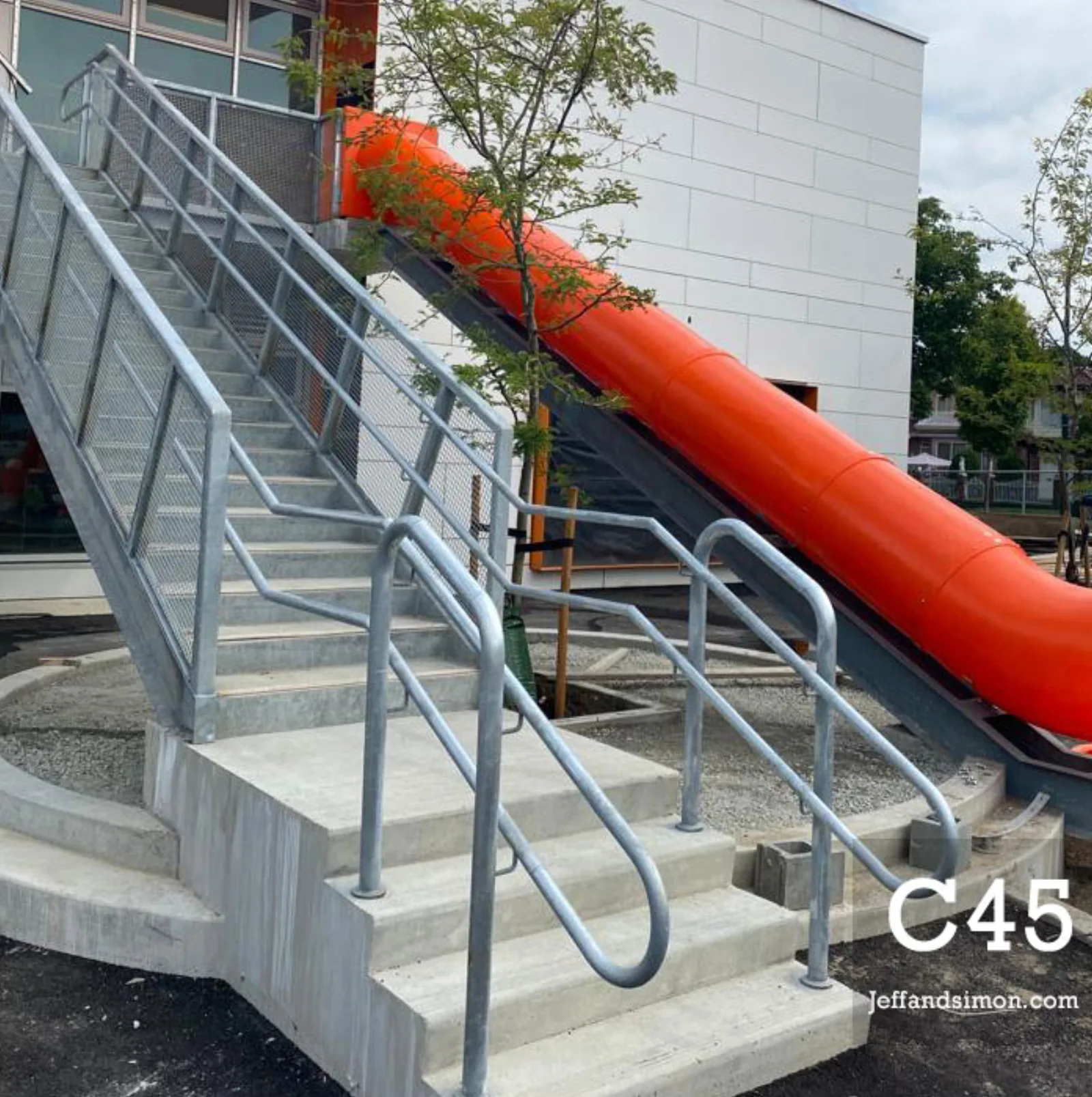
A fire-rated stair enclosure is a vertical fire separation that protects the egress stair from fire and smoke in the rest of the building. The walls, the doors, the floor and ceiling penetrations, and any glazing in the enclosure all have to deliver a rated assembly. The steel stair inside the enclosure is the fabricator's scope, but the enclosure itself is built by the GC's wall and door trades. Where the two scopes meet, anchor points, penetrations, door frames, and smoke-seal details, is where fabrication and Code review either align or fight. This page is a fabricator's view of how the enclosure scope shapes the stair we build. It is not a substitute for the architect's Code analysis, the engineer of record, or AHJ review.
Why exit stairs sit inside rated enclosures
BC Building Code Part 3 requires exit stairs in most multi-storey commercial buildings to be separated from the rest of the floor by a fire separation with a specified fire-resistance rating (FRR), usually expressed in hours. The intent is to keep the egress path tenable while occupants leave the building during a fire. The rating depends on the building's occupancy, height, sprinkler status, and the code edition that applies. Smaller, single-storey buildings and some non-required stairs are exempt, confirm the requirement with the architect's code analysis, not by analogy to a previous project.
- FRR is set by occupancy, height, sprinkler status, and active code edition.
- The enclosure must be continuous from the lowest exit level to the roof or top of stair.
- Penetrations (pipes, ducts, conduit) must be firestopped to maintain the rating.
- Doors into the enclosure are rated assemblies with closers and labelled hardware.
What the fabricator builds vs. what the enclosure trades build
The steel stair, stringers, treads, landings, guards, and handrails, is the fabricator's scope. The enclosure walls, the rated doors, the fire-stopping around penetrations, and the smoke seals are the GC's wall, door, and firestop trades. The interface details, where the stair attaches to a rated wall, where a landing penetrates a rated floor, where a guard meets the enclosure wall, are the place fabrication coordination matters most. A bolt pattern that penetrates a rated wall has to be addressed in the firestop scope; a landing edge that lands on a rated floor has to be detailed so the rating is preserved.
- Stair anchor points into rated walls: coordinate with firestop scope.
- Landings at rated floors: maintain floor rating around the landing edge.
- Penetrations for railing posts through rated wall returns: detail at shop drawing.
- Door frames inside the enclosure are not the fabricator's scope but must be coordinated.
Doors into the enclosure: rated assemblies, not steel fabrication
The door into a rated exit stair is a labelled, rated assembly, frame, leaf, hardware, closer, and intumescent seal, supplied by the door and frame trade, not by the stair fabricator. Common ratings for exit-stair doors are tied to the wall rating and listed in the active code edition. The fabricator's role is to coordinate the rough opening location, the landing geometry at the door swing, and the threshold detail with the GC. A door swinging into a landing that is too short for the occupant load is a coordination issue we flag at shop drawing review.
Smoke management and pressurization in tall buildings
Taller commercial buildings often require a smoke management or stair pressurization system on the exit stairs in addition to the fire-resistance rating. Mechanical pressurization keeps smoke out of the stair by holding the enclosure at a slight positive pressure during a fire alarm. The mechanical scope is the mechanical engineer's, but the enclosure has to be tight enough to hold the pressure, which means door seals, threshold seals, and any wall penetrations have to be detailed correctly. The stair itself does not have to be airtight, but landings and risers should not introduce penetrations that defeat the pressurization.
Single-exit stair (SES) enclosures: a 2026 BC update
The 2024 BC Building Code amendment that permits single-exit stair (SES) designs in residential buildings up to six storeys carries a stricter enclosure scope than a conventional two-stair design. SES designs require full sprinklers, mechanical smoke management of the stair, a wider clear stair width, and rated enclosure provisions that account for the single egress path. The City of Vancouver adopted the amendment effective January 20, 2026. SES enclosures are not a "lighter" enclosure scope, they are usually a heavier one. See our breakdown at BC single-exit staircase 2026, what it means for builders.
- Applies to residential buildings up to six storeys, not general commercial.
- Sprinkler + smoke management are mandatory co-requirements.
- Wider stair = larger structural sections and heavier fabrication scope.
- Confirm AHJ acceptance and edition before assuming SES is available on the project.
Steel finish inside a rated enclosure
The steel stair finish does not provide the fire-resistance rating, the enclosure walls do, but interior coatings inside an exit stair are still subject to flame-spread and smoke-developed limits set by the code for finish materials in exits. Powder coat applied to bare steel typically tests within the limits, but the architect's finish schedule should confirm the specified finish against the relevant code provisions. Intumescent coatings are sometimes specified on exposed structural steel where the steel itself is required to contribute to a fire-resistance rating, that scope is engineered and is not the same as a decorative finish.
Coordination checklist before shop drawings are released
On a commercial project with a rated exit stair we ask the design team for the wall rating, the door rating, the floor rating at landings, the sprinkler and smoke management scope, and the architect's interior finish schedule for the enclosure. With those five pieces in hand, the shop drawing can document the stair-to-enclosure interfaces correctly and the firestop trade can pick up the penetrations without re-design at install.
Related questions
Does the steel stair itself need a fire-resistance rating?
Usually no, the enclosure walls provide the rating that protects the stair, not the stair members themselves. In some cases the structural steel in a stair contributes to the building's overall fire-resistance scheme and requires intumescent coating or encasement to deliver a rated section. That call is made by the engineer of record and the architect's code review, not by the fabricator.
Who provides the rated door into the exit stair?
The door and frame trade. Rated stair doors are labelled assemblies, frame, leaf, hardware, closer, and seal, supplied as a system. The stair fabricator coordinates the rough opening, the landing geometry, and the threshold but does not supply the rated door.
How are guard posts and handrails handled where they meet a rated wall?
Penetrations through a rated wall for guard posts or handrail brackets have to be firestopped to maintain the rating. The fabricator details the connection and the firestop trade installs the rated sealant. On most projects we prefer surface-mounted brackets that avoid penetrating the wall entirely, which simplifies the firestop scope.
Is a fire-rated paint required on the stair steel?
Not unless the structural steel itself is required to contribute to a fire-resistance rating, which is rare on stair members in a separately-rated enclosure. Where it is required, usually on exposed columns and beams in certain occupancies, the coating is an engineered intumescent specified by the engineer of record and applied to a documented dry film thickness. A standard powder coat or finish paint is not a fire-rated coating.
Do non-required and feature stairs need to be enclosed?
Non-required stairs, for example a lobby feature stair that is not part of the means of egress, are usually not required to sit inside a rated enclosure, because they are not credited as an exit. They still have to meet other code provisions on geometry, guards, and handrails, and the architect's code review sets out which stairs are required and which are not.
Continue planning
- Commercial stairs hub overview
- Commercial egress stairs (single page)
- Commercial stair services
- Commercial staircase design (Trends)
Plan fire-rated stair enclosures | vancouver commercial stairs for a real Vancouver project
Send drawings, photos, or a rough scope and we will help define the practical next step.