Upper Lonsdale and Grouse Staircase Guide: Custom Stairs on North Shore Mountain Homes
Custom steel staircases for Upper Lonsdale and Grouse-side mountain homes: sloped lots, snow exposure, and fabrication details for the Capilano context.
An Upper Lonsdale home is not a Vancouver home with a view. The stair has to read the slope, the snow, and the mountain weather before the design moodboard.
Upper Lonsdale, Edgemont, and the Capilano-side neighbourhoods running up toward Grouse have a building stock that does not match anywhere else in the Lower Mainland. The lots are steep. The homes are tall and split-level. The views are oriented south toward the inlet, north toward the mountain, or both, and the floor plans are usually organized around the view rather than around the street. The staircase is rarely a back-of-house element in these homes. It is the structural and visual spine that connects the levels and frames the view.
This post walks through how custom steel stairs are designed and fabricated for these properties, what changes from a comparable South Side project, and the decisions that have to be made before the architect locks the floor plan.
The slope and the split-level plan
A typical Upper Lonsdale lot drops several meters from the back of the property to the front. The home reads as a three-storey building from the street and a four-level building from the back yard. The main living level is set high enough to clear the slope, the garage and entry are set into the slope, and the bedrooms are usually above. The staircase has to connect all of those levels and the route is rarely straight.
What this means in fabrication: a single feature stair often runs three flights with two landings, and the structural support points change at every floor. A flight that is mono stringer on the lower run may transition to a switchback at the mid-landing and back to a mono stringer on the upper run. The shop drawings show all of these as a single coordinated structure, not three separate stairs that meet at the landings.
The stair also tends to occupy a significant footprint on the floor plan because the rise per level is greater than on a flat-lot home. A 3.2 m ceiling height on the main level translates to a long flight, and a long flight needs a long run, which crowds the room around it. We resolve the geometry early with the architect to make sure the floor plan accommodates the actual code-compliant run, not the diagrammatic stair that fits the sketch.
View orientation drives the railing decision
The reason most clients build in this part of the North Shore is the view. The stair is between the user and the view on at least one side, and the railing is the element that either preserves or interrupts the sightline.
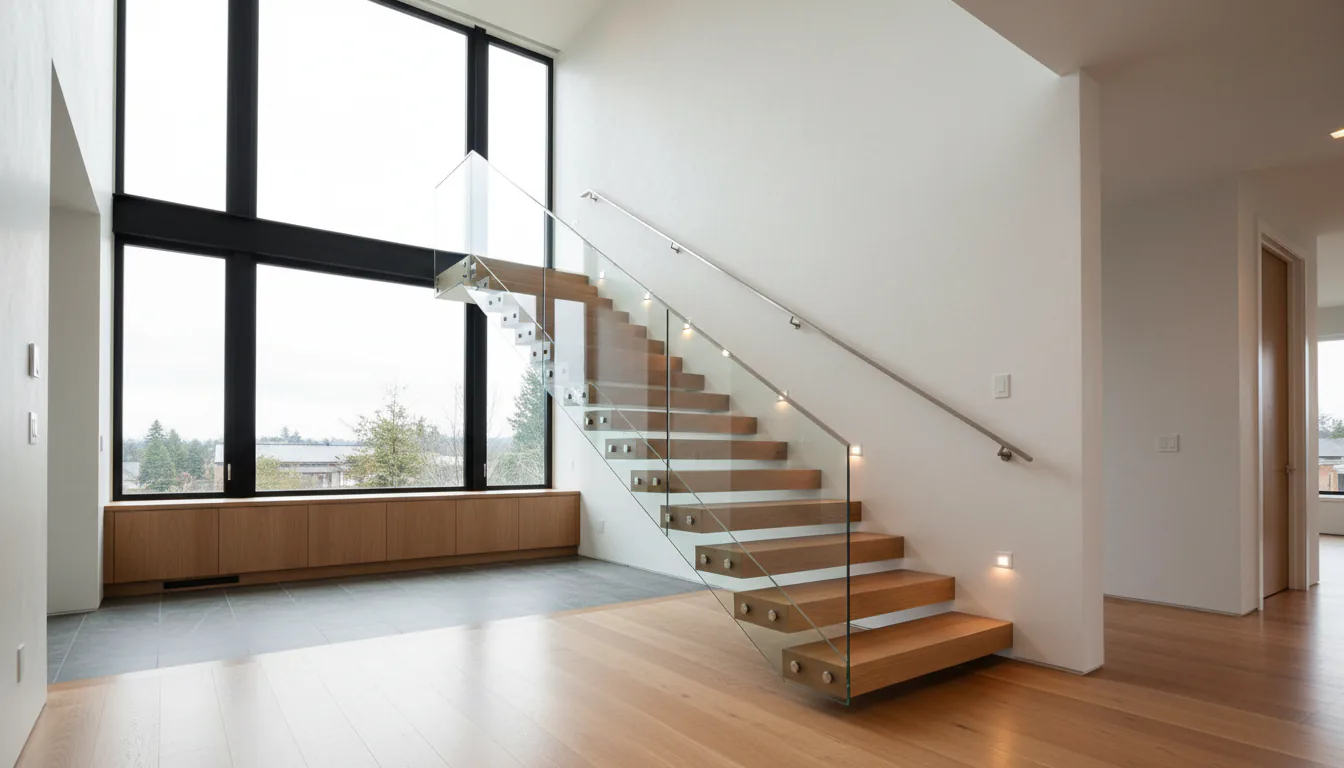
Glass railings are the most common choice on the view side. A continuous glass panel with a slim top rail keeps the view clean, and the railing reads as a visual extension of the window wall behind it. The cost is higher than cable or picket, but the visual return is meaningful when the view is the reason the home exists.
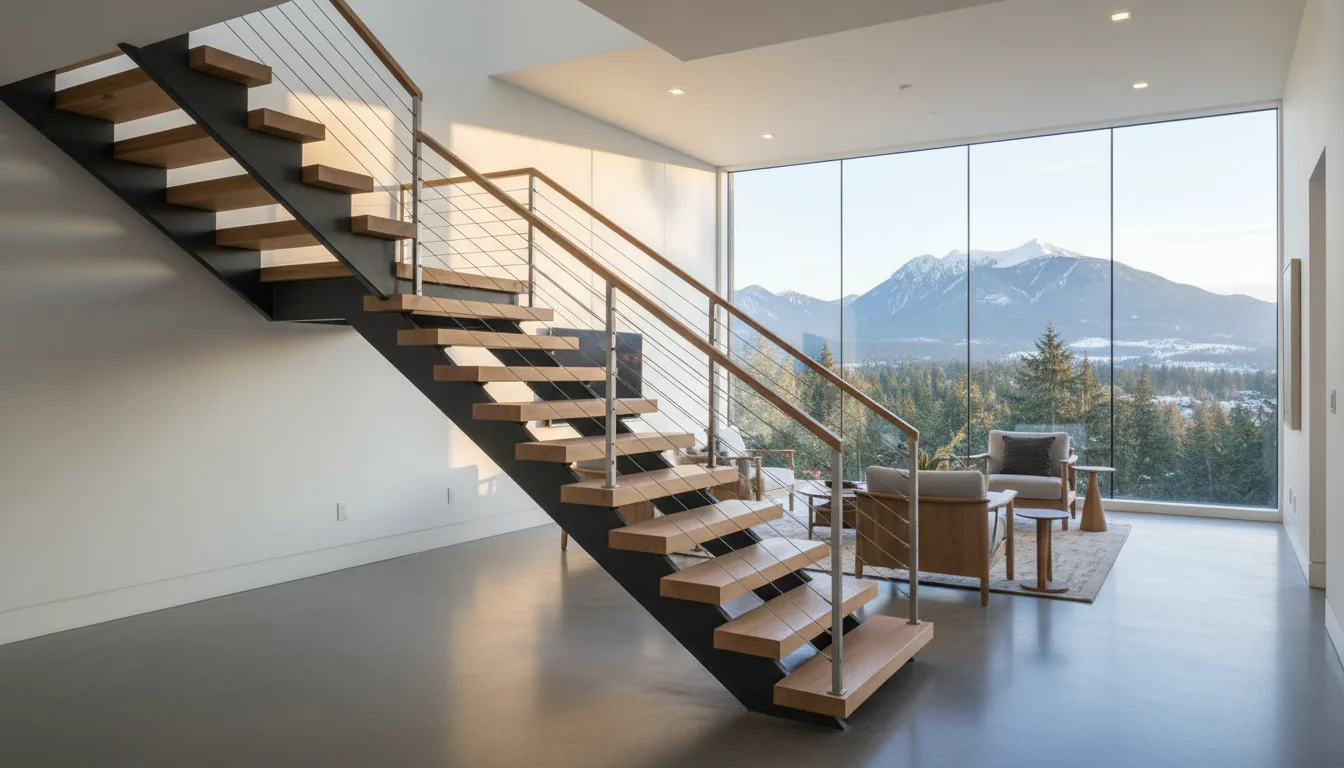
Cable railings are the second-most-common choice and earn their place when the budget is tighter or the architectural intent is more industrial. Horizontal cable runs are nearly transparent at distance and provide most of the view-preservation benefit at a lower cost. The hardware specification matters on the North Shore, we default to grade 316 stainless on coastal sites and on any project where the home is within direct salt-air exposure distance of the inlet.
On the inboard side of the stair, away from the view, picket or panel railings are more common because the visual transparency is no longer the priority and the lower cost is welcome. A mixed-railing project, glass on the view side, picket on the wall side, works as long as the top rail and post system are consistent so the stair reads as one piece.
For a deeper look at the railing decisions specific to view properties, see our West Vancouver staircase guide and the glass railings for West Vancouver view homes piece.
Snow load and the exterior stair question
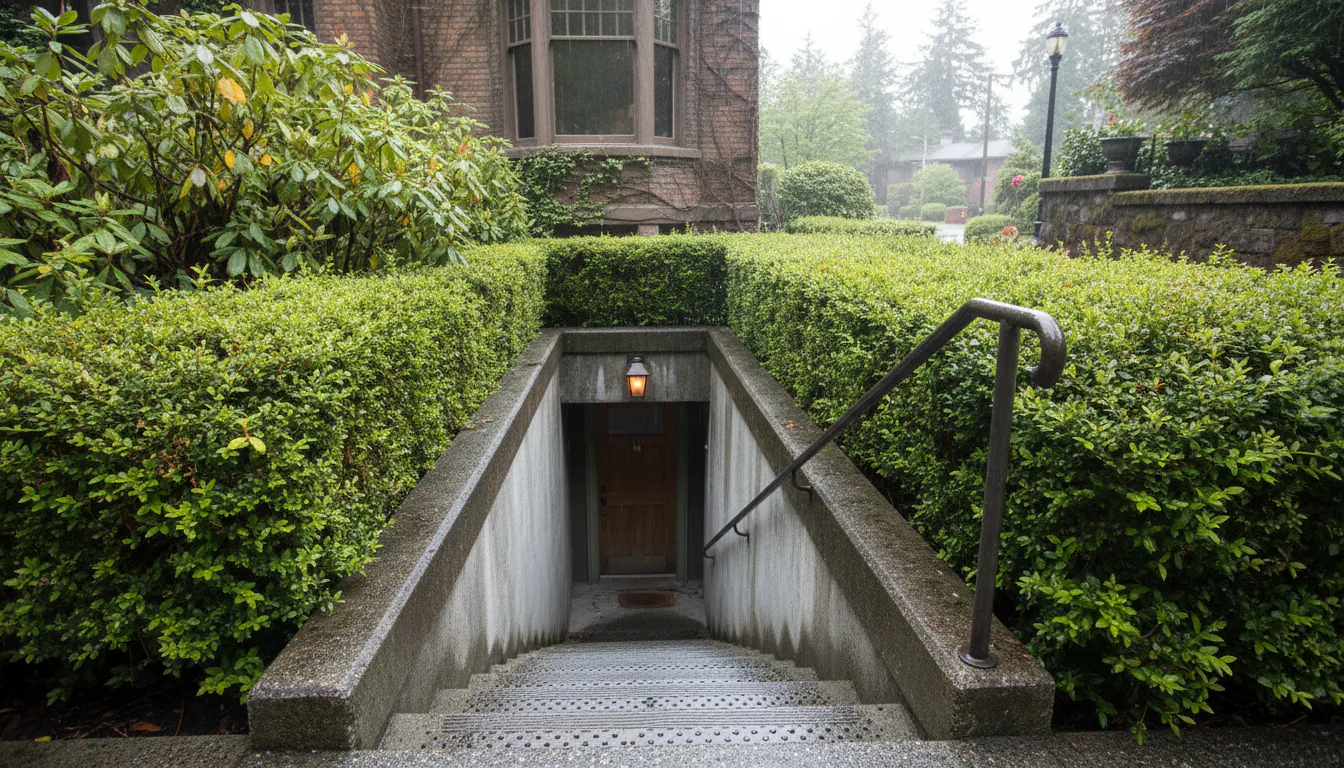
Upper Lonsdale gets meaningful snowfall at elevation. The District of North Vancouver’s snow load varies by elevation band, and homes above the 200 m contour see noticeably more snow than the equivalent South Side address. Exterior stairs on these properties have to be designed for the snow load, the freeze-thaw cycle, and the maintenance overhead of a stair that is buried under snow for parts of the winter.
The fabrication decisions: hot-dip galvanized stringers for any exterior stair that sees winter exposure, grating or perforated treads that allow snow and meltwater to fall through rather than building up on the stair, and a stainless steel or aluminum railing system that does not require seasonal paint touch-ups. Our piece on hot-dip galvanizing for exterior stairs on the North Shore covers the finish system in detail.
Snow shedding from the home above the stair is the other consideration. A stair that lives below a steeply pitched roof line is in the path of every winter snow slide, and a cable or glass railing that does not handle the impact load gets damaged in the first heavy winter. We coordinate with the architect on the snow-shedding pattern and recommend either picket or perforated panel railings under any roof line that sheds snow.
The DNV permit pathway
The District of North Vancouver runs its own building permit process and the DNV inspections process sets the schedule. The structural review on a multi-level feature stair typically requires engineered drawings, and the engineer’s stamp has to be on the permit submission, not added at inspection.
The DNV inspectors are familiar with the local building stock and the typical structural questions on a steep-slope home. We have not seen the DNV review of a stair package take longer than a comparable City of Vancouver review on a similar project, but the documentation requirements differ in detail. The engineer’s letter, the structural drawings, the stair shop drawings, and the railing engineering need to be packaged together for the submission.
The schedule from first design conversation to install on a typical Upper Lonsdale custom feature stair runs four to six months. Less if the design is locked early and the engineer is already engaged on the broader structural design; more if the architectural decisions about the stair shift through the permit cycle.
Multi-level coordination, the structural backup
The structural backup for a feature stair on a multi-level home is more than the local connection at each floor. The lateral load from the stair, the load from the railings, and the seismic considerations from the building’s structural system all interact at the stair location. A mono stringer that lands on a cantilevered floor at the upper level changes the loading on the floor below, and the floor framing has to be sized to take it.
This coordination has to happen at the structural drawings stage, not at the stair shop drawings stage. We share the stair structural concept with the project engineer before the floor framing is finalized so the connection points have the backup they need. A stair that arrives at a floor framed without the right backup adds weeks of remedial framing.
Material palette, the warm against the mountain
The visual decisions on these stairs reflect the surrounding context. The mountain palette is darker greens, weathered cedar, wet stone, and the long blue light of a Pacific Northwest afternoon. The stair material reads against that backdrop.
Most projects in this part of the North Shore land on a blackened or dark powder-coat steel structure with thick warm wood treads, white oak or walnut, sometimes a rift-cut quarter-sawn fir to match local timber framing details. The combination reads warm against the cool surrounding context and does not fight with the view.
Cooler material combinations, stainless against light maple, polished steel against pale stone, sometimes appear in modernist projects but are rarely the right answer. The stair has to live in the same light as the mountain, and the cool palettes look thin in that light.
For broader context on related neighbourhoods, see our Lynn Valley staircase renovation guide and the North Shore exterior stair and deck considerations.
The budget conversation specific to this market
The properties in Upper Lonsdale and the Capilano-side neighbourhoods support a level of stair investment that the budget at a comparable Burnaby property usually does not. The stair budget on a custom new build in this part of the North Shore frequently lands well above the typical residential stair range because the architectural ambition is higher, the structural complexity is greater, and the homeowners are willing to invest in a piece that will define the home.
The honest version of the cost conversation is that the visible stair is the smallest part of the budget. The structural backup, the engineering, the permit, and the multi-level coordination together usually cost more than the finished steel and wood the visitor sees. Clients who frame the cost only in terms of “steel and treads” are usually surprised when the quote arrives. Clients who understand the structural and coordination cost upfront are usually pleased with the result.
Sources
- District of North Vancouver, Building Inspections
- BC Building Code Section 9.8, Stairs, Ramps, Landings, Handrails and Guards
Related reading: the Lynn Valley staircase renovation guide, the West Vancouver staircase guide, and the North Shore exterior stair and deck considerations.
Related questions
What's different about a stair in a Grouse-side home compared to a flat Vancouver lot?
Upper Lonsdale homes are usually built on slopes with multiple split-levels and longer flights. The stair often runs between three or four levels and becomes the spine of the floor plan. Snow load on exterior stairs is meaningfully higher than on the South Side, and the finish system has to handle freeze-thaw cycles that downtown homes do not see.
Does the District of North Vancouver have different permit rules than the City of Vancouver?
Yes. The District of North Vancouver runs its own permit process and the [DNV building bylaw and inspections](https://www.dnv.org/property-and-development/building-inspections) apply. The structural review and the heritage or development permits run on DNV's timelines, which differ from the City of Vancouver. We confirm the local AHJ at first site visit.
Are floating stairs common on these mountain homes?
Yes. The big-volume living spaces typical of newer Upper Lonsdale and Capilano Highlands custom builds are designed around feature stairs, and mono stringer or floating designs are the dominant request. The structural decisions interact with the open floor plan and the view orientation in ways that need to be resolved early.