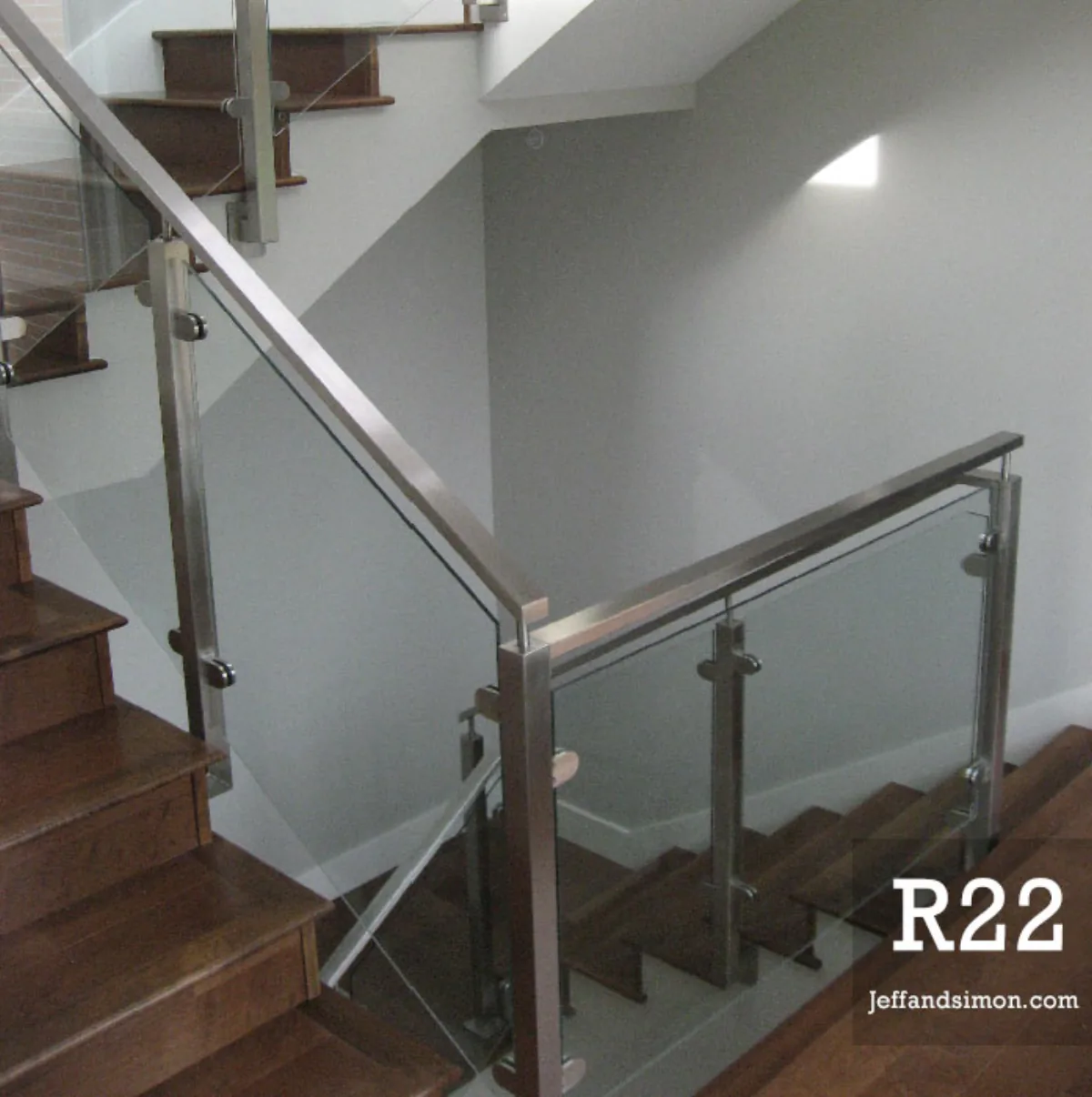
A glass guard on a floating stair is the cleanest visual result available, and it is also the detail with the most ways to go wrong on site. The glass is part of the guard system under the BC Building Code, the hardware has to land on a structure that is often only 80–100 mm wide, and the panels have to be ordered against the as-built stair, not the design drawing. This page covers the integration decisions we resolve before the stair leaves the shop.
Hardware options against a mono stringer
Three hardware families dominate Metro Vancouver floating-stair work. A base shoe runs along the top of the stringer or the edge of the tread and clamps the glass continuously. Side-mounted clamps grip the glass at discrete points and bolt into the side face of the stringer or tread. Stand-offs pass a stainless barrel through a hole in the glass and into a steel plate. Each lands differently and has a different impact on the stringer detail.
- Base shoe: cleanest continuous look, demands a flat continuous mounting surface.
- Side clamps: most flexible for cantilevered treads, hardware is visible as discrete points.
- Stand-offs: industrial read, requires precisely located holes in tempered/laminated glass.
Engineering scope
Structural glass guards must meet the guard load requirements in the BC Building Code ([BC Building Code 2024](https://free.bcpublications.ca/civix/content/public/bcbc2024/)) and Engineers and Geoscientists BC bulletins on structural glazing where applicable ([EGBC](https://www.egbc.ca/)). On a floating stair the engineering scope usually has to address two things at once, the stair structure itself and the glass-as-guard load path. Tempered laminated glass (typically two plies bonded with an interlayer) is the standard panel build for an interior guard; the engineer specifies the make-up against the project loads.
Sequencing with the stair
Glass cannot be ordered from the design drawing. Once the stair is installed, the glass shop measures each opening at the panel-by-panel level and orders the glass to that measurement. In our shop we sequence it as: structural steel → stair install → glass templating → glass fabrication → glass install. Cutting that order, for example, ordering glass off the design drawing in parallel with steel, is the most common cause of returned panels on a floating stair.
- Glass templating happens after the stair is installed and the floor finish is committed.
- Lead time from template to glass install is typically several weeks; confirm with the glazier.
- Any change to the stair after templating means new glass.
Top rail or no top rail
A frameless glass guard with no top rail is the most minimal visual and demands the tightest engineering. A glass guard with a slim metal top rail (cap rail) reads almost as clean and gives the engineer a continuous load distribution member. The choice changes both the engineering scope and the visual; it is decided at the design stage, not late.
Where coordination breaks down
The most common floating-stair glass coordination failures are not structural. A floor finish that lands higher than expected and shortens the visible glass below the cap rail. A wall-side glass termination that hits a baseboard or door trim. A handrail return that intersects the glass panel. Each of these is solvable on paper and expensive to fix after templating. We resolve them in the design review before the stair is fabricated.
Related questions
Can a floating stair have a glass guard with no top rail at all?
Yes, frameless glass is common on residential floating stairs in Metro Vancouver. The glass make-up is engineered against the BC Building Code guard load requirements. The hardware (base shoe or clamps) becomes the only metal in the guard, so its detailing carries more visual weight.
Tempered or laminated glass for a stair guard?
Most residential structural glass guards in our work are tempered laminated, two tempered plies bonded with a PVB or SGP interlayer. The interlayer keeps the panel in place if one ply breaks, which the BC Building Code references for guard performance. The exact make-up is set by the engineer against the project loads and the hardware choice.
Why can't I order the glass at the same time as the stair?
The glass panels are sized to the actual installed stair openings, not the drawing. Floors move, walls move, and a mono stringer is rarely installed to the nearest millimetre of the design drawing. Templating the glass after the stair is installed is the only reliable way to get panels that fit without site grinding.
How much does a glass guard on a floating stair cost?
Glass guards are the most expensive of the four common stair railing systems because the glass is the structure. Final pricing scales with panel count, hardware spec, glass make-up, and stair geometry. We price the glass guard package together with the stair so the trade-off against cable or picket is visible on one quote.
Continue planning
- Floating stairs hub overview
- All four support strategies
- Mono stringer staircase deep dive (Trends)
- Floating stair fabrication guide
Plan glass guard integration on floating stairs for a real Vancouver project
Send drawings, photos, or a rough scope and we will help define the practical next step.