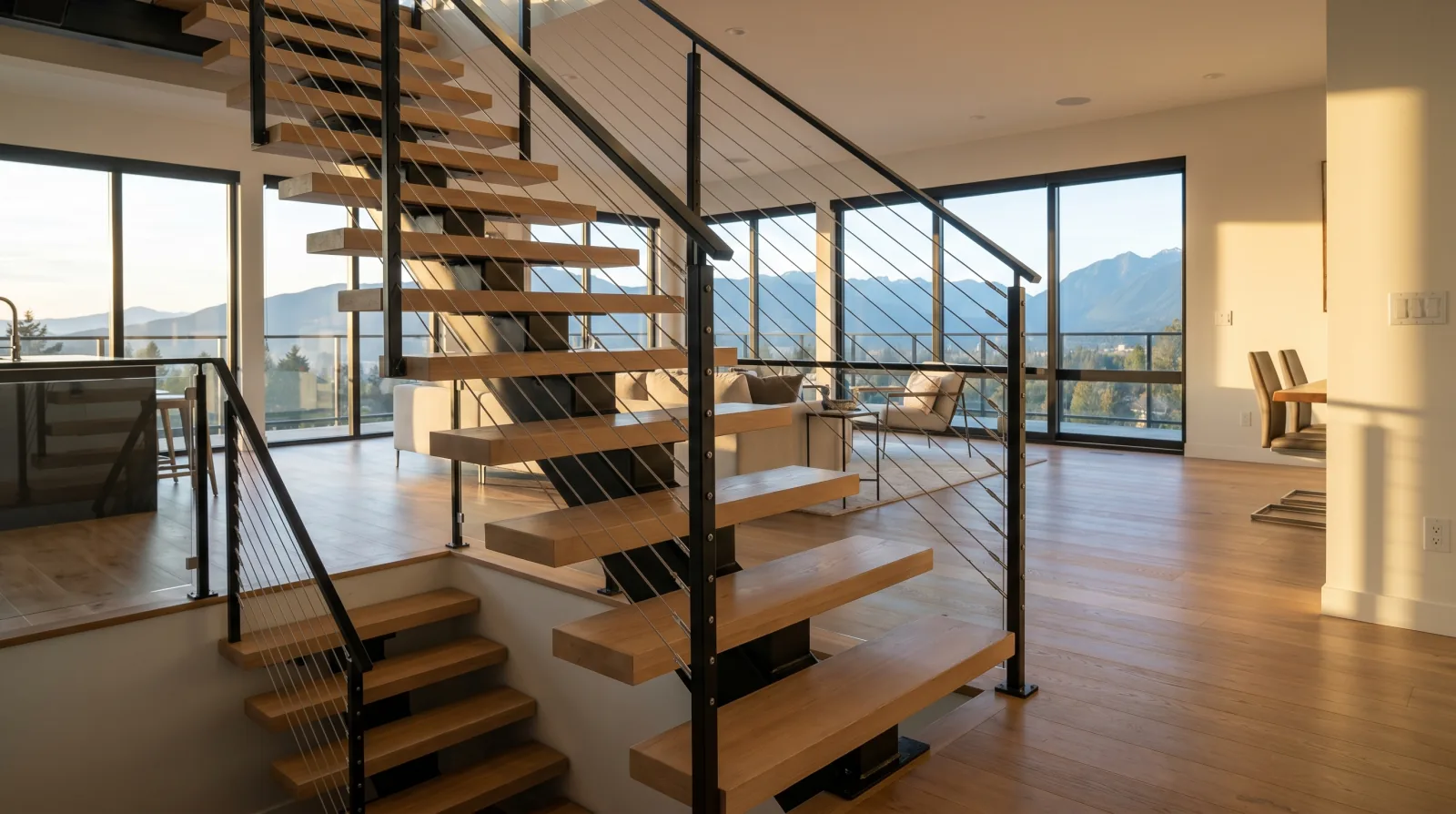
An installation day for a floating stair is short, usually one day for a single-flight residential stair, sometimes two days for a longer or harder-access project. It looks calm because most of the work happened earlier: the engineering, the framing prep, the shop fabrication, and the access planning. This page walks through what we do on site, in the order we do it, so the GC, the homeowner, and the trades that follow know what to expect.
Before install day
By the time the truck arrives, the framing, embeds, and openings have already been confirmed against the shop drawings in the structural prep walk. The floor finish under the lower landing and at the upper landing is usually committed (either installed and protected, or final-confirmed in elevation). Drywall behind a cantilevered stair is closed only after the embed inspection and the engineer's sign-off. If any of these are not done, install is rescheduled rather than improvised on site.
- Framing prep walk completed, see the [structural prep checklist](/floating-stairs/structural-prep-checklist/).
- Floor heights and finishes confirmed against the shop drawing.
- Site access mapped, door widths, parking, and the lift method confirmed in advance.
- Trade schedule confirmed, drywall, glass templating, and millwork all sequenced around the stair install date.
Step 1: Delivery and stage
The stringer and treads arrive on a flatbed or in a covered truck. Bracket sub-assemblies and railing posts (where they ship with the stair) are bundled separately. We stage the stair near the install location with the stringer protected on dunnage so the powder coat or finish is not damaged. On a finished interior, floor protection (ram board, plywood, blankets) goes down before any steel enters the room.
Step 2: Lift and dry-set the stringer
The stringer is the heaviest single piece on a mono-stringer floating stair, sometimes 200–400 kg depending on the span. We lift it into position with a lift assist (typically a manual genie or, on taller stairs, a small powered lift). The stringer is dry-set against the lower anchor and the upper-floor edge, checked for length and bearing, then checked for plumb in both directions against the design drawing. Nothing is welded or bolted in this step, it is a fit verification.
Step 3: Anchor and weld
Once the stringer is plumb and the bearing surfaces are confirmed, the lower anchor is fastened (mechanical anchors into concrete, or a welded connection to a steel sub-frame depending on the build). The upper connection is bolted or welded to the floor-edge assembly. On cantilevered stairs, the wall-side embeds are fastened to the steel back-plate or LVL pack in the wall before drywall closes the wall. Welded connections are inspected by the project engineer where the engineering scope requires it.
- Anchor type follows the engineering, never substituted on site without engineer approval.
- Welds are visually inspected on every project; engineer-witnessed where the scope requires.
- Embed inspection windows close only after the engineer or AHJ signs off, where required.
Step 4: Set the treads
Treads are set into the bracket from above and fastened from below where the bracket detail allows. Each tread is checked for level along the run and across the width, a tread that is 2 mm out at the front edge is visible to the eye and gets re-shimmed before the next tread is set. Wood treads ship pre-finished and are handled with gloves until the protection goes back on. Steel treads are checked for plumb and flush at every weld.
Step 5: Plumb, square, and final check
After all treads are set, the full stair is checked for plumb (the stringer should be vertical from the top tread to the bottom in both axes), for square (the stair should not twist), and for consistent rise (the same rise dimension from tread to tread within the BC Building Code tolerance, uneven rise is a code issue, not a finish issue). Anything outside tolerance is corrected before the railing arrives.
Step 6: Protect and hand off
Once the stair is set, the treads are covered with ram board or a fitted protective wrap until the railing, the wall finish, and the glass guard are complete. The railing follows the stair installer (usually the same shop on our projects). Glass templating, where the design uses a glass guard, happens after the railing posts and bracket lines are committed, see the [glass guard integration page](/floating-stairs/glass-guard-integration/). The stair is uncovered for client walk-through after the rest of the finishes are done in the stair zone.
What we do not do on install day
We do not field-cut stringers to fix framing problems. We do not field-weld primary connections without engineer awareness. We do not install treads on a stringer that is out of plumb. If a problem on site cannot be resolved within the engineered tolerances, the stair leaves the site and the cause is fixed before reinstall. That standard is the reason most of our floating-stair installs complete in a single day.
Related questions
How long does it take to install a floating staircase?
A single-flight residential floating stair usually installs in one day. Multi-flight stairs, cantilevered stairs with extensive embed work, and difficult-access projects can extend to two days. The lead time before install, engineering, shop fabrication, and prep walks, is much longer than the install itself.
Can the homeowner stay in the house during install?
Usually yes, with the stair zone and the lift route closed off. Welding produces heat, fumes, and sparks at the connections; we set up local containment and ventilation for that work. The rest of the home is accessible. Communicate the install window to the homeowner in advance so the schedule is not a surprise.
Does the floor under the lower landing have to be finished before install?
Usually yes, or at minimum the finished-floor elevation has to be locked in writing. A stair set against an unfinished floor lands at the wrong height when the floor finish goes in, which forces either a riser correction (visible) or a floor cut at the bottom (also visible). Coordinate the floor finish with the stair installer at shop-drawing review.
Who inspects the install?
The project engineer where the engineering scope requires inspection (most cantilevered stairs and some mono-stringer stairs). The authority having jurisdiction for the building permit inspections, confirm with the AHJ at permit. The fabricator performs the in-shop quality inspection before delivery. The GC and the architect typically walk the stair after install and before railing.
What happens if a tread is damaged during install?
Small finish defects on a steel tread (a powder-coat scuff, a paint mark) are touched up on site with matching coating. A wood tread with a visible damage usually gets replaced, wood treads are fabricated as a numbered set against the stringer, and a spare is sometimes ordered for exactly this reason. Talk to the fabricator about whether a spare is included in the shop package.
Continue planning
- Floating stairs hub overview
- All four support strategies
- Mono stringer staircase deep dive (Trends)
- Floating stair fabrication guide
Plan floating stair installation process: what actually happens on site for a real Vancouver project
Send drawings, photos, or a rough scope and we will help define the practical next step.