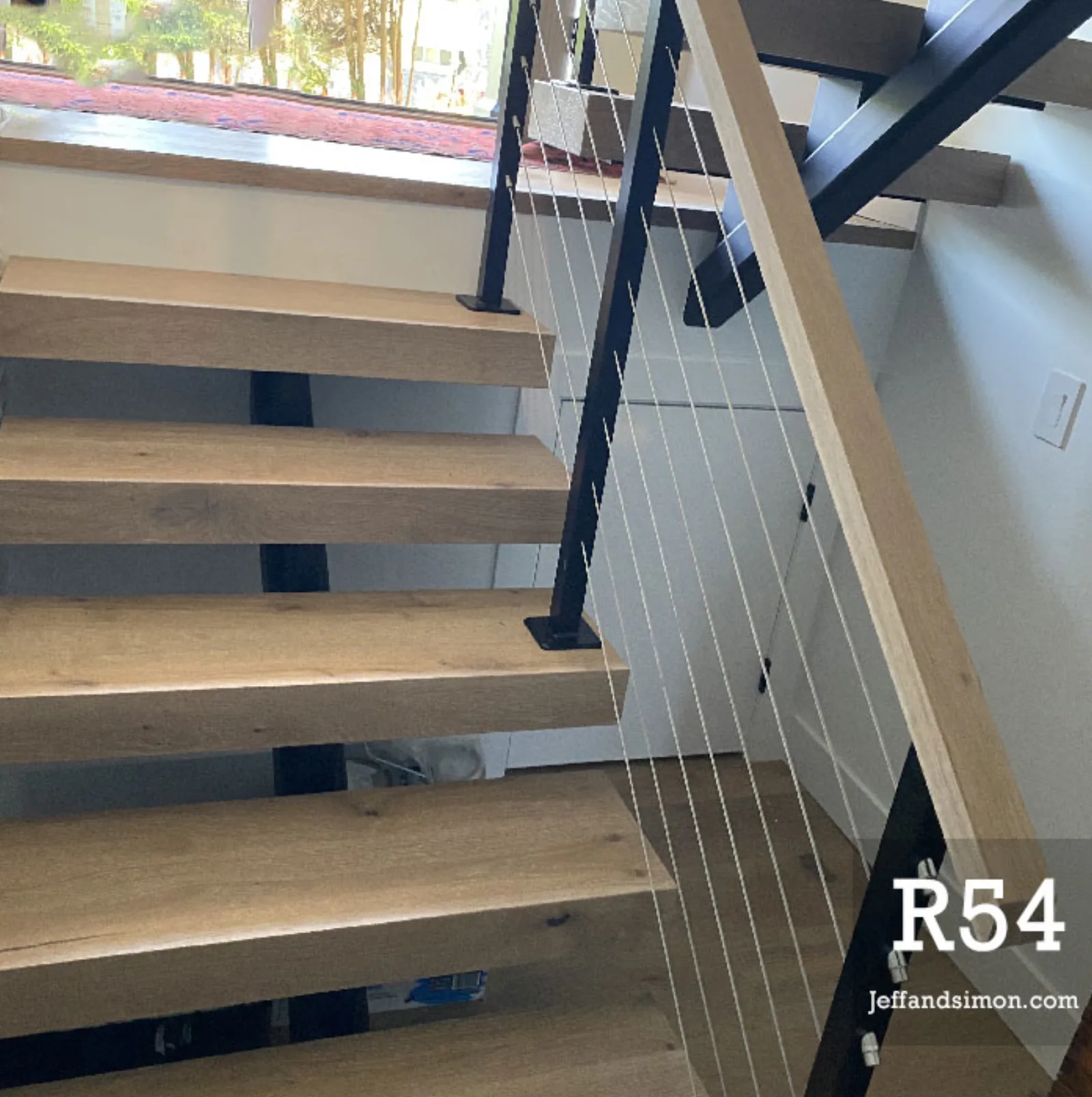
On a floating stair the tread is the part the client touches every day. It is also the part the eye lands on, because everything else (stringer, cantilever, railing) is designed to recede. Wood and steel are the two materials we specify most often in Metro Vancouver. They feel different underfoot, sound different on a wood-frame floor, and connect to the stringer differently. This page lays out the trade-off so the decision can be made early, before the bracket detail is fabricated.
What we mean by wood treads
On a floating stair, a wood tread is a solid hardwood slab, typically 50–75 mm (2–3 in) thick, sized to overhang the stringer on both sides. Common species in our work are white oak, walnut, and quarter-sawn fir. Engineered hardwood is not appropriate at this thickness; the visible end-grain on the overhang has to read as solid material. The tread is fastened from below into a steel bracket welded to the stringer, so no fasteners are visible on the walking surface.
- Solid hardwood, 50–75 mm thick, finished on five faces (top, bottom, three edges; the back face hides against the bracket).
- Site-finished or shop-finished, shop finish is more consistent and is what we usually specify.
- Sealed with a hardwax oil or a commercial polyurethane depending on the client's maintenance preference.
What we mean by steel treads
Steel treads on a floating stair are usually one of two builds. A folded steel pan is a sheet-metal tread (typically 3–6 mm plate) with a return on the front and back edges, often filled with concrete, terrazzo, or a thinset tile for the walking surface. A solid steel plate tread (10–20 mm) is welded directly to the stringer bracket and either left as the walking surface or topped with a slim hardwood, stone, or microcement layer. Each behaves differently on the structure and on the eye.
- Folded steel pan: lighter, can carry a fill (concrete, terrazzo) for a finished walking surface.
- Solid steel plate: heavier, reads as one continuous metal element with the stringer.
- Steel-plate-with-topper: combines steel structure with a softer top finish (oak, stone, microcement).
Feel and sound underfoot
A 50 mm solid wood tread is the warmest material on a floating stair, quiet, slightly warm to the touch, and forgiving on bare feet. Steel treads, especially uncovered plate, are louder underfoot, cooler to the touch, and harder. A wood floor under a steel-tread stair will transmit footfall noise to the floor below more than the same wood floor under a wood-tread stair. In an open-concept Vancouver home where the stair is in the main living area, the acoustic difference is noticeable. A steel-plate-with-hardwood-topper splits the difference well.
The bracket detail is different
A wood tread sits in a steel bracket welded to the stringer, typically a U-channel or an L-bracket that supports the tread from below and from the back. The bracket is concealed under the tread; the visible joint is wood-to-stringer. A steel tread is welded directly to the stringer (no bracket), or to a small steel ear that becomes part of the welded assembly. The visible joint is metal-to-metal. The bracket choice is locked at shop drawings, not at install, changing the tread material after fabrication usually means re-fabricating the stringer.
Finish life and refinishing
A wood tread will pick up wear at the front edge over years of use. A hardwax-oil finish can be spot-refinished in place; a polyurethane finish has to be sanded and re-coated as a full job. A steel tread does not wear in the same way, but a powder-coated steel tread will scratch through to the steel at the front edge, and the scratch is usually visible. Blackened steel patinas slightly over time, which most clients read as an asset, not a defect. Stone and concrete fills on a steel pan are essentially permanent and clean with normal floor-cleaning routines.
Where wood wins, where steel wins
Wood wins when the design intent is warm, residential, and quiet, and when the rest of the floor is wood. Steel wins when the design intent is industrial, monolithic, or when the stair has to read as one continuous metal object (mono stringer plus matching steel treads is the most extreme version of this). The hybrid, steel structure with a softer tread topper, is the most common spec on contemporary Vancouver custom homes because it preserves the visual continuity of the steel while keeping the walking surface warm.
- All-wood treads: warmest residential read, easiest to refinish, quietest underfoot.
- All-steel treads: most monolithic look, lowest maintenance, loudest underfoot.
- Steel plate with hardwood topper: most common on contemporary Vancouver custom homes.
Code applies to both
BC Building Code tread-and-riser geometry, slip resistance, and (where open risers are used) the 100 mm sphere rule apply regardless of tread material. Confirm the current edition with the authority having jurisdiction, start with the published [BC Building Code 2024](https://free.bcpublications.ca/civix/content/public/bcbc2024/) and (for City of Vancouver projects) the [Vancouver Building By-law](https://vancouver.ca/your-government/vancouver-building-by-law.aspx). Slip resistance on a polished steel tread can be a real concern on an exterior stair; on an interior stair it is usually addressed with surface finish (light blast, brushed, or a slim non-slip nosing) rather than a code variance.
Related questions
Can I switch from wood treads to steel treads after the stair is fabricated?
Usually no. The bracket detail at the stringer is different, a wood tread sits in a concealed steel bracket, a steel tread welds directly to the stringer. Changing the tread material after fabrication means re-fabricating the stringer assembly. Lock the tread material at shop drawings.
Do steel treads need a non-slip surface in a Vancouver home?
On an interior stair, most clients are comfortable with a lightly textured steel surface (light blast, brushed, blackened patina) without a separate non-slip strip. On an exterior steel stair, slip resistance becomes a real concern in rain, we usually specify a textured plate, a grating insert, or a non-slip nosing. Confirm requirements with the authority having jurisdiction for the project.
How thick should a solid wood tread be on a floating stair?
We specify 50–75 mm (2–3 in) solid hardwood for floating-stair treads. Thinner treads can deflect noticeably under load and look visually undersized against the steel stringer. Thicker treads are heavier on the bracket and can make the stair feel chunky. The exact thickness is set in shop drawings against the cantilever and the species.
Will steel treads make the upstairs feel colder?
Steel treads themselves do not change room temperature meaningfully, they are a small fraction of the floor area. They do feel cooler underfoot than wood, which clients sometimes interpret as a colder room. If barefoot warmth matters in the space, a hardwood topper on a steel plate is the usual solution.
Is there a hybrid that gives both the monolithic steel look and the warmth of wood?
Yes, a solid steel plate tread (10–20 mm) welded to the stringer, topped with a slim 20–25 mm hardwood plank. From the side the stair reads as continuous steel; from above the walking surface is warm wood. It is more fabrication than either pure option, but it is the most-specified hybrid in our recent contemporary Vancouver work.
Continue planning
- Floating stairs hub overview
- All four support strategies
- Mono stringer staircase deep dive (Trends)
- Floating stair fabrication guide
Plan wood vs steel treads on a floating stair for a real Vancouver project
Send drawings, photos, or a rough scope and we will help define the practical next step.