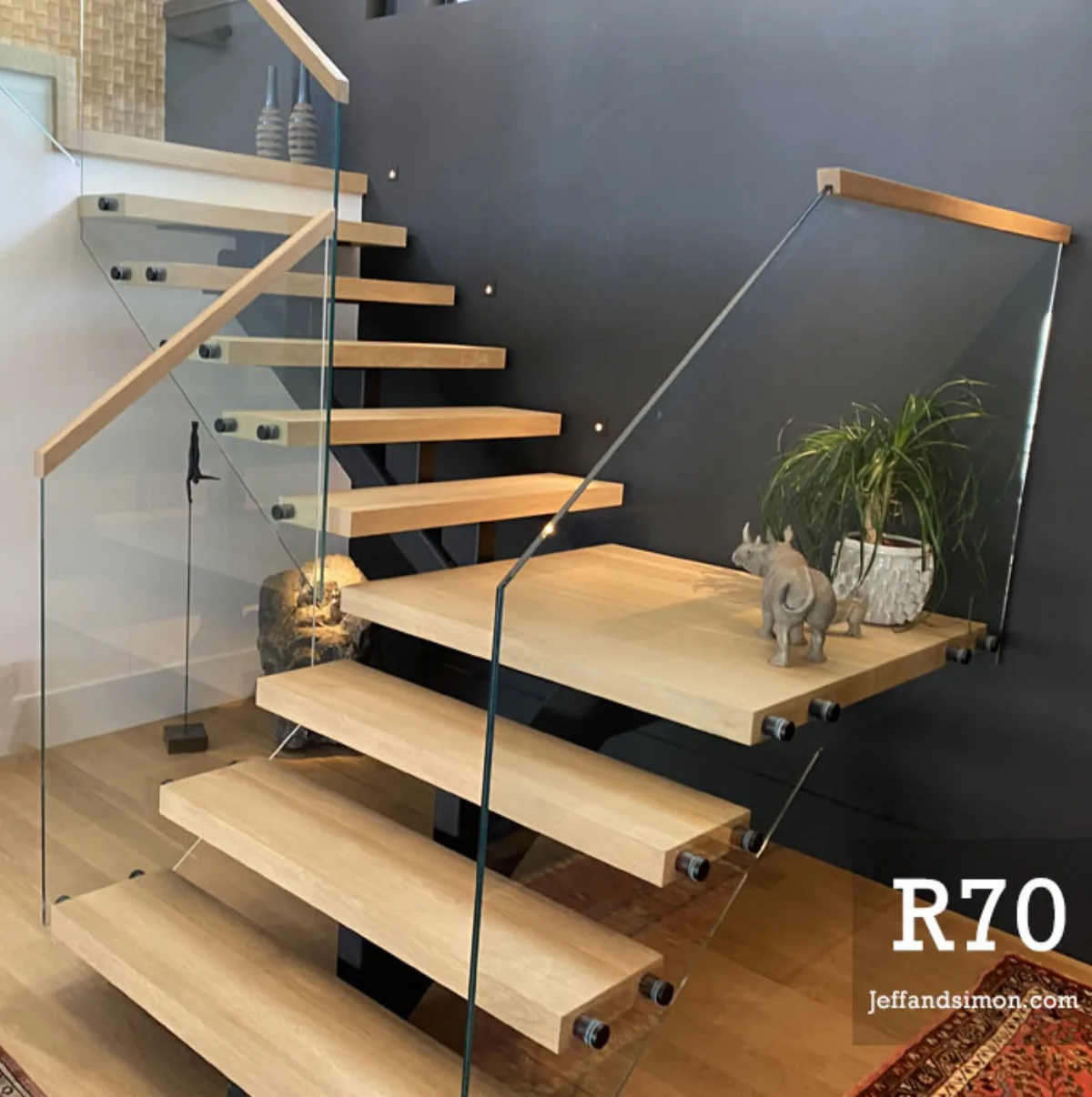
A custom residential steel staircase can be the design centrepiece of a home or a clean, durable alternative to wood that lasts without warping, creaking, or seasonal movement. The structural decisions, beam type, railing system, tread material, and finish, are all made before steel is cut. This guide covers what to plan.
Steel outperforms wood where it counts
Wood stairs in Vancouver homes swell, shrink, and creak. A well-fabricated steel stair does not. The stringer does not warp. The treads do not loosen. The finish system holds up to decades of use without sanding. Steel stairs in residential homes hold their geometry through BC's wet winters and dry summers.
Design options: from minimal to sculptural
Steel staircases span the full range from practical to architectural. A straight-run open-riser stair with cable railing is clean and code-direct. A sculptural mono stringer with walnut treads, glass guards, and blackened steel becomes a defining interior feature. Both are custom fabrication from the same material.
- Straight-run: simplest geometry, most cost-predictable, fast to install.
- L-shaped or U-shaped: needs landing coordination and clear opening dimensions.
- Curved or helical: high design value, longer lead time, specialist drawing work.
- Split-level or custom geometry: anything the space demands, quoted after a site review.
Railing makes or breaks the look
The railing system is the most visible part of the finished stair and usually the largest cost variable. Glass guards read open and modern. Cable railing is practical and light. Steel pickets add rhythm. Stainless hardware adds durability in high-use and coastal applications. Settle the railing choice before quoting, it affects fabrication, engineering, and the installation sequence.
Tread material drives the feel underfoot
Steel-pan treads with hardwood fill are the residential standard. Solid wood treads on steel brackets are slightly lighter in profile. Steel-plate treads with grip coating are cleanest for outdoor stairs. Engineered stone and large-format tile work with concealed brackets when the detail is carefully coordinated with the tile contractor. Each material changes the bracket detail, the tread thickness, and the finished floor heights.
Permits and structural coordination
Replacing or relocating a staircase in a home almost always requires a building permit. Structural changes to the floor opening, the stair connections, or the guard system need to be coordinated with the building permit application. We prepare fabrication drawings and coordinate with the project engineer or permit reviewer as part of the project scope.
Related questions
How much does a custom residential steel staircase cost in Vancouver?
A straight-run residential steel staircase with open treads and cable railing typically starts around $18,000–$30,000 installed. Adding glass guards, premium tread material, or a curved or L-shaped layout moves the project into the $35,000–$65,000 range. Cantilevered or suspended stairs, complex geometry, and high-end finishes go above that. Every project is quoted after a site review.
Does a residential steel staircase need a permit?
Replacing an existing staircase or modifying the stair opening almost always requires a building permit. Cosmetic railing replacements are sometimes permit-exempt. Confirm the scope with your municipality before fabrication starts.
Can a steel staircase be added to an existing home?
Yes. Most residential steel staircase retrofits go into homes with an existing stair opening. The opening dimensions, finished floor heights, framing layout, and connection points all need to be field-measured before fabrication. Some openings need framing modifications to work cleanly.
How long does a residential steel staircase take?
Most residential projects run 6–10 weeks from signed drawings to installation. Projects with premium coatings, glass guards, or complex geometry can run longer. Lead time depends on the engineering cycle, finish schedule, and shop load at the time of order.
Discuss residential steel staircase for a real project
Send drawings, photos, or a rough scope and we will help define the practical next step.