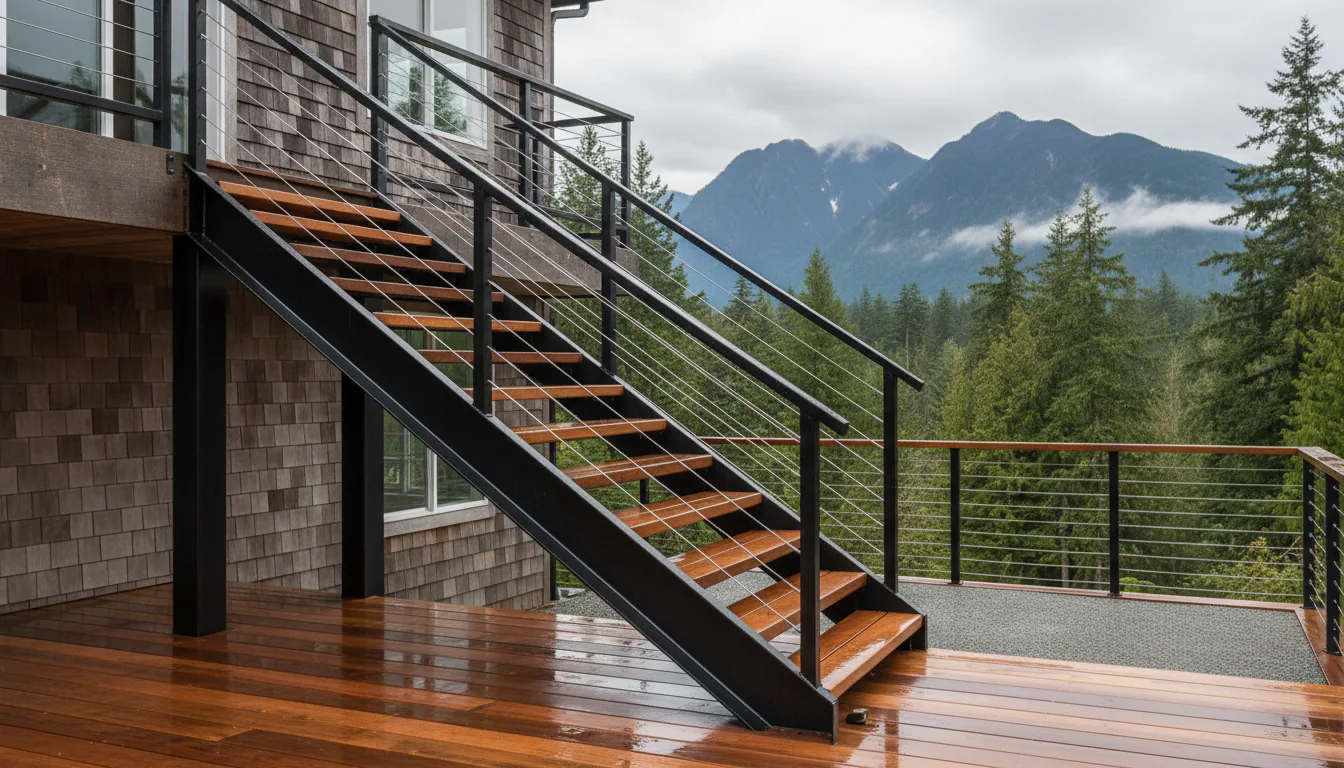
A well-built steel staircase will outlast the rest of the building's finishes, but the surface that protects the steel is what the homeowner actually sees and touches. Interior blackened steel, powder-coat, and stainless finishes each respond differently to cleaning, wear, and occasional touch-up. Exterior galvanized and powder-over-galvanized stairs on Metro Vancouver's coastal climate need a different routine. This page covers what to do, what not to do, and when to call the fabricator back instead of trying a field repair.
Interior finishes, what each one needs
Three finishes dominate interior steel staircase work in Vancouver custom homes: blackened or hot-rolled with a wax or oil topcoat; flat or satin powder coat in black, charcoal, or a custom RAL; and brushed or polished stainless steel. Each has a different cleaning protocol and a different repair pathway.
- Blackened / wax finish: dust regularly with a soft dry cloth; wipe with a barely-damp cloth if needed; refresh the wax topcoat every 12–24 months on touch surfaces (handrail caps, tread nosings) with the same wax product used at fabrication.
- Powder coat: dust and wipe with mild soap and water; avoid solvents, abrasives, and ammonia-based cleaners; touch-up sticks in the original RAL colour are provided at install for chip repair.
- Brushed stainless: wipe with stainless-specific cleaner in the direction of the brush grain; avoid chloride-based cleaners (bleach, some bathroom sprays) which can pit the surface over time.
- Polished stainless: clean with non-abrasive stainless polish; fingerprints show easily but rinse off with the standard cleaner.
- Oiled hot-rolled steel: re-oil annually with the original oil product; expect the surface patina to deepen over the first year and stabilize.
Exterior steel, coastal climate considerations
Metro Vancouver's coastal environment is harder on exterior steel than the inland BC interior. Salt-laden air on the North Shore, the Sea-to-Sky corridor, and the Lower Mainland marine zones accelerates any finish failure on exposed metal. Hot-dip galvanizing is the long-life baseline for exterior structural steel; American Galvanizers Association data shows hot-dip galvanizing protects steel for 50+ years in mild rural environments and shorter (but still decades) in coastal exposure depending on coating thickness and substrate. A powder-coat layer over galvanizing (duplex system) extends life further and adds colour, but the duplex system has its own inspection routine.
- Annual visual inspection: walk the stair looking for chips, scratches, or rust bleed at weld points and connections.
- Wash twice a year: rinse with fresh water to remove salt deposits; mild detergent if dirt is heavy.
- Touch up coating defects within the same season: bare galvanizing in a chip needs cold-galvanizing repair paint; bare powder coat over galvanizing needs powder-touch-up product.
- Hardware check: bolts, fasteners, and welded connections inspected annually for any sign of movement or corrosion.
- Drainage check on stair structure: weep holes and drainage paths clear; standing water on horizontal surfaces is the most common corrosion accelerator.
Treads, wood, stone, and steel
Tread surfaces wear faster than the steel structure. Wood treads (white oak, walnut, rift-cut quarter-sawn) need the same finish maintenance the rest of the home's hardwood needs, typically a refresh of the topcoat every five to ten years depending on traffic, plus pad-on-pad cleaning routine in between. Stone or terrazzo treads need a sealer refresh every two to five years depending on the stone. Solid steel treads need the same care as the stringer finish. Edge nosing is the highest-wear zone on every tread material; expect to address nosing wear (re-finish, re-polish, or re-seal) before the field of the tread shows wear.
- Hardwood treads: refresh topcoat every 5–10 years; address nosing wear first.
- Stone or terrazzo treads: seal every 2–5 years per stone-supplier specification.
- Steel treads: same finish protocol as the stringer.
- All tread materials: protective mats during heavy moving days; never drag furniture across treads.
Railings and guards
Glass guard panels need glass-cleaner attention every few weeks on touch surfaces; the stainless or steel hardware that holds the glass needs an annual check for fastener torque and any sign of finish degradation. Cable railings need an annual cable-tension check, stainless cable stretches slightly in the first year of service and benefits from a torque-and-re-tension visit. Picket and rod railings are the lowest-maintenance guard system, requiring only the finish care described above. All railings should be checked annually for fastener tightness at the post-to-structure connections, a railing that develops play at the post base is a safety item, not an aesthetic one.
When to call the fabricator back
Most maintenance is owner-managed. Three situations should trigger a callback to the original fabricator instead of a DIY repair. First, structural movement, any unexpected play, deflection, or new noise from the stair structure is an engineering item, not a finish item. Second, finish damage in a hard-to-match colour or surface, touch-up on a custom blackened wax finish or a hand-burnished bronze is shop work, not field work. Third, hardware replacement on glass guards, the engineering loads on guard hardware are non-trivial and replacement parts must match the original specification. A fabricator call-back for a finish touch-up on a stair installed within the past five years is a normal part of the service relationship, not a warranty claim.
Related questions
How often does a steel staircase need professional maintenance?
Most residential interior steel stairs need only annual owner-managed care: dust, clean per finish protocol, and a finish refresh every one to two years on touch surfaces. Exterior galvanized stairs need an annual visual inspection and a twice-yearly fresh-water rinse in coastal zones. Professional fabricator visits are typically only needed for finish touch-up on hard-to-match surfaces or for any structural concern.
Can a blackened steel finish be refreshed at home?
Yes, on touch surfaces. The wax or oil topcoat used at fabrication is the product to use for refresh, applying it with a clean soft cloth, then buffing off the excess after 10–15 minutes. For larger surfaces or surfaces with visible wear-through to the base metal, a fabricator call-back is the better path, the blackening chemistry is shop work.
How do I touch up a chip in powder-coat finish?
Touch-up sticks in the original RAL colour are provided at install. Clean the area, apply a thin coat of the touch-up product, and let it cure. For larger areas of damage, more than a coin-sized chip, a fabricator call-back is the better path because the larger touch-up needs a feathered edge to read well, and that is workshop work.
How long does an exterior galvanized steel staircase last?
Hot-dip galvanizing on exterior structural steel typically protects the steel for 30–70+ years depending on coating thickness, the local environment, and ongoing maintenance. Coastal exposure shortens that range; inland exposure lengthens it. A duplex coating system (powder coat over galvanizing) extends life further and adds colour. The American Galvanizers Association publishes service-life calculators based on coating thickness and atmospheric category.
What is the most common maintenance mistake on a steel staircase?
Using an aggressive cleaner, solvent, abrasive, or chloride-based, on a finished surface that is not designed for it. Powder coat damaged by solvent, blackened steel stripped by aggressive cleaning, stainless pitted by bleach, all of these are preventable with the cleaning protocol that matches the finish. The second most common mistake is leaving water standing on horizontal surfaces of exterior galvanized stairs, which accelerates any coating breakdown.
Discuss steel staircase maintenance vancouver for a real project
Send drawings, photos, or a rough scope and we will help define the practical next step.