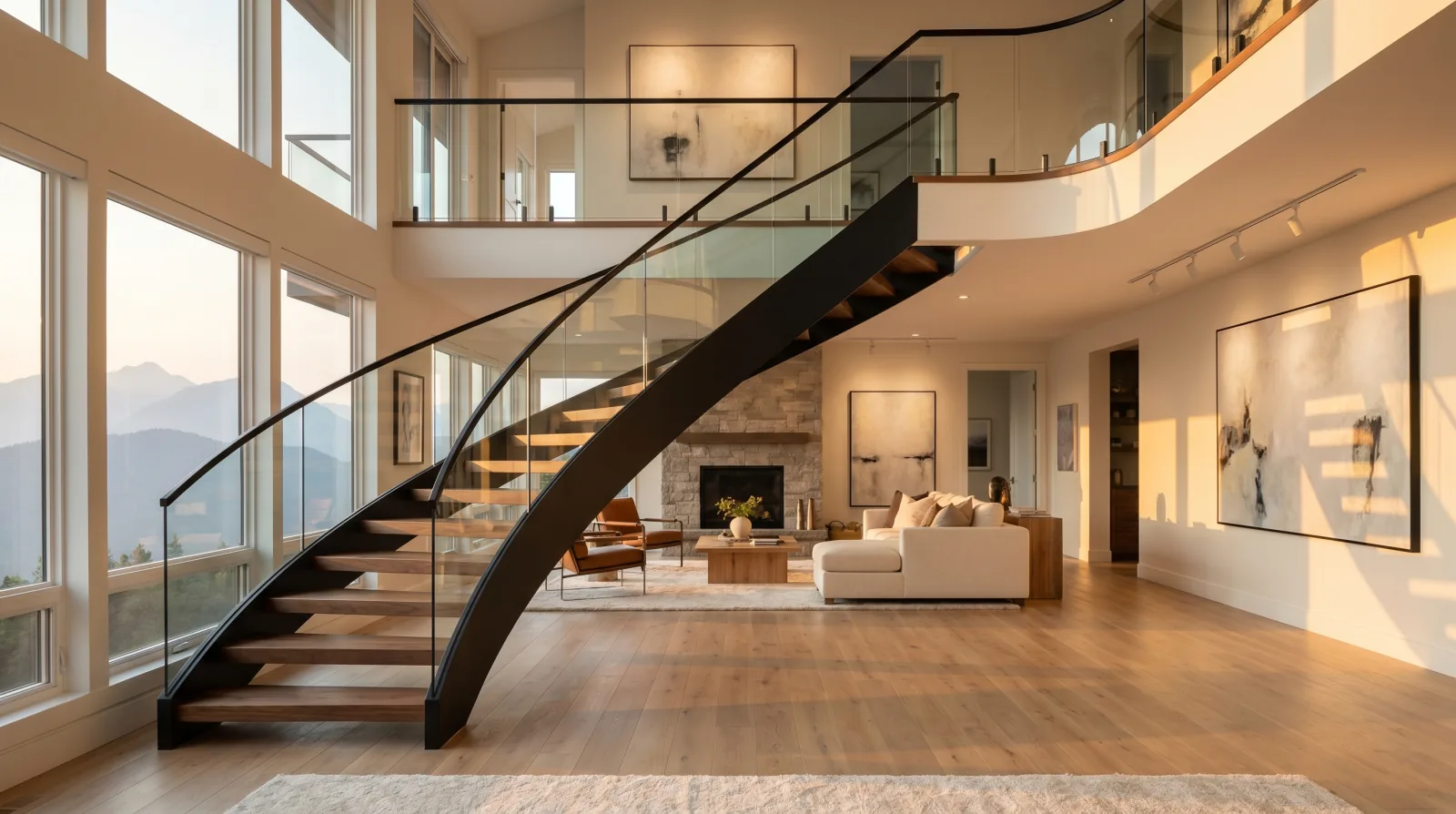
Replacing or upgrading a staircase is one of the larger discretionary renovation decisions a Vancouver homeowner makes, and the resale question is usually the first one asked. The honest answer is that staircase work can absolutely add value, but only when the spend is matched to the home, the buyer, and the rest of the interior. A $45,000 feature stair in a $1.5M starter townhouse is not the same investment as the same stair in a $4M West Side single-family home. This page covers what tends to increase resale, what does not, and how to think about staircase ROI before committing to a fabrication scope. It is not financial or legal advice, talk to a Vancouver-area realtor or appraiser for project-specific resale guidance.
Two reasons staircases affect home value
Buyers respond to a staircase for two distinct reasons, and they often get conflated. The first is a safety and condition signal: a worn, creaking, or visibly out-of-code stair raises questions about the rest of the home. Replacing a failing stair removes a negative signal in a way that any inspector or buyer can see. The second is a design and lifestyle signal: a feature staircase that is intentionally part of the interior architecture creates a perceived-quality lift across the whole space. Most successful staircase investments in Vancouver address both, they correct a deficient or dated stair AND establish the home's interior as a designed environment.
- Condition signal: an old or unsafe stair is a visible negative that suppresses offers regardless of the rest of the home.
- Design signal: a feature stair contributes to the buyer's read of the interior as 'designed' rather than 'finished'.
- Both signals matter, the strongest projects address both at once.
What appraisers and realtors actually measure
A residential appraisal in BC follows the comparable-sales method for most single-family and multi-family properties, the appraiser values the home against recent sales of similar homes in the same neighbourhood, adjusting for differences. Custom finishes (including a feature staircase) are not line items on the appraisal form. They influence value through condition ratings, quality categories, and overall presentation. Realtors think differently: a striking interior gets more showings, drives more competing offers, and supports a higher list price. Both effects are real; neither shows up as a dollar-for-dollar return on the staircase invoice. Industry resources from organizations such as [BC Assessment](https://www.bcassessment.ca/) and the [Real Estate Board of Greater Vancouver](https://www.rebgv.org/) are the right starting point for understanding how property values are tracked locally.
- BC residential appraisal: comparable-sales method dominates, custom finishes show up indirectly via condition and quality ratings.
- Realtor pricing: feature interiors drive more showings and stronger offer dynamics; the staircase is part of the read.
- Neither path produces a dollar-for-dollar return, staircase work returns value through positioning, not line-item accounting.
When a staircase upgrade reliably adds value
Five scenarios consistently support a real value lift from staircase work. First, replacing a stair that fails BC Building Code or has visible safety problems, buyers respond strongly to negative-signal removal. Second, replacing a dated stair (90s carpeted, dark stained oak, hollow MDF risers) in a home where the rest of the interior has been updated, the stair becomes the obvious laggard and pulls down the room. Third, opening up a closed staircase in a home where the modern open-plan reno is the value proposition, light and sightlines matter more than the stair itself. Fourth, adding a feature stair to a renovated entry or great room, the stair acts as the visual anchor for the whole space. Fifth, replacing a heavy wood stair with a steel one in a home that markets as modern or architectural, the steel is part of the brand. The [Replacing Wood Stairs with Steel page](/steel-staircases/replacing-wood-stairs-with-steel/) covers the practical side of that swap.
- Replacing a code-deficient or unsafe stair, strong negative-signal removal.
- Updating a dated stair where the rest of the home has been renovated.
- Opening up a closed stair to support an open-plan layout.
- Adding a feature stair to a renovated entry or great room.
- Replacing wood with steel in a home marketed as modern or architectural.
When a staircase upgrade does not add value
Two scenarios usually do not return the investment. The first is over-improvement: spending feature-stair money in a home or neighbourhood where buyer expectations are for conventional finishes. A $50,000 sculptural stair in a $1.3M East Vancouver townhouse will impress visitors but will not move the appraisal or the offer dynamics. The second is mismatched style: installing a contemporary mono stringer in a heritage Craftsman where the rest of the interior has not been modernized. The stair will read as wrong rather than impressive. The honest test is whether the stair would still be the right choice if resale were not part of the conversation. If yes, the value question is secondary. If no, the project is being scoped for a buyer who does not exist yet.
- Over-improvement: feature stair in a home or neighbourhood that does not support the spend.
- Mismatched style: contemporary stair in an unrenovated heritage or traditional interior.
- Honest test: would this stair still be the right choice if resale were not part of the decision?
How to think about ROI without a fabricated number
Trying to assign a percentage return to staircase work is a trap, every reputable resale-ROI dataset is national or US-based, not Vancouver-specific, and not specific to feature-stair work. A more useful frame is: what does the staircase enable in the rest of the home, and what does the rest of the home enable for the staircase? A staircase upgrade rarely pays back on its own. A staircase upgrade as part of a coherent interior reno that lifts the home into a higher buyer category can pay back well. Stairs work hardest as a value multiplier on other work, not as a stand-alone investment.
- Avoid percentage-return claims, there is no Vancouver-specific dataset that supports them.
- Frame the stair as part of an interior strategy, not as a stand-alone improvement.
- The strongest returns come from staircase work that visibly upgrades the read of the surrounding rooms.
What this means for project scoping
The practical advice from years of fabricating stairs into Vancouver renovations and new builds: scope the staircase to the home, not to the showroom photo. Match the steel and tread package to the existing finish level. Resolve the floor connection, the railing, and the lighting around the stair before fabrication starts. Confirm any code-related work, particularly open-riser configurations and guard heights, with the authority having jurisdiction. And bring the fabricator into the conversation before drywall is closed, because a feature stair retrofitted into a finished interior carries a meaningful cost premium over one designed in from the start. The [Steel Staircase Cost Guide](/steel-staircases/steel-staircase-cost-guide/) is the right next read once a direction is set.
- Scope the stair to the home, not to a showroom photo.
- Match the steel and tread package to the existing finish level of the interior.
- Resolve the floor connection, railing, and stair lighting before fabrication starts.
- Confirm any code-related guard or open-riser questions with the authority having jurisdiction.
- Bring the fabricator into the conversation before drywall is closed.
Who to talk to before committing
Three conversations should happen before a homeowner commits to staircase work for resale-driven reasons. A Vancouver-area realtor who has sold homes in the same neighbourhood within the last twelve months can speak to current buyer expectations. A residential appraiser can confirm how custom interior work flows through the comparable-sales method for the property. The fabricator (and where needed, the structural engineer) can confirm what is buildable in the existing structure and what the realistic budget range is. None of these conversations replace the others, they answer different questions about the same decision.
Related questions
Does a new staircase add resale value to a Vancouver home?
It can, but rarely as a stand-alone investment. Staircase work tends to add value most reliably when it removes a negative signal (a code-deficient or visibly dated stair) or when it acts as the visual anchor for a larger interior renovation that lifts the home into a higher buyer category. A feature stair installed without coordinated work on the surrounding interior usually does not produce a dollar-for-dollar return.
What is the ROI on a custom steel staircase?
There is no Vancouver-specific dataset that supports a percentage-return number on feature-stair work, and most published staircase-ROI figures are US national averages that do not transfer cleanly to Metro Vancouver. The more useful question is what the staircase enables in the rest of the home. A coordinated interior upgrade that includes a new stair can substantially increase market positioning; a stair done in isolation usually cannot.
Will a feature staircase help my home sell faster?
Often yes. Striking interiors generate more showings and stronger offer competition, and a feature staircase contributes directly to the buyer's first read of the space. The effect is most reliable when the stair is consistent with the rest of the home, a contemporary stair in a fully modernized interior reinforces the message, while the same stair in an unrenovated heritage home reads as out of place.
Is it better to replace the staircase or refinish the existing one?
Depends on the existing stair. If the structure is sound and the look is dated, refinishing the treads, replacing the guard, and recoating the stringers can be cost-effective. If the stair has code or safety issues, the configuration is wrong for the floor plan, or the steel structure is heavily worn, replacement is the better path. The [Replacing Wood Stairs with Steel page](/steel-staircases/replacing-wood-stairs-with-steel/) covers the swap in more detail.
How much should I spend on a staircase for resale purposes?
Match the spend to the home and the neighbourhood. In a home where the rest of the interior is renovated and the comparable sales support a higher price band, a feature stair can be a reasonable investment. In a home where the surrounding finishes are conventional, the same spend will not be reflected in the appraisal or the buyer response. Talk to a Vancouver-area realtor about comparable sales before scoping the project.
Does adding a staircase to a basement secondary suite affect home value?
Yes, often substantially, but for different reasons than a feature stair in the main living area. A safe, code-compliant stair to a legal secondary suite supports the suite's rental income and is part of the value of the suite itself. The stair is a functional and code-compliance item, not a design statement. See the [Space-Saving Stair Options page](/steel-staircases/space-saving-stair-options/) for typical configurations in compact suites.
Are open-riser staircases code-compliant for resale in BC?
Yes, when designed correctly. The BC Building Code allows open-riser stairs in most residential applications, subject to the 100 mm sphere rule that prevents a child-sized sphere from passing between treads ([BC Building Code Part 9.8](https://free.bcpublications.ca/civix/document/id/public/bcbc2024/bcbc_2024dbp9s8)). A non-compliant open-riser configuration is a negative inspection finding and will affect resale. Confirm any open-riser design with the authority having jurisdiction before fabrication.
Should I talk to a realtor before committing to a staircase project?
If the project is partly motivated by resale, yes. A Vancouver-area realtor who has sold comparable homes in the same neighbourhood within the last twelve months can speak to current buyer expectations and whether the proposed spend matches the market. The conversation usually takes less than an hour and almost always changes the scope in a useful way.
Discuss does a new staircase add home value in vancouver? for a real project
Send drawings, photos, or a rough scope and we will help define the practical next step.