Vancouver's housing-density shift has put space-saving stairs in the middle of more design conversations than at any time in recent memory. Laneway houses, secondary suites, infill duplexes, and small-footprint single-family homes all need a stair that connects two floors without consuming floor area that the rest of the plan cannot spare. The right answer is rarely a spiral, it is usually a tightly designed straight-run, a switchback with a compact landing, or in narrow cases an alternating-tread stair under the right code conditions. This page covers the practical options Vancouver Stairs fabricates for tight spaces, the BC Building Code constraints that narrow the choice, and the design moves that recover the most floor area without compromising the stair.
What 'space-saving' actually means
Space-saving is not a stair type, it is a constraint that drives stair-type selection. The constraint is usually one of three: a narrow plan where the stair has to fit in a corridor-width footprint, a small floor area where the stair's plan opening can't take a full conventional run, or a vertical separation between two floors that demands a tight rise. Each constraint narrows the options differently. A narrow-plan home wants a straight-run against a wall. A small floor area wants a switchback with a tight landing. A tight vertical rise may need an alternating-tread or, as a last resort, a spiral.
- Narrow plan → straight-run against a wall is usually the right answer.
- Small floor area → switchback with a compact landing recovers floor area on both levels.
- Tight vertical rise → alternating-tread or spiral, both with code restrictions.
Straight-run against a wall: the default for laneway houses
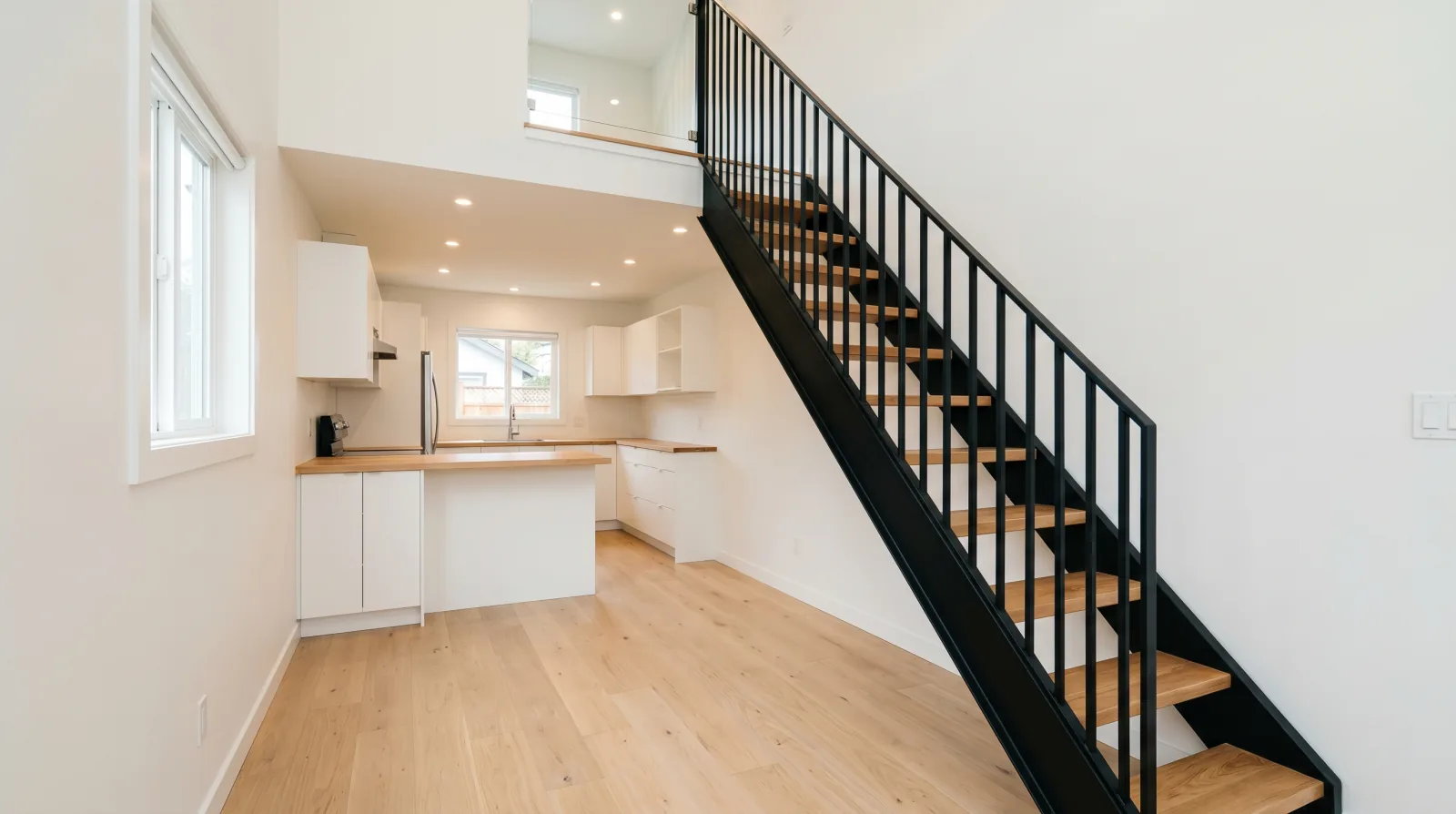
Most Vancouver laneway houses end up with a straight-run staircase pressed against an interior wall, typically a steel mono stringer or a steel double stringer with a wall-mounted handrail. The straight-run takes the smallest practical floor area for a code-compliant stair in a residential occupancy, and it preserves a clean wall on one side for storage, art, or a closet under the stair. Open-riser configurations open the space visually and let light through from one floor to the other. The [Mono Stringer Stairs hub](/metal-stair-fabrication/mono-stringer-stairs/) covers the structural and design detail for the most common laneway-house version.
- Footprint: smallest practical floor area for a code-compliant residential stair.
- Wall side: typically wall-mounted handrail, leaving the wall otherwise clean.
- Open side: cable, glass, or steel-picket guard depending on design.
- Open risers: open the space visually and let light pass between floors.
Switchback (U-shape) with a tight landing
A switchback staircase turns 180 degrees through a single landing, recovering the long footprint of a straight run by stacking the stair on itself. The landing is the key dimension, a half-landing big enough to be code-compliant for the occupancy and the stair width. Switchbacks suit secondary suites, infill duplexes, and small homes with a deeper floor plan but limited width. They are also the standard configuration for most multi-family and commercial egress stairs because the half-landing requirement is straightforward to meet in those occupancies. The [Switchback vs Straight Run page](/commercial-stairs/switchback-vs-straight-run/) compares the two configurations from the commercial side; the same tradeoffs apply at the residential scale.
- Footprint: stacks the run on itself, recovers length at the cost of width.
- Landing dimension is the critical detail, must satisfy BC Building Code minimums.
- Suits deep, narrow floor plans typical of Vancouver infill lots.
- Standard for commercial and multi-family egress stairs; works at residential scale too.
Alternating-tread (ship's ladder) stairs, code-restricted but useful
An alternating-tread staircase uses treads that alternate between the left and right foot, allowing a steeper pitch (typically 45–68 degrees) than a conventional stair. The result is a stair that fits in a very small floor area and reaches a tight vertical rise that conventional geometry cannot. BC Building Code restricts alternating-tread stairs to secondary access, typically lofts, mezzanines, equipment access, and limited-use upper floors, and explicitly does not permit them as the primary stair to a habitable room in most configurations. They are useful when the geometry won't accept anything else and the use case fits the code's allowed scope. Confirm permitted use with the authority having jurisdiction before specifying one. The BC Building Code provisions are in [Part 9.8](https://free.bcpublications.ca/civix/document/id/public/bcbc2024/bcbc_2024dbp9s8) for housing and small buildings.
- Geometry: alternating treads allow a steeper pitch and a much smaller footprint than a conventional stair.
- Code: BC Building Code restricts use to secondary access, lofts, mezzanines, limited-use upper floors.
- Not permitted as the primary stair to a habitable room in most configurations, confirm with the AHJ.
- Useful when nothing else fits and the use case matches the code's allowed scope.
Spiral staircases: smallest footprint, narrowest allowed use
A spiral staircase rotates around a fixed centre column with treads cantilevering from the column itself. The footprint is the smallest of any stair type, typically a circle 1.4 m to 2.0 m across, which makes spirals attractive for tight spaces. In BC, spiral staircases are generally restricted to secondary access (rooftop decks, lofts, mezzanines) and are not permitted as the primary or only stair to a habitable room in most configurations. Code restrictions also apply to tread depth at the walk line, headroom, and centre-column diameter. The [Spiral Staircases page](/metal-stair-fabrication/spiral-staircases/) covers the fabrication and configuration detail. Confirm the permitted use with the AHJ before specifying.
- Footprint: smallest of any stair type, typically a circle 1.4 m–2.0 m across.
- Allowed use in BC: generally secondary access only, roof decks, lofts, mezzanines.
- Walk-line tread depth and headroom are code-driven, confirm geometry early.
- Avoid as the only stair to a habitable room, confirm with the AHJ before specifying.
BC Building Code minimums that govern every space-saving stair
Even the smallest stair has to satisfy BC Building Code minimums for the occupancy. Tread depth, riser height, headroom, guard height, and (where children may be present) the 100 mm sphere rule between open risers all apply regardless of footprint. For residential Part 9 buildings, the [BC Building Code Part 9.8 provisions](https://free.bcpublications.ca/civix/document/id/public/bcbc2024/bcbc_2024dbp9s8) are the operative section; commercial and multi-family buildings fall under Part 3. The City of Vancouver overlays the [Vancouver Building By-law](https://vancouver.ca/your-government/vancouver-building-by-law.aspx) on top of the provincial code; other Metro municipalities reference the provincial code directly. This page is a planning overview, not a code review, every project needs sign-off from the authority having jurisdiction.
- Tread depth, riser height, headroom: set by code regardless of stair type.
- Guard height: typically 900 mm on stair flights, 1070 mm on landings for residential (confirm with AHJ).
- Open-riser 100 mm sphere rule: applies to most residential open-tread stairs.
- Vancouver projects: confirm [Vancouver Building By-law](https://vancouver.ca/your-government/vancouver-building-by-law.aspx) overlay with the design team and the AHJ.
Design moves that recover floor area without compromising the stair
A handful of design moves consistently recover floor area on tight-stair projects. Pushing the stair to a wall instead of floating it in the room frees up plan area for furniture. Specifying open risers lets light pass through the stair and makes a small space read larger. Using a wall-mounted handrail on one side instead of a guard system narrows the stair footprint by a hundred millimetres or more. Designing the under-stair area for storage (a hall closet, a powder room, a mechanical chase) reclaims the volume the stair displaces. And resolving the floor opening dimensions against the chosen stair type before framing is signed off avoids the most expensive late-stage rework, re-framing to accommodate a stair the opening cannot accept.
- Push the stair to a wall, frees plan area on both levels.
- Specify open risers, lets light pass through, makes small spaces read larger.
- Wall-mounted handrail on the wall side, narrower footprint than a guard system on both sides.
- Design under-stair storage, reclaims the volume the stair displaces.
- Confirm the floor opening dimensions against the chosen stair type before framing.
Related questions
What is the smallest staircase that meets BC code for a Vancouver laneway house?
A straight-run steel mono stringer or double stringer pressed against an interior wall typically takes the smallest practical floor area for a code-compliant primary residential stair. The exact width and length depend on the floor-to-floor rise, the chosen tread depth and riser height, and the headroom available. Confirm the geometry against [BC Building Code Part 9.8](https://free.bcpublications.ca/civix/document/id/public/bcbc2024/bcbc_2024dbp9s8) and the authority having jurisdiction before framing.
Can I use a spiral staircase as the main stair in a Vancouver home?
Usually no. BC Building Code generally restricts spiral staircases to secondary access, roof decks, lofts, mezzanines, and they are not typically permitted as the primary or only stair to a habitable room. The exact rule depends on occupancy and configuration. Confirm with the authority having jurisdiction before specifying. The [Spiral Staircases page](/metal-stair-fabrication/spiral-staircases/) covers fabrication detail.
Are alternating-tread stairs allowed in BC?
Yes, but only for secondary access in most configurations, lofts, mezzanines, equipment access, limited-use upper floors. BC Building Code does not generally permit alternating-tread stairs as the primary stair to a habitable room. They are useful when conventional geometry will not fit and the use case matches the code's allowed scope. Confirm with the authority having jurisdiction before specifying.
Is a switchback or a straight-run better for a Vancouver secondary suite?
Depends on the floor plan. A straight-run is more efficient if the plan is long and narrow. A switchback recovers length at the cost of width and works better if the plan is deeper. Switchbacks also create a half-landing that can be useful for furniture clearance at the top or bottom of the stair. The [Switchback vs Straight Run page](/commercial-stairs/switchback-vs-straight-run/) covers the comparison in detail.
How narrow can a residential stair be in BC?
BC Building Code Part 9.8 sets minimum widths for residential stairs that depend on the occupancy and the use, primary stair to a habitable room versus secondary access. The provincial code sets the baseline; the City of Vancouver adds its own overlay through the [Vancouver Building By-law](https://vancouver.ca/your-government/vancouver-building-by-law.aspx). This page is not a substitute for the code, confirm the minimum width for your project with an architect or the authority having jurisdiction.
Does open-riser construction make a small stair feel bigger?
Yes, usually. Open risers let light pass through the stair from one floor to the other and visually reduce the mass of the stair in the room. The effect is real in small Vancouver homes, laneway houses, and secondary suites where the stair is one of the largest interior elements. Open-riser stairs must satisfy the 100 mm sphere rule between treads where children may be present, see [BC Building Code Part 9.8](https://free.bcpublications.ca/civix/document/id/public/bcbc2024/bcbc_2024dbp9s8) and the [BC Code: Open Risers & Guards page](/floating-stairs/bc-code-open-risers-guards/).
What is the cheapest space-saving staircase?
A straight-run double stringer with a wall-mounted handrail on one side and an open-riser tread package is usually the most cost-efficient compact stair. Mono stringer adds cost for the cantilevered tread loading and bracket detailing. Spiral kits are sometimes the cheapest unit cost but rarely the cheapest installed cost when the floor framing has to be modified to accept them. See the [Steel Staircase Cost Guide](/steel-staircases/steel-staircase-cost-guide/) for the full breakdown.
Can I add a steel staircase to an existing tight space?
Often yes, but the constraints are different than a new build. The floor opening dimensions, the anchor conditions at top and bottom, the headroom under any existing soffits, and the access path for the steel into the room all have to be confirmed before fabrication. Retrofitting a stair into a finished interior is more expensive than designing one in from the start. Send photos, drawings, and dimensions for a project-specific quote.
Discuss space-saving staircase options for vancouver homes for a real project
Send drawings, photos, or a rough scope and we will help define the practical next step.