Picking a staircase type is the first design decision that locks in cost, engineering scope, and the floor plan around the stair. The right answer depends on how the steel will read in the room, what the floor framing can anchor into, how much space the stair has to live in, and what the BC Building Code allows for the occupancy. This page walks through the staircase types Vancouver Stairs fabricates and the questions that point a project at one type over another. It is a planning guide, not a substitute for review by an architect, an engineer, or the authority having jurisdiction.
Start with the structural question, not the style
Most homeowners start by browsing photos and then try to back into a structural type. That is the wrong sequence. The structural type, mono stringer, double stringer, closed stringer, cantilevered, curved, or spiral, sets the load path, the anchor points, the engineering scope, and the way the stair lands on the floor. Style follows structure: a mono stringer can read modern or sculptural depending on tread, guard, and finish, but the underlying structure is fixed before any of those choices matter. See the [Stair Stringer Types page](/metal-stair-fabrication/stair-stringer-types/) for the full primer on what a stringer is and how each type works.
- Structural type sets the engineering scope and the anchor conditions.
- Style, tread material, guard system, finish, is layered on top of the structure.
- A type chosen for the wrong reason (looks first, structure second) is the most common source of late-stage redesign on a Vancouver custom stair.
Mono stringer: the modern default for Vancouver custom homes
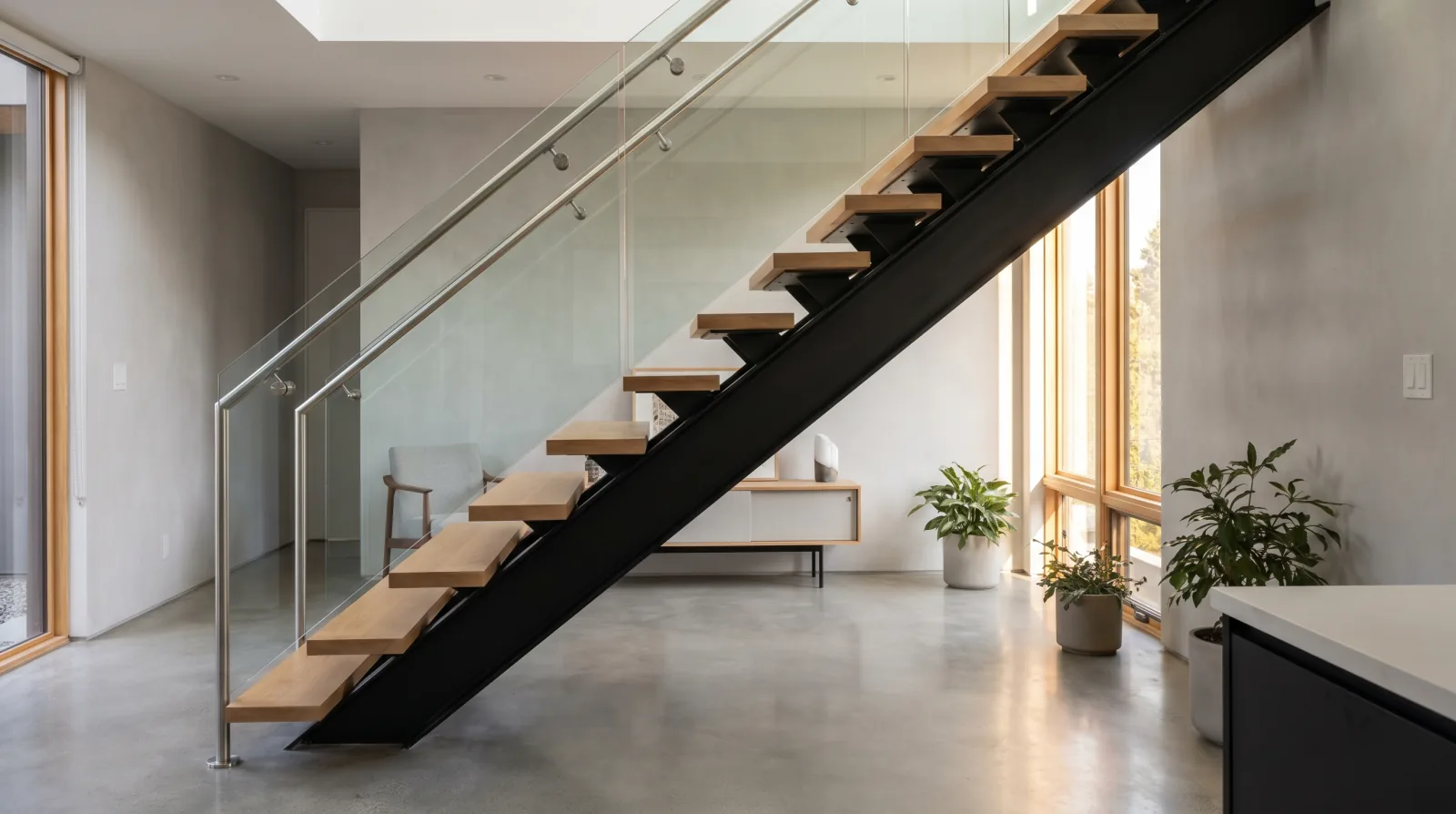
A mono stringer staircase uses one central steel beam to support the treads, with each tread cantilevering equally on both sides of the beam. Open risers are the default, and the stair reads as a floating modern feature when paired with cable or glass guards. In Metro Vancouver custom residential work the mono stringer has become the most common feature-stair choice in modernist single-family and laneway homes. Pick it when the design wants visible, design-led steel, when the anchor conditions support a single concentrated load path at both ends, and when open risers fit the rest of the interior. Full coverage is on the [Mono Stringer Stairs hub](/metal-stair-fabrication/mono-stringer-stairs/).
- Best for: modern open-plan interiors where the steel is meant to read as architecture.
- Anchor: needs a strong base condition (slab or engineered footing) and a structural top connection at the floor edge.
- Engineering: usually a stamped detail from a BC P.Eng, see [Engineers and Geoscientists BC](https://www.egbc.ca/).
- Avoid if: the anchor conditions are weak, the floor opening is tight, or the design wants closed risers.
Floating staircase: a visual category, not one structure
Floating is a look, open risers, no visible side stringer, treads that read as if unsupported, produced by several different structural strategies. Most floating stairs in Vancouver custom homes use either a mono stringer (single central beam visible from below) or a cantilevered system (treads anchored into the wall, no beam visible at all). Both produce a floating read; both have different cost and engineering implications. The [Floating Stairs hub](/floating-stairs/) lays out all four support strategies side by side, and the dedicated [cantilevered vs mono stringer comparison](/floating-stairs/cantilevered-vs-mono-stringer/) covers the cost and structural tradeoffs.
- Floating = visual category. Always ask which support strategy is producing the floating look.
- Mono stringer floating: open central beam visible from below; moderate engineering scope.
- Cantilevered floating: no visible stringer at all; the wall does the work; highest engineering scope.
- Hidden double stringer floating: two beams tucked under the tread; rare but useful when wall coordination is impossible.
Cantilevered: the cleanest floating look at the highest cost
A cantilevered staircase has no visible stringer at all because each tread is anchored directly into a wall armature that does the structural work. The result is the cleanest possible floating read. The cost is high: the wall behind the stair has to be a fully engineered steel armature, designed and installed before drywall and finishes go on. Late changes are very expensive and most often impossible without reopening the wall. Pick a cantilevered stair only when the architectural budget supports the engineering and the wall framing is committed to receiving the stair from day one.
- Best for: feature-stair projects where the floating effect must be total and the budget can support the wall work.
- Anchor: each tread is its own cantilever, the wall framing is the entire structural system.
- Engineering: project-specific, stamped by a P.Eng. Wall armature is designed before drywall.
- Avoid if: the wall is interior framing not designed for the stair, or the project is past the framing stage.
Double stringer: predictable, efficient, and the standard for commercial
A double stringer uses two parallel beams, one on each side of the stair, with the treads spanning between them. Exposed side stringers read as conventional industrial structure; hidden double stringers tuck the two beams under the tread to mimic a floating look without the mono stringer's cantilever loading. Double stringers are the standard for commercial egress stairs because they pair efficiently with pan-formed concrete-filled or grating treads. In residential work they remain a strong choice for longer spans, exterior stairs, and projects where the architectural intent is more traditional. See the [Commercial Egress Stairs page](/metal-stair-fabrication/commercial-egress-stairs/) and the [BC Code for Commercial Stairs page](/commercial-stairs/bc-code-commercial-stairs/) for code-driven configurations.
- Best for: commercial egress, industrial, exterior, longer-span residential, or traditional interior designs.
- Anchor: each stringer carries half the load, anchor conditions are more forgiving than a mono stringer.
- Engineering: predictable, well-understood load path. Usually the most cost-efficient stringer type.
- Avoid if: the design intent is a clean modern feature-stair with no visible side structure.
Curved, helical, and spiral: the geometry-driven options
Curved, helical, and spiral staircases all turn through space, but they are different structures and different price points. A curved stair sweeps through an arc between two floors and is usually supported on a curved single or twin stringer. A helical stair makes a full revolution around an open central axis and almost always uses twin stringers (inner and outer) or a stiffened single curved plate. A spiral stair rotates around a fixed centre column with the treads cantilevering from the column itself. Each has its own engineering complexity, lead time, and floor-area requirement. The [Curved & Helical Staircase Design Vancouver page](/steel-staircases/curved-helical-staircase-design/) covers the design and fabrication detail for the first two; the [Spiral Staircases page](/metal-stair-fabrication/spiral-staircases/) covers the centre-column type.
- Curved: partial arc, usually 90°–180°. Mid-to-high cost. Needs a larger floor opening than a straight run.
- Helical: full revolution, no centre column. Highest cost and longest lead time. Sculptural centrepiece.
- Spiral: centre column, treads cantilever from the column. Smallest floor area of the three. Limited code use (see below).
- Confirm the geometry classification with the design team before framing, opening dimensions differ substantially between the three.
Code constraints that narrow the choice
Not every staircase type is allowed for every use. The BC Building Code Part 9 (residential) and Part 3 (commercial, multi-family) set minimum tread depths, riser heights, headroom, and guard configurations that apply to every stair regardless of type. Spiral staircases in BC are generally restricted to secondary access (lofts, mezzanines) and are not allowed as the primary or only stair to a habitable room in many configurations, confirm with the authority having jurisdiction before specifying one for a main run. Open-riser stairs (mono stringer, floating, cantilevered) must satisfy the 100 mm sphere rule between treads where children may be present. See the [BC Stair Code Requirements blog post](/trends/bc-stair-code-requirements-metal-stairs/) and the [BC Code: Open Risers & Guards page](/floating-stairs/bc-code-open-risers-guards/) for the code-specific detail.
- Geometry, headroom, guards, handrails: [BC Building Code Part 9.8](https://free.bcpublications.ca/civix/document/id/public/bcbc2024/bcbc_2024dbp9s8) for housing and small buildings.
- Open-riser 100 mm sphere rule: applies to most residential open-tread stairs.
- Spiral stairs: restricted use in many configurations, confirm with the AHJ before specifying.
- Part 3 buildings (multi-family, commercial): Designated Structural Engineer signs off on the stair package regardless of type.
Space, anchor conditions, and budget, the practical filters
Once the structural type is narrowed by design intent and code, three practical filters usually decide the final choice. Floor area available drives whether a curved or helical stair fits at all and whether a spiral is the only way to make a secondary access work. The anchor conditions at top and bottom decide whether a mono stringer or a cantilevered stair is feasible without rebuilding floor framing or walls. Budget then sets the ceiling on engineering complexity, finish work, and fabrication detail. The strongest projects bring the fabricator into the conversation before the floor opening is framed and before the wall behind the stair is closed.
- Floor area: curved and helical need the largest opening; mono stringer and double stringer fit conventional residential openings; spiral fits the tightest footprint.
- Anchor conditions: cantilevered needs a wall purpose-built for it; mono stringer needs two strong end anchors; double stringer can land on conventional framing.
- Engineering budget: cantilevered > helical > mono stringer > double stringer > spiral kits.
- Finish budget: blackened wax and bronze finishes are the highest premium; standard powder coat is the most cost-efficient.
Related questions
What is the most common staircase type in modern Vancouver custom homes?
The mono stringer staircase has become the most common feature-stair choice in modernist single-family and laneway homes in Metro Vancouver. It pairs a clean floating look with a single, well-understood structural detail and works equally well with cable, glass, or steel-picket guards. Where the design wants no visible structure at all, a cantilevered configuration is the alternative, at a higher engineering and coordination cost.
How do I decide between a mono stringer and a cantilevered staircase?
Both produce a floating look, but the structure is different. A mono stringer uses one central beam visible from below and reads as a designed steel element. A cantilevered stair has no visible structure at all because each tread anchors into a wall armature. Pick mono stringer when the steel itself is part of the design intent, when the budget is moderate, and when the floor anchor conditions are strong. Pick cantilevered when the floating effect must be total, when the wall behind the stair can be engineered from day one, and when the budget supports the additional wall and engineering work.
Is a spiral staircase allowed as the main stair in a BC home?
Usually no. Spiral staircases in BC are generally restricted to secondary access, lofts, mezzanines, roof decks, and are not typically permitted as the primary or only stair to a habitable room. The exact rule depends on the occupancy, the authority having jurisdiction, and the configuration. Confirm with the AHJ before specifying a spiral as the main run, and see the [BC Building Code Part 9.8](https://free.bcpublications.ca/civix/document/id/public/bcbc2024/bcbc_2024dbp9s8) provisions.
Which staircase type is the most cost-efficient?
Straight-run double-stringer stairs are typically the most cost-efficient because the structural detail is predictable and the load path is straightforward. Closed stringers paired with traditional tread packages are also cost-efficient. Mono stringers sit in the mid-range. Curved, helical, and cantilevered stairs are the highest cost because of engineering complexity, fabrication detail, and coordination scope. See the [Steel Staircase Cost Guide](/steel-staircases/steel-staircase-cost-guide/) for the full breakdown by configuration.
What is a 'floating' staircase, exactly?
Floating is a visual category, not a structural type. A floating stair has open risers and no visible side stringer so the treads read as if unsupported. The floating look is produced by several different structures, mono stringer (central beam visible from below), cantilevered (treads anchored into the wall), or hidden double stringer (two beams tucked under the tread). Always ask which support strategy is producing the floating effect on a given project.
Can the staircase type change after framing is closed?
Often, but not without cost. Switching to a cantilevered stair after the wall is closed usually requires reopening the wall to install the armature, which can run into significant rework. Switching between mono stringer and double stringer is usually feasible if the floor anchor conditions allow. The cheapest place to change staircase type is on the drawing, before framing is signed off and before any steel is fabricated.
Do I need an engineer for every staircase type in BC?
Most custom steel staircases need engineering review by a BC P.Eng. Part 3 buildings, commercial, multi-family, and larger projects, require a Designated Structural Engineer for the stair package regardless of type or complexity ([Engineers and Geoscientists BC](https://www.egbc.ca/)). On Part 9 residential projects, engineering is usually required when the stair involves a cantilever, a non-standard anchor, a curved or helical geometry, or a span outside conventional limits. This page is not a substitute for code review by an architect, an engineer, or the authority having jurisdiction.
How long does it take to fabricate each staircase type?
Lead time varies with geometry, engineering review, and finish. A straight-run mono stringer or double stringer in our shop typically moves from signed contract to installation in a 8–14 week range, with engineering review and finish work driving most of the variation. Curved and helical stairs run longer because of plate-rolling lead times and the extra engineering coordination. Cantilevered stairs depend more on the wall-armature coordination with the framing trade than on shop time. Confirm a project-specific schedule with a current quote, these are typical ranges, not commitments.
Discuss which staircase type is right for you? a vancouver selector guide for a real project
Send drawings, photos, or a rough scope and we will help define the practical next step.